
A practical content strategy with clear SOPs, tracked metrics, and enforceable AI governance creates topical authority and predictable organic lead flow. Content strategy is a repeatable set of processes that plan, create, maintain, and retire content to meet user needs and business goals.
The playbook lays out research methods, topical mapping, briefing templates, QA checklists, automation rules, and measurable maintenance cadences. It delivers export-ready topic lists, AI-assisted briefs, editorial SOPs, an ROI workbook, and refresh rules ready for handoff. Heads of Content & SEO and growth teams get the operational artifacts and SLAs needed to scale production.
Timely SOPs and governance lower CAC, reduce rework, and protect compliance while keeping publish velocity predictable. Modular content models supported about 100 articles per month and cut time-to-publish to roughly 20 minutes in one implementation. Proceed through the playbook to implement the SOPs, metrics, and AI governance controls.
Content Strategy SOPs & AI Key Takeaways
- Define content strategy as repeatable processes across planning, creation, maintenance, and unpublishing.
- Use SOPs with approval SLAs and sprint templates to reduce handoff friction.
- Map keywords to intent and buyer stage using Content Clusters and topical maps.
- Track one to two Content KPIs per business outcome and run quarterly reviews.
- Require human review and label AI-assisted drafts with audit logs and checks.
- Export a machine-readable Content Model and CMS-ready schema for engineering handoff.
- Use intake rubrics and research sprints to build a prioritized monthly slate.
What Is Content Strategy And Why Does It Matter?

Content strategy is the ongoing practice of planning, creating, delivering, measuring, and governing content so it meets user needs and business objectives. When teams ask “what is content strategy” they mean a repeatable set of activities that keep content useful and tied to business outcomes. Kristina Halvorson framed this as a continuous Content Lifecycle with four phases:
- Planning
- Creation
- Maintenance
- Unpublishing
Content strategy fundamentals require treating those phases as processes, not one-off tasks. That approach reduces duplication, prevents cannibalization, and makes maintenance predictable.
An SEO Content Strategy aligns content to measurable search goals and buyer behavior. Search visibility becomes an early-stage pipeline driver because many buyers self-educate before contacting sales. Key alignment areas to track include:
- Keyword coverage mapped to intent and buyer stage
- Content Clusters that organize topic depth and pillar authority
- Measurement that links organic traffic to lead quality and pipeline velocity
A practical content strategy produces measurable business outcomes when each outcome has a focused KPI and a maintenance cadence. Recommended outcomes and starter KPIs are:
- Lower customer acquisition cost — cost-per-lead
- More qualified organic leads — lead-to-opportunity rate
- Higher on-page conversion rates — conversion rate
- Lower post-purchase churn — retention rate
Begin measurement with one to two KPIs per outcome and a Content Lifecycle review cadence starting at three months.
A playbook reduces research time and handoff friction by standardizing core deliverables. Core artifacts to include are:
- Content inventory and audit templates
- Persona briefs and editorial standards
- Keyword and topic map plus Content Clusters
- Content model and reusable content frames
Hygraph’s modular content model work shows modular approaches scale publishing and shorten time-to-publish.
Clear role definitions and formal Content Governance cut review cycles and rework. Typical governance elements include:
- Service-level agreements (SLAs) for subject-matter experts, writers, editors, and publishers
- Briefing templates with required metadata: target keyword, intent, CTAs, internal linking plan, and measurement plan
- An approval checklist and artificial intelligence (AI) governance controls to limit rework and speed reviews
Connect the topic map to the content planning workflow so teams can execute the playbook consistently.
How Do You Define Goals Audience And Value Proposition?
TopicalMap.com Agency recommends you convert business targets into SMART content strategy goals that map to revenue and predictable lead flow. These content strategy goals must tie to one or two measurable Content KPIs so outcomes remain traceable to pipeline value.
Key SMART elements to set for content strategy goals:
- Specific: name the exact outcome, for example, generate 100 Marketing Qualified Leads per month.
- Measurable: pick 1–2 Content KPIs such as monthly qualified leads or lead-to-opportunity rate.
- Achievable: record a baseline and model realistic uplift from historical conversion rates.
- Relevant: connect each goal to pipeline value and sales velocity.
- Time-bound: assign clear deadlines and check-ins, for example a 90-day review for an initial uplift target.
Map primary and secondary audiences with persona templates and channel needs to guide your Audience Research and keyword planning. content strategy audience research captures the fields to link personas to topic work.
Audience Research templates should capture:
- Persona profiles: role, company size, decision authority, typical objections.
- Purchase triggers and pain points tied to buying signals.
- Preferred channels and content formats by stage.
- Buyer’s-journey stage and activation paths for handoffs to sales.
Align content outcomes to explicit deliverables so every asset has a funnel role and helps build topical authority. Typical deliverables include:
- Gated lead magnets (e-books, audit checklists) wired into HubSpot or automation workflows.
- Pillar Pages, topic clusters, and cluster articles that establish topical coverage.
- Editorial SLAs, content calendars, and reusable Content Model specs for multichannel reuse.
Choose tooling and vendors by comparing provider criteria and a topical map for content strategy. Compare those criteria using choosing a topical map provider.
Define measurement, cadence, and governance to prove ROI with regular routines and qualitative checks.
Measurement and governance fundamentals:
- Set baselines and reporting sources for Content KPIs per goal.
- Run quarterly reviews and align update tasks to baseline performance.
- Use content audits, scorecards, session recordings, and customer quotes as evidence.
State a concise value proposition that traces content to business outcomes. Example: TopicalMap.com Agency helps growth teams generate predictable, Search Engine Optimization (SEO)-driven leads through data-backed topic maps and agency execution. Supporting line: topical authority, conversion-focused assets, and operational SLAs to shorten pipeline velocity.
Playbook and toolkit highlights:
- Ready-to-run SOPs, channel editorial checklists, a pre-filled ROI calculator, importable dashboards, copy-paste Content Model specs, and an AI governance kit with prompt templates and review SLAs.
What Downloadable Playbooks And SOPs Should You Use?
A compact, ready-to-run deliverable kit helps your team turn strategy into repeatable tasks and clear handoffs.
Core downloadable playbooks and SOPs to deploy immediately:
- Channel SOPs for blog, LinkedIn, YouTube, TikTok, and email.
- Each SOP contains:
- Sample creative briefs
- Editorial checklists
- Weekly sprint templates
- Approval SLAs
- 6–12 week production and promotion cadences
- Each SOP contains:
- Content Calendar template paired with a topical map for content planning to prevent cannibalization and guide internal linking.
- ROI workbook and measurement playbook prefilled for Google Sheets with benchmarks, KPI examples, SMART goals, and revenue-attribution formulas.
- Content Inventory and Content Audit workbook plus an unpublish decision tree, lifecycle tagging, and an SEO-safe checklist for redirects and archive rules.
- Reusable Content Model components and an Editorial Standards pack with CMS field/schema snippets (JSON/YAML), metadata taxonomies, modular Topic Cluster templates, accessibility checks, and AI-assisted review SLAs.
The template contains these fields:
- Title
- Target persona
- Buyer’s journey stage
- Primary keyword
- Format
- Owner
- Deadlines
- Publish channel
- Repurposing plan
- SLA columns
The ROI workbook and audit artifacts accelerate measurement and governance:
- Prebuilt KPI sheets: traffic, leads, conversion rate, cost per lead
- Formulas that translate views and clicks into revenue attribution and sensitivity analysis
- Recommended cadence for Content KPI scorecards and an audit runbook to keep the inventory healthy
These deliverables shorten time-to-publish and reduce handoff friction when paired with documented review SLAs and a cross-functional governance plan.
What CMS And Content Model Specs Should You Include?
Create one exportable Content Model and a machine-readable Information Architecture for Content to remove ambiguity between your engineering and editorial teams. The deliverable should be precise enough to hand to an engineer or a writer without follow-up.
Core content types and reusable components to define precisely:
- Article: mandatory title (60 chars), body (rich text), author (reference), publish_date (date); optional reading_time (integer), lead_image (image + alt)
- Landing page: mandatory headline, hero component, CTA (boolean); optional testimonial block
- Pillar Pages: mandatory long-form body, topic cluster reference, internal_links array; optional summary
- FAQ, Knowledge base, Case study: Q/A pairs, references, attachments
- Reusable components: hero, author card, related links, promo banner
Required SEO and metadata fields per entry:
- Title tag (60 char limit)
- Meta description (155 char limit)
- Canonical URL
- Primary keyword and secondary keywords (array)
- Meta robots and structured data type (Article/Product/FAQ)
- Open Graph and Twitter Card assets with recommended image dimensions
Taxonomy, URL, slug, and publishing rules to include:
- Hierarchical categories and non-hierarchical tags
- Content stage taxonomy: awareness, consideration, purchase
- Locale codes and automated tag suggestions from keyword research
- URL templates: /{locale}/{category}/{yyyy}/{mm}/{slug} and /{locale}/product/{product-slug}
- Slug rules: lowercase, hyphens, 2–6 words, canonical redirects
- Roles and workflow: author, editor, SEO reviewer, legal approver, publisher; editor + SEO reviewer required before public publish; content review every 3 months minimum
Export the Content Model diagram and a machine-readable schema for CMS implementation as the final deliverable.
What Channel SOPs Templates And Workflow Docs Should You Download?
Download a bundled Content Operations package that standardizes production and distribution across teams and file systems. The set includes a Content Calendar in CSV and Google Sheet formats that tracks these fields:
- Title
- Target keyword
- Buyer-journey stage
- Format
- Assigned owner
- Draft due date
- Publish date
- Distribution channels (social, email, syndication)
- KPI column
Channel SOPs enforce consistent quality and timing across channels and should specify these items:
- Social SOP: post cadence, character limits, hashtag strategy, approval SLA
- Email SOP: subject-line testing matrix, segmentation rules, send windows, unsubscribe handling
- Syndication SOP: canonical-tag policy, backlink attribution, republishing frequency
Modular templates and component-based page models speed reuse and reduce handoffs; include these templates:
- Blog post and long-form guide shells with reusable sections
- Short social snippets and email copy blocks
- Component list for product and category pages
Handoff checklists and the publishing workflow remove ambiguity and lock in maintenance cadence; include these checklists:
- Pre-publish QA: accessibility, metadata, SEO meta tags, internal links
- SME handoff: assets, approvals, quoted copy
- Post-publish: promotion schedule, analytics tagging, 3-month review
Map an operations playbook to measurable KPIs by linking each lifecycle step to targets and import the calendar CSV into your CMS and project tracker to enforce SLAs and measure impact.
How Do You Plan Content Topics Formats And Channels?
Use a repeatable intake matrix and a compact research sprint to turn raw ideas into a prioritized monthly slate for Content Planning.
Intake matrix (0–3 rubric) scores each idea on three axes:
- Audience intent: map to Buyer’s Journey stage and score 0–3.
- Keyword opportunity: evaluate search volume, difficulty, and topical relevance and score 0–3.
- Business impact: assess revenue potential, lead quality, or retention lift and score 0–3.
Use this sample qualification process to pick a top-12 monthly slate:
- Sum the three axis scores for each idea (maximum 9).
- Rank ideas by total score and alignment with quarterly OKRs.
- Select the top 12 and reserve ~20% capacity for experiments.
Run a compact research sprint to convert top ideas into executable outlines and seeds for the calendar:
- Conduct Audience Research through interviews and analytics to confirm pain points and preferred channels.
- Do Keyword Research to surface target terms, search intent, and SERP gaps.
- Produce Content Clusters: a pillar page plus linked cluster pieces mapped to personas.
- Draft a Topic Cluster outline and tag each piece with priority and launch window.
Match formats to intent with a simple decision matrix and favor owned channels first:
- Awareness: short video, social carousel, blog summary.
- Consideration: long-form article, webinar, comparison guide.
- Purchase: case study, product demo, pricing page.
Format decisions align with the content strategy content types by intent.
Prioritize channels with a lightweight ROI check before committing resources:
- Estimate reach potential, production cost, and conversion velocity.
- Require a minimum expected KPI uplift or time-to-conversion improvement to approve spend.
- Use modular Content Models so one asset can be repurposed across channels and speed-to-publish is improved.
Institutionalize cadence, governance, and a re-ranking loop to keep work aligned with results:
- Maintain a Content Calendar with SLAs and quarterly reviews.
- Score content audits by SEO traffic, leads, and conversion rate.
- Reassign production capacity based on audit outcomes and KPI shifts.
Close the loop with timed optimization plans and ready-to-run artifacts:
- Standardize 30/90/180-day plans for metadata and internal linking, content expansion, and repurposing into video or podcast.
- Bundle a topical map for content planning, channel SOP playbooks, an ROI & resourcing workbook, and editorial templates so execution and measurement start fast.
How Do You Measure Content Performance?
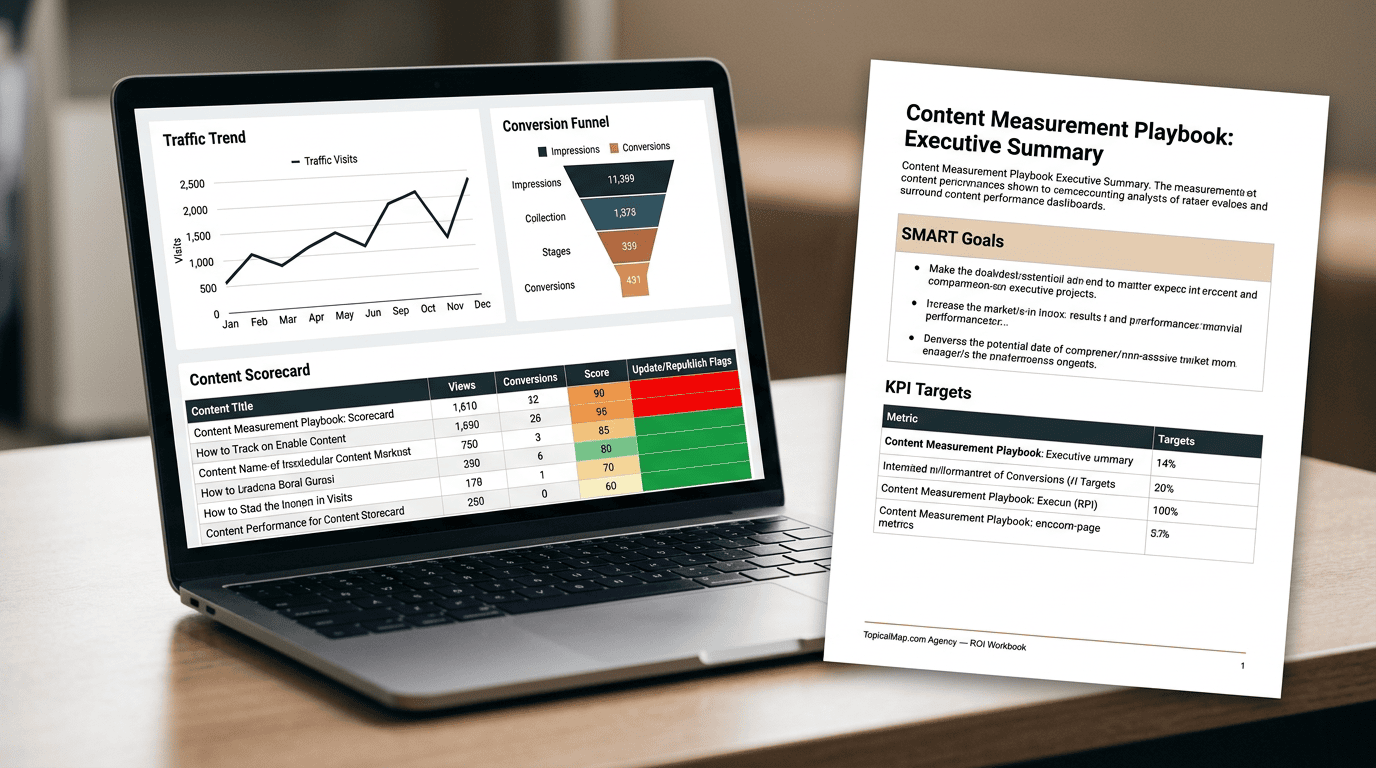
Measure content performance by assigning each asset a clear business outcome and a short set of Content KPIs that reflect that outcome.
Map primary goals to 1–2 KPIs each:
- Awareness: organic sessions and share of voice (traffic)
- Acquisition: cost per lead and conversion rate for demo requests or signups
- Retention: churn rate and repeat visit frequency
- Revenue: pipeline contribution and average deal value attributed to content
Track front-end engagement with behavioral and qualitative signals on a regular cadence to inform Content Maintenance decisions.
Key engagement metrics to monitor monthly and quarterly:
- Pageviews, unique users, time on page, scroll depth, click-through rate
- Bounce rate and exit rate
- Session recordings and on-site survey quotes
- Content scorecard deltas mapped to actions: update, repurpose, unpublish
Connect content to conversions and revenue by instrumenting events and translating ratios into dollar impact.
Conversion instrumentation checklist:
- Tag campaigns with UTM parameters
- Register conversion events and align event names across tools
- Define attribution windows and apply them consistently
- Calculate views→leads ratios and cost per lead to estimate revenue contribution
Run recurring lifecycle reviews and produce a Content Audit and inventory to decide update, republish, or archive actions.
Quarterly checkpoints to schedule:
- Planning
- Creation
- Content Maintenance
- Unpublishing
- Set SMART content strategy goals with measurable timelines
Optimize the roadmap with operational KPIs, governance, and quarterly reviews to make SEO Content Strategy decisions data-driven and repeatable.
What Engagement And SEO Metrics Should You Track?
These core metrics show reach, engagement, and topical authority for your content.
Track the following metrics:
- Traffic:
- Sessions and unique users measured in Google Analytics or an equivalent platform.
- Compare month‑over‑month and map results to business goals such as awareness or leads.
- Click-through rate (CTR):
- Measure CTR for search snippets and internal links.
- Treat a low CTR with high impressions as a metadata or headline rewrite opportunity.
- Engagement:
- Time on page and scroll depth to assess task completion and reading patterns.
- Prioritize updates using content scorecards and schedule reviews based on scorecard signals.
- SERP rankings and impressions:
- Track rankings for target keywords and impressions to reveal keyword reach.
- Flag pages that gain impressions but drop in rank to adjust headings and internal linking.
- Backlinks and referring domains:
- Count high-quality backlinks and monitor referring domains as authority signals.
- Report backlink changes alongside conversions and keep one to two KPIs per goal.
Combine these metrics with on page signals for topical authority to prioritize updates that build topical authority and tie results to a small set of business outcomes.
What Business KPIs And ROI Metrics Should You Track?
Return on Investment (ROI) measures value returned per dollar spent. Track Key Performance Indicators (KPIs) to connect content to revenue.
Key KPIs to track:
- Lead quality: score leads by firmographic fit and behavioral intent to surface marketing-qualified leads.
- Conversion rate: visitor→lead and lead→opportunity percentages.
- Customer Acquisition Cost (CAC): total marketing plus sales spend divided by new customers.
- Lifetime Value (LTV): average revenue per customer over a defined period.
- Pipeline influenced: dollar value of opportunities touched by content.
Each KPI should map to a reliable data source and instrumentation plan:
- CMS analytics and Google Analytics for page behavior and conversion events.
- HubSpot and Customer Relationship Management (CRM) records for lead lifecycle and deal stages.
- UTM tagging and form-level lead scoring to capture campaign source and intent.
- CRM deal-stage revenue attribution and cross-channel event tracking for pipeline touches.
Report cadence, targets, and stakeholder visuals:
- Monthly dashboards for trends and a quarterly content scorecard; start with 1–2 KPIs per business goal.
- SMART targets example: reduce CAC by 15% in six months and increase qualified-lead rate by 20%.
- Visuals: CAC and LTV trend charts, cohort LTV curves, waterfall attribution, and a one-page executive summary tying content to pipeline-influenced revenue and ROI.
How Do You Scale Content Production With AI And Governance?
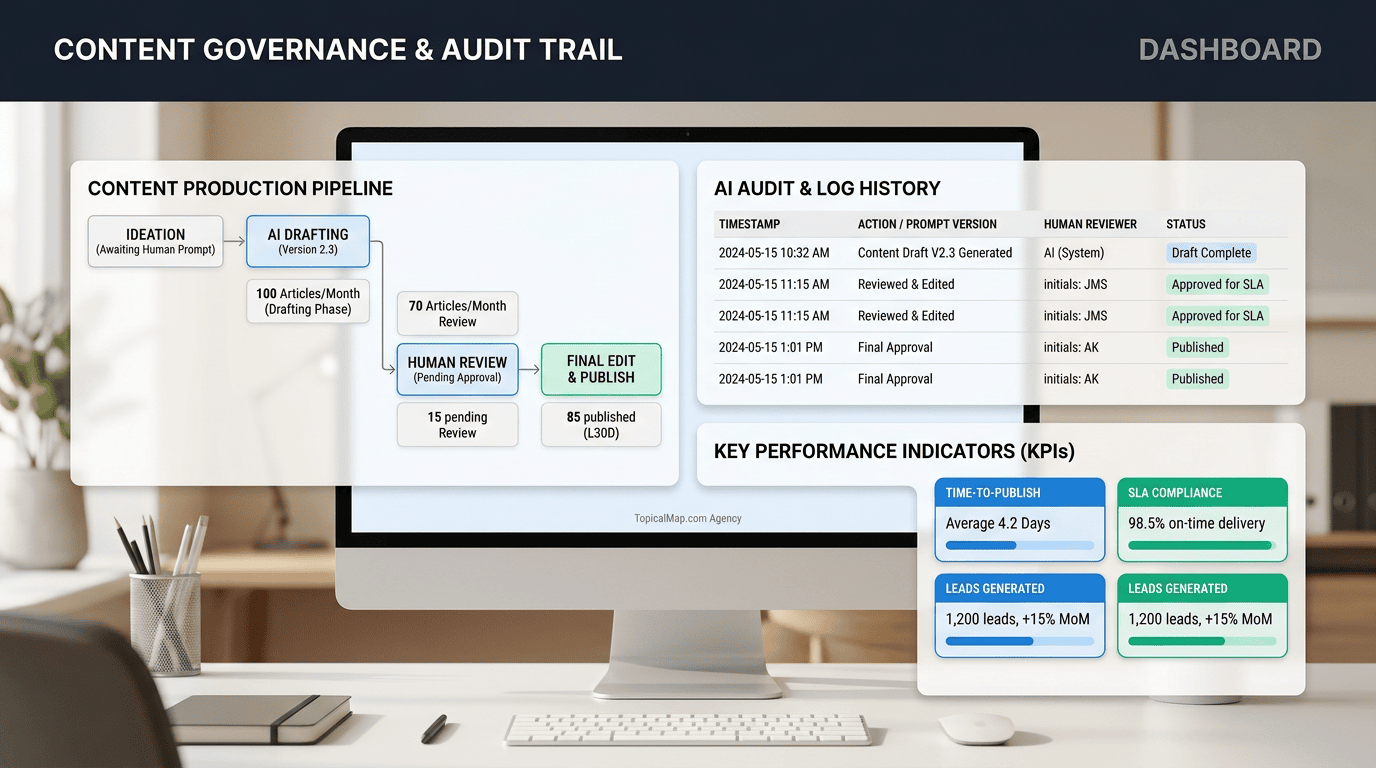
Scale content production responsibly by pairing a documented content strategy with Content Governance, clear Content Operations, human review gates for AI-assisted drafts, and modular content assets.
Key pillars to establish first:
- A content strategy aligned to business objectives with 1–2 measurable Content KPIs per goal (traffic, conversions, cost per lead).
- A mapped Content Lifecycle to connect strategy, governance, and operations.
- A prioritized content inventory and audit that feeds the editorial calendar and resourcing plan.
Make handoffs and cadence predictable with an operational plan:
- Define planning cadences and publication windows tied to the Content Calendar.
- Assign owners for ideation, AI-assisted drafting, human editing, SME technical review, legal review, and final publication.
- Set SLA targets for SME response times and time-to-publish, then track those targets inside Content Operations.
Make Content Governance enforceable and auditable:
- Publish editorial standards that cover voice, metadata, accessibility, and SEO rules.
- Form a governance council with product, legal, compliance, and SMEs and document publish/unpublish and archival authority.
- Record reviewer findings in the Content Calendar and link scorecard changes to revenue, task success, or user satisfaction metrics.
Protect quality with editorial controls and audit trails for AI-assisted work:
- Require human-in-the-loop review and clearly label AI-assisted drafts before publication.
- Run plagiarism, factuality, and bias detection tools and require human fact-checking for substantive claims.
- Log prompt versions and major edits for auditability and add mandatory approvals for regulated language.
Operationalize modular content and continuous measurement:
- Adopt component-based content models to enable reuse; in one practical case modular models supported ~100 articles per month and cut time-to-publish to about 20 minutes.
- Integrate task, SEO, and analytics signals into publishing workflows for ongoing optimization.
- Bundle SOP playbooks and an ROI and resourcing workbook to speed execution and benchmarking.
Schedule formal reviews following usability-review best practices and embed change management and training so governance scales with the program.
Content Strategy FAQs
Find concise answers to the practical questions you and your team ask about content strategy. These FAQs address planning, KPIs, building topical authority, and transparent AI-assisted workflows so you can apply them in your content roadmap.
1. How much budget should I allocate to content strategy?
You should allocate 10–30% of total marketing spend to content strategy and production, increasing to 30–50% for content‑led or product‑education‑heavy businesses. Split the budget by production stage and channel to keep priorities measurable.
Production-stage split:
- Planning and research: 10–15% (audits, user research)
- Creation: 50–60% (writing, design, video)
- Distribution and promotion: 20–25% (owned, paid, earned)
- Maintenance and optimization: 10–15% with at least quarterly reviews
Channel rule of thumb:
- Owned (website, newsletter, knowledge base): 40–60%
- Paid amplification: 20–30%
- Earned, social, partnerships: 10–20%
- Experimental formats: 5–10%
Creation-budget allocation:
- Evergreen and knowledge base: ~60%
- Short-form and newsletters: ~30%
- High-cost experiments: ~10%
If content drives more than 30% of qualified pipeline or materially lowers support tickets, increase the content budget by 10–20% and invest in operations or technology when time-to-publish is the limiting factor.
2. Who should own content governance roles and approvals?
A cross-functional content governance council should serve as the final policy owner and sponsor quarterly reviews. Core operational roles are Content Strategist (strategy and KPIs), Content Owner/Subject Matter Expert (accuracy), Editor (quality and tone), SEO Specialist (SEO and internal linking), and Publisher (publishing and metadata). The approval flow runs from SME draft to Editor review, then SEO and accessibility check, legal sign-off when required, and Publisher release, with SLAs of three business days per review. You should notify the Content Strategist after 24 hours of SME delay, route legal holds to the Head of Compliance, and convene the governance council if bottlenecks recur.
3. What legal or compliance risks should content teams monitor?
Main legal and compliance risks to monitor are:
- Copyright (ownership, licenses, fair use)
- Privacy and data‑protection obligations, including GDPR
- False or misleading claims that could trigger consumer‑protection issues
- Industry‑specific regulations for health, finance, and legal content
- AI governance and model‑use policies for AI‑assisted content
Quick mitigation steps to manage those risks are:
- Keep written licenses for images, video, and third‑party text and replace assets during unpublishing
- Anonymize or minimize personal data and document consent records
- Vet factual and product claims with legal or subject‑matter experts and add clear disclosures for endorsements
- Schedule legal reviews on a three‑month cadence and involve legal early for AI‑assisted or high‑risk content
You should document these controls and schedule quarterly reviews to keep policies current.
4. How often should you refresh evergreen content pieces?
Aim for a full review of evergreen content per Nielsen Norman Group guidance.
You should run lightweight monthly spot-checks on top pages with a content scorecard tied to one or two KPIs such as organic traffic or conversions.
Trigger a refresh for sustained traffic or ranking drops greater than 10%, outdated facts or dates, new competitor coverage, declining user-behavior metrics, or product and policy changes.
Run an audit in Google Analytics and Semrush, update facts and structure, refresh meta title/description and schema, republish with an “Updated” date, reshare to email and social, and log scorecard results.
5. Which integrations speed up content-to-distribution workflows?
You can shorten time-to-publish by integrating tools that remove handoff friction and automate distribution.
CMS platforms, including headless CMS, provide centralized storage and APIs for omnichannel publishing and modular content models that speed channel pushes.
Analytics platforms such as Google Analytics, Hotjar, Semrush, and Ahrefs tie performance data to content planning and KPIs so teams optimize channels and measure impact.
CRM and marketing automation like HubSpot sync audience segments for targeted sends, workflow tools such as ClickUp and Asana automate approvals and schedules, and AI-assisted tools accelerate drafts, localization, and A/B copy variants that feed directly into the CMS.