Common SEO topical map mistakes can quietly weaken a content plan before it has a chance to rank. SEO managers and content teams often see tidy keyword clusters that still create cannibalization, weak internal paths, and pages that chase the wrong intent. A topical map is a content blueprint that assigns pillar, cluster, and subtopic pages to one connected subject, and these takeaways show how to catch the breakdowns early.
The 10 mistakes covered here include intent mismatch, broad seed topics, flat pillar structures, overlapping URLs, thin pages, stale coverage, weak internal linking, ignored entities, and missing bottom-of-funnel topics. Along the way, the article points to a SERP check, an overlap test, and a page-role framework that helps decide whether one query belongs on one URL or several. It also shows how to turn a spreadsheet into a cleaner audit plan that reduces guesswork before anything goes live.
SEO managers, heads of content, agency strategists, growth marketers, and niche site owners stand to gain the most from a map that keeps rankings, attribution, and AI citations aligned. A cluster about dog food, for example, can look complete until a SERP review shows one page should handle comparisons while another handles buying questions. The next sections make those mistakes easy to spot and easier to fix before they reach production.
SEO Topical Map Mistakes Key Takeaways
- Match page format to the SERP’s dominant intent.
- Start with a focused seed topic that can grow.
- Give each pillar, cluster, and subtopic page a distinct job.
- Consolidate URLs that target the same search need.
- Build internal links that reflect topic hierarchy and relevance.
- Refresh the map regularly to catch gaps and stale coverage.
- Include comparison, pricing, and other bottom-of-funnel pages.
What Makes A Topical Map Fail?
A Topical Map fails when it starts with keywords instead of a clear pillar, cluster, and subtopic hierarchy. Pages sit beside each other with no logical route for users or crawlers, and a Content Map can still look neat while missing the structure that makes it work. The topical map SEO guide helps you catch that breakdown before it wastes publishing time.
Every page needs a clear job. Pillar pages should set the main answer, supporting pages should add depth, and expansion pages should cover adjacent questions. When those roles blur, duplicate coverage and Keyword Cannibalization show up fast.
The most common failure points look like this:
- Intent mismatch. The map targets search terms that do not match the reader’s real question or buying stage, so the content feels broad and weak for Search Engine Optimization (SEO).
- Flat planning. Teams jump between unrelated topics instead of building one silo at a time, which breaks the internal path from page to page.
- Stale coverage. The map is never revisited, so gaps stay open and subtopics drift away from search trends and competitor coverage.
- Thin overlap. Pages repeat the same angles, which makes the site look busy without adding real depth.
The warning signs are usually thin or repetitive content, missing internal links, and topic gaps that hide behind a map that looks complete on paper. Strong Content Strategy treats Topical Mapping as a living system, not a one-time spreadsheet, and that is what builds topical authority over time.
1. Targeting the Wrong Search Intent
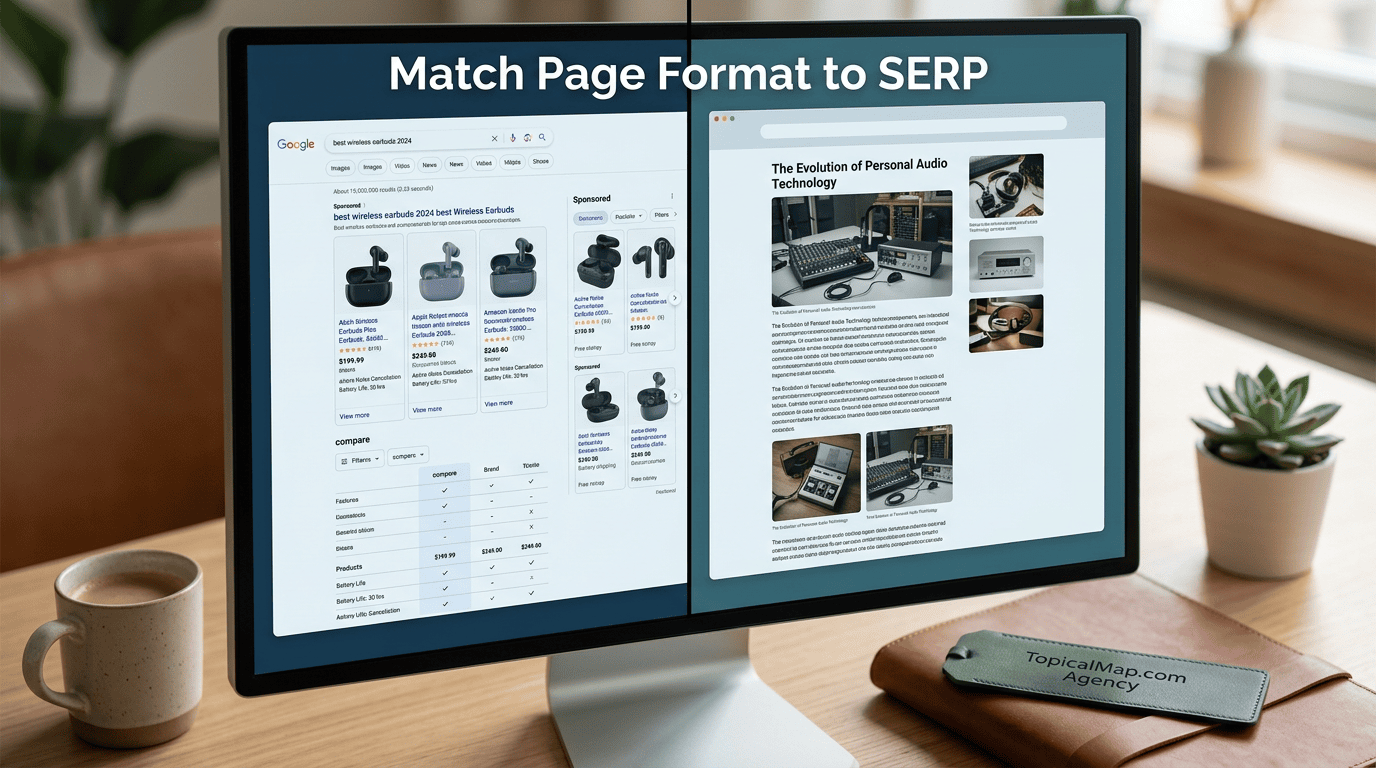
The biggest mistake is mapping a how-to article to a query that wants product pages, category pages, or comparison content. When the Search Engine Results Page (SERP) already rewards those formats, a generic educational page is out of step with the query, and weaker rankings, higher bounce rates, and thin engagement usually follow. The mismatch is easier to spot when you audit missing intent labels in topical maps.
Use the SERP as your first filter for page selection:
- Match the format the results already favor, whether that is a listicle, guide, video, or product-led page.
- Treat Search Intent as more than Informational Intent versus Transactional Intent.
- Map each query to User Search Intent, whether the searcher wants to learn, compare, shortlist, or buy.
- Add supporting questions and zero-volume queries to build the informational layer around your core pages.
That approach gives each URL one clear job. Start with a broad educational page, then split off transactional pages, commercial investigation pages, and comparison pages so each asset supports topical authority without keyword cannibalization. It also keeps your Content Strategy cleaner and makes the page set easier to navigate.
Keyword Research alone is not enough for SEO Strategy. The page format, depth, and angle need to match what the SERP already rewards, and related subtopics should be clustered before anything goes live. That is how you build a map that reflects real user intent instead of forcing every keyword into the same template.
2. Starting With A Seed Topic That Is Too Broad
Starting with a seed topic that is too broad blurs topical signals. A term like “dogs” can generate thousands of ideas, but many miss the audience, so readers and search systems get a muddy read on what the site really owns.
The safer starting point is the narrowest niche that still has room to expand:
- “Dogs” is too wide for a focused map.
- “Dog food for golden retrievers” is often too tight to support lasting coverage.
- “Dog food” usually sits closer to the right scope because it is specific enough to organize and broad enough to grow.
The topical map SEO overview works best when Topical Mapping is treated as Content Clusters, not a keyword dump. In the Pillar-Cluster Model, a Pillar Page anchors the main subject while the Topic Hierarchy fills in the supporting pages.
That structure holds best inside a Nested Silo Structure. When unrelated topics get mixed into one cluster, authority gets diluted and keyword cannibalization becomes more likely.
How to build a topical map shows the next move. Build depth in one theme first, then widen into adjacent subtopics only after the core cluster is covered and internally connected.
3. Building A Flat Pillar-Cluster Structure
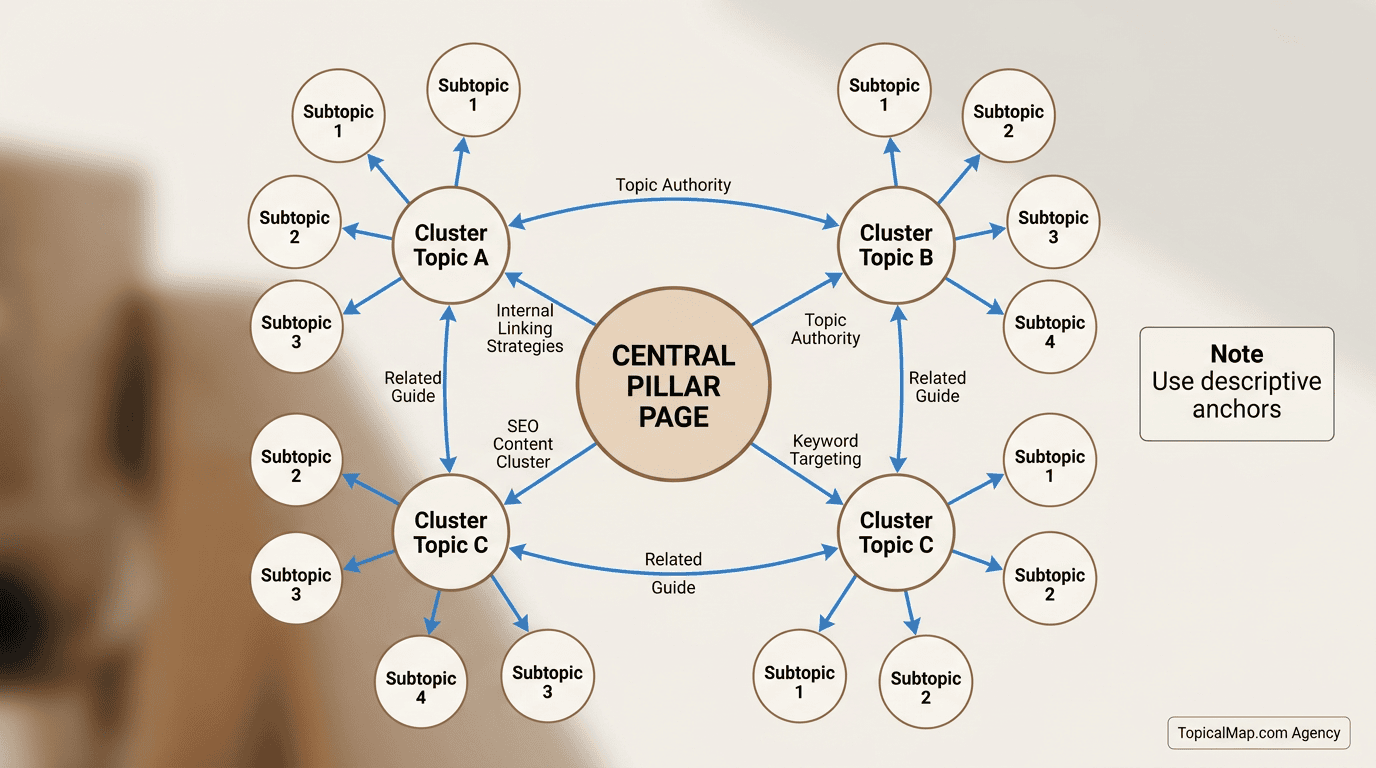
A flat map blurs the job of each URL. When too many pages sit at the same level, readers and crawlers struggle to see which page is the pillar, which pages support it, and how the subject fits together. That blur is where topic cannibalization in topical maps starts to show up, because several pages chase the same broad intent instead of owning distinct roles.
A cleaner structure gives each page a clear job:
- The pillar page owns the broad theme and serves as the main entry point.
- Cluster pages target narrower search intent and support the pillar with focused coverage.
- Subtopic pages go deeper on specific questions, use cases, or edge cases.
- Nested silos and pillar-and-spoke paths make the relationships obvious through tighter internal linking.
That hierarchy beats a generic folder dump. It helps search engines read the site as one connected subject area instead of a pile of unrelated posts. It also reduces Keyword Cannibalization by keeping each URL on a distinct lane.
Competitor maps that skip pillars often look busy but read like disconnected fragments. Your content plan gets stronger when every page either leads, supports, or expands the topic. Readers and crawlers should be able to move from the main pillar to supporting articles and back again without losing the thread.
4. Letting Pages Cannibalize The Same Query
Keyword cannibalization shows up when two or more URLs answer the same search need. Search engines then have to choose a primary page, and that split often weakens both. The safer move is to consolidate overlapping terms onto one authoritative page and keep close variants inside the same topical cluster or Nested Silo Structure.
A fast overlap test usually settles the question:
- If one searcher would be happy with either page, they belong on one URL.
- If the SERPs, People Also Ask, and niche forums point to the same intent, keep the query together.
- If the result pages clearly reflect a different job to be done, separate the topic.
Broader research before publishing helps you catch the mismatch early. Use competitor gap analysis, Reddit, and People Also Ask to surface nearby terms, then compare the SERPs before you draft. That keeps Internal Linking cleaner and gives your topical authority a stronger foundation.
The same rule applies to accidental rankings. Treat them as a new page only when the search results show a clearly different intent. If the SERPs look alike, fold the term into the current page, trim the stray URL, and let one page own the query. Poor internal linking in topical maps is often the quiet reason competing pages stay stuck.
5. Skipping Internal Linking Between Related Pages
Weak internal linking turns related pages into semantic orphans. Search engines get fewer clues about where each page fits, and readers have a harder time finding the next useful step.
In a topical map, internal links do more than move traffic. They signal hierarchy, relationships, and authority, which is why a cluster should read like a connected knowledge system rather than a stack of standalone posts. Without that structure, even Comprehensive Content can behave like Thin Content, and the result is a cluster full of Shallow Pages.
A practical linking pattern keeps the map tight and readable:
- Add 2 to 3 contextual links from a new or supporting page to the most relevant related pages.
- Use anchor text that matches the destination topic, and vary it naturally so it doesn’t look forced.
- Link one level up or down in the hierarchy, and connect sibling pages when the relationship is real.
- Avoid generic anchors like “click here,” and do not repeat the same phrase so often that it feels over-optimized.
- Keep value moving across the cluster instead of letting one strong page hoard all the authority.
That structure supports Semantic SEO. It also spreads link equity across the topical map, so one strong URL can lift the whole cluster instead of trapping value in isolation.
6. Publishing Thin Or Repetitive Content
Thin pages rarely earn trust. When Keyword Research becomes the whole plan, a page can match a term without adding evidence, detail, or a clear point of view. That kind of AI-assisted filler rarely builds topical authority or lasting SEO value.
Depth usually beats volume. A smaller set of substantial pages that covers the main subtopics, use cases, and follow-up questions often outperforms a pile of shallow posts. Strong topical maps start with Seed Topics and then fill the gaps that matter most to Search Intent.
The warning signs are easy to spot:
- Repeated titles that chase the same angle with minor wording changes
- Outlines that answer the same question on multiple pages
- Generic summaries that could have come from any source
- Weak coverage of User Search Intent, especially where Informational Intent and Transactional Intent call for different pages
Originality is the real separator. A useful page adds examples, tradeoffs, and practical detail that show firsthand experience. AI drafts still need human editing for accuracy, context, and a distinct voice.
A cleaner SEO Strategy covers each important subtopic once, in enough depth to satisfy intent. That keeps internal linking clearer and avoids near-duplicates that dilute site authority.
7. Failing To Validate Keywords With The SERP
Keyword research stays incomplete until you validate the live SERP. Search volume shows demand, but the results page shows what Google expects to rank. That might be a listicle, a guide, a product page, a video, or a hub page, and that choice shapes both Semantic SEO and Topical Authority.
A fast SERP review often shows the gaps your tools miss:
- People Also Ask questions that point to missing subtopics and follow-up intent.
- Reddit-style threads that reveal what searchers still want after the first answer.
- Competitor gap patterns that expose missing supporting pages, use cases, or comparisons.
- Mixed media results, such as videos, images, infographics, or hub pages with sitelinks, that signal the depth and structure needed to compete.
This check also keeps your map from drifting too broad or too narrow. A seed like “dog” can balloon into noisy clusters with mixed intent. A phrase like “dog food for golden retrievers” can skew so transactional that it crowds out useful educational pages. That’s where Over-Optimization and Keyword Stuffing start to creep in.
Validate every keyword idea against the SERP before it enters the topical map. Keep only the queries whose result set matches the intent, format, and page type you plan to build. Broader research from competitor pages, related queries, and clustered subtopics gives you the smaller questions that make the map more complete and search-ready.
8. Ignoring Entities And Knowledge Graph Signals
A topical map that ignores entities will feel thin, even when the keywords look complete. You need pages that reflect how Google groups ideas, not just how a keyword tool labels them. That means covering related entities, attributes, and relationships so the page reads like a real subject, not a phrase swap.
A clean structure makes those connections obvious:
- Broad topic: SEO
- Supporting branch: off-page SEO
- Connected subtopics: link building, HARO, skyscraper link building, and broken link strategy
- Relationship layer: which pages support the core topic, which pages explain tactics, and which pages deserve deeper detail
That hierarchy helps users and search engines follow the knowledge structure without flattening everything into keyword variations. It also strengthens Topical Authority because the site shows depth, not repetition.
The real trap is semantic Over-Optimization. Keyword Stuffing, duplicate pages, thin explainers, and cramming too many concept variations into one URL can make the map look forced. That usually weakens relevance and can clash with experience, expertise, authoritativeness, and trustworthiness signals.
Internal Linking is the other half of the signal. When related pages point to one another in a clear path, crawlers move through the cluster more easily and authority spreads more naturally. Strong coverage also uses the language your audience actually says, while filling entity gaps without turning the plan into an AI-style synonym dump or a scattered content spray across silos.
9. Treating The Map As A One-Time Document
A topical map is a living system, not a finished asset. Search demand shifts, competitors publish new angles, and the topic universe keeps expanding, so a map that looked complete last quarter can slip out of date fast.
Stale maps usually fail in predictable ways:
- Pages stop matching current search intent.
- New subtopics never enter coverage.
- Older sections turn thin, repetitive, or duplicate.
- Internal links drift, and keyword cannibalization gets harder to spot.
Quarterly reviews give you a practical cadence for keeping the map current. That is the right time to add new product models, fresh trends, and emerging topics before gaps appear. Rankings for target keywords, non-indexed pages, and underperforming content groups in Google Search Console and Google Analytics 4 should shape the update list. One competitor had 60 posts with only 9 indexed pages, which showed the structure had fallen out of sync.
Keeping published, draft, and planned content aligned also protects silo structure and supports topical authority. AI Search Optimization in 2026 belongs in that ongoing refresh, not on the sidelines. Sites that keep refining coverage can compound gains over time, and one competitor case with about 50 interconnected posts drove a 300% organic traffic increase and roughly 1,000 new keywords.
10. Leaving Out Bottom-of-Funnel Topics
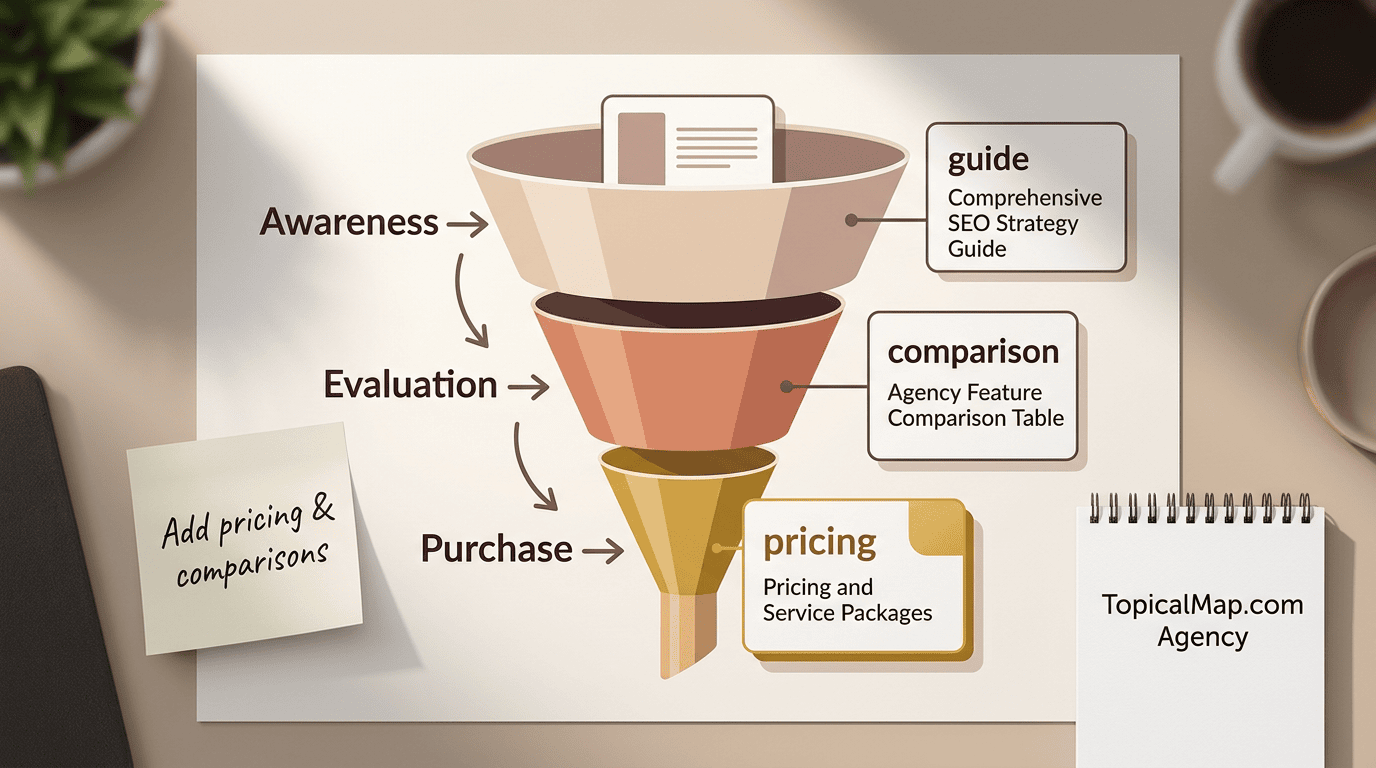
A map that ends with informational posts can attract traffic and still miss the people ready to compare vendors, request a demo, check pricing, or buy. In SEO and AEO, commercial-intent pages turn attention into revenue. A cluster built only around awareness topics often turns into Thin Content or a set of Shallow Pages that look active but do little for sales.
Broad awareness terms also need restraint. Covering them too early and too widely spreads authority thin. The better move is to dominate a focused niche first, then expand into adjacent commercial queries so topical authority grows without waste.
A complete map should make room for bottom-of-funnel topics:
- Best-fit comparisons and alternatives
- Pricing and package pages
- Versus queries
- Use-case pages
- Zero-volume long-tail buyer questions
That is where Comprehensive Content earns its keep. Teams often find a gap between broad education and the pages that close the sale, such as topical map service pricing or agency vs template, and that gap shows up before more top-of-funnel content can capture demand.
Buyer journeys rarely stop at curiosity. Readers move from problem awareness to solution evaluation and then to purchase questions, so your map should connect all three stages. Supporting and long-tail questions help prove expertise, strengthen internal linking, and match real search intent across SaaS, e-commerce, and niche sites.
Common SEO Topical Map Mistakes FAQs
These FAQs break down the mistakes that can derail your Topical Map before it gains traction. They also show how the Pillar-Cluster Model, Content Clusters, Topic Hierarchy, and your Content Map work together in practice.
1. Should You Map New Or Existing Sites?
For both new and existing sites, the best approach is the same: build the topical map first, then place current pages into that structure. On an established site, you can audit published URLs after the map is set to spot overlap, cannibalization, and thin coverage. That fresh view also makes missing subtopics easier to find and gives your pillar, cluster, and subtopic hierarchy a cleaner path for SEO.
2. How Often Should You Update A Map?
Review it monthly for fast-moving topics and quarterly for steadier niches. Review it monthly for fast-moving topics and quarterly for steadier niches, and update it sooner when rankings, traffic, or page performance points to cannibalization or missing subtopics. Recheck the SERP after intent shifts or competitor changes, then fold new subtopics into the existing hierarchy so your draft, in-progress, and live pages stay aligned.
3. Who Should Own Topical Map Maintenance?
For most teams, you should make the SEO strategist or senior content strategist the primary owner of topical map maintenance. Writers and content leads can flag gaps, stale pages, and missing internal links, while an editor or content operations lead keeps the pillar, cluster, and subtopic structure consistent. A subject-matter expert or product marketer should review new angles, terminology, and bottom-of-funnel topics, and the owner should keep internal linking aligned with the live content plan using descriptive anchors.
4. Can One Map Cover Multiple Product Lines?
Yes. One SEO map can handle several product lines when they share the same entities, audience, and search intent, because a shared framework can organize the broader category without creating overlap. A single parent topic works best when it naturally sits above related lines and breaks into connected subtopics, since modern search systems read semantic relationships, not just keywords. When the lines serve different use cases, use different terminology, or move through different buyer journeys, split them into separate topic systems or mini-silos. If one line starts cannibalizing another, the map is too broad and should be broken apart.