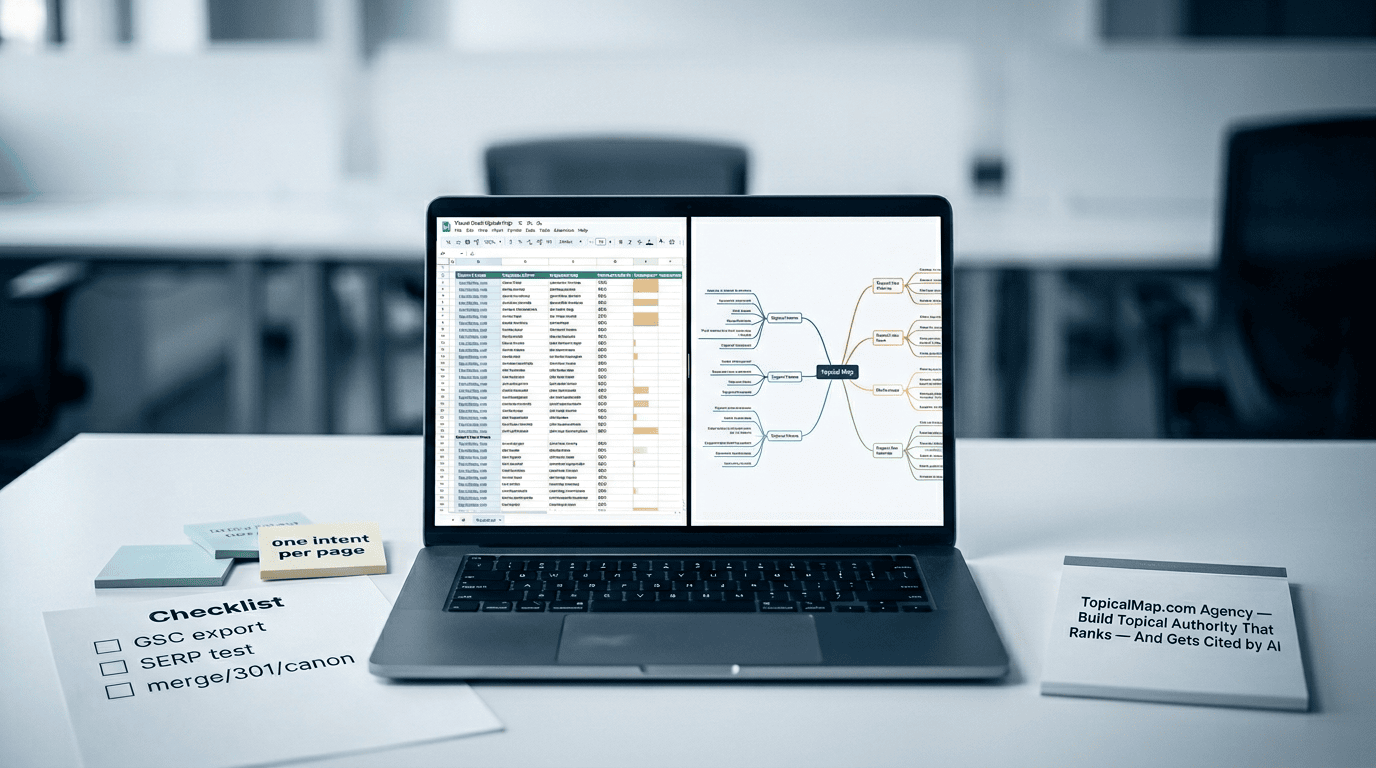
Finding and fixing topic cannibalization in topical maps is a practical SEO cleanup process, not just a keyword check. Content teams often see two or more pages swapping positions while Search Console spreads clicks and impressions across competing URLs. It happens when multiple pages target the same or nearly the same search intent. The goal is to identify the dominant page, remove overlap, and tighten the map so authority stops fragmenting.
The workflow covers Search Console exports, query to page pivots, and SERP overlap tests that confirm whether pages really share intent. It also shows how to score overlap, choose between a merge, 301 redirect, canonical tag, or intent reassignment, and adjust internal links so one URL owns the topic. A final review step adds baseline comparisons and an audit-ready handoff with clear remediation notes.
Heads of content, SEO managers, agency teams, and growth leads at SaaS and e-commerce brands care about cleaner architecture and cleaner attribution. One common fix is folding a weaker cluster page into a stronger pillar, redirecting the old URL, and then watching ranking swaps settle over the next few weeks. That also helps AI systems point to one clear source instead of two competing pages, and the sections ahead lay out the path from diagnosis to implementation.
Topical Map Cannibalization Key Takeaways
- Cannibalization means multiple pages target the same or nearly the same search intent.
- Search Console query and page exports reveal competing URLs and ranking swaps.
- SERP overlap tests confirm whether suspect pages satisfy one shared intent.
- Prioritize pages with high overlap, split clicks, and divided backlink equity.
- Consolidate with a merge, 301 redirect, canonical tag, or intent reassignment.
- Update internal links so one page clearly owns the topic.
- Track baseline and follow-up metrics for 2 to 12 weeks after fixes.
What Is Topic Cannibalization In Topical Maps?
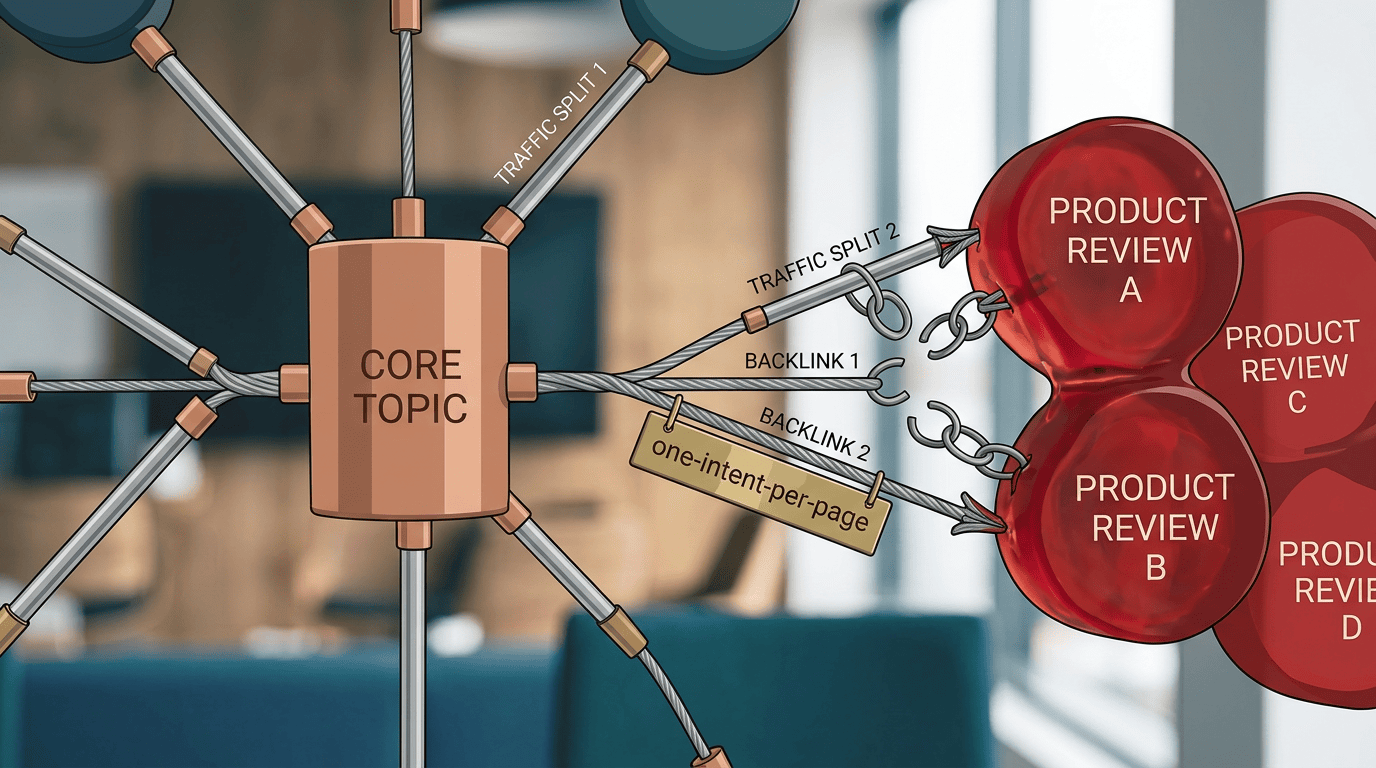
Topic cannibalization happens when two or more pages in your topical map target the same or nearly the same search intent. Instead of building topical authority, those pages split rankings, links, and user signals. The result is fragmented authority, and it can confuse search engines and artificial intelligence (AI) systems trying to identify your clearest answer.
The problem is not limited to identical keywords. Keyword cannibalization, content cannibalization, and intent cannibalization can all show up when pages chase overlapping goals and compete in the same SERP. That overlap can also weaken click-through rates when titles and descriptions send mixed signals.
Poor map design usually starts the mess. Common SEO topical map mistakes show up when boundaries are too fuzzy, and missing intent labels in topical maps makes ownership unclear.
Use a one-intent-per-page rule:
- Give each node one primary job.
- Add example queries and target SERP features.
- Merge, redirect, or canonicalize pages with more than 70% overlap.
Think of the topical map like a book-chapter outline. Each chapter should earn a single role, and internal links should move readers deeper without creating another competing page. Build the map first, then audit existing pages in a spreadsheet and mind map before duplication weakens your SEO plan.
How Do You Diagnose Cannibalization With GSC And SERP Tests
A clean cannibalization diagnosis starts in Google Search Console and with a SERP overlap test. Set a rolling 90-day range, export the Query and Page reports, and pivot query to page and page to query the way Yoast recommends. That makes competing URLs easier to spot, including long-tail variations that split demand.
Use Google Search Console to flag the pattern:
- Filter Queries for the target keyword or close variants.
- Apply the Page filter to list every ranking URL.
- Watch for similar clicks, impressions, and average position across multiple pages.
- Track ranking swaps across weeks, since they often signal intent cannibalization.
The SERP test confirms whether the pages share search intent. Open an incognito browser, run each suspect keyword, capture the top 10 to 20 results, and note features like People Also Ask, FAQ, and video. If six or more identical URLs repeat across related queries, treat the cluster as a consolidation candidate and keep the dominant URL.
Pair to review | GSC signals | SERP overlap | Matching features | Action |
|---|---|---|---|---|
Related queries | Clicks, impressions, position spread | Identical URLs ÷ 10 | Same feature set | Prioritize when overlap and traffic are both high |
Prioritize cases with high overlap and comparable traffic, then hand off the dominant URL with the supporting evidence. Confirm intent against the topical map before you choose merge, redirect, canonicalize, or internal-link redesign.
How Do You Prioritize And Fix Cannibalization Issues
A scoring rubric keeps cannibalization remediation from turning into guesswork. Weight Search Console clicks, average position, keyword overlap, and how backlink equity is split across duplicate URLs. Pages that are losing clicks while sharing target keywords and external links should move first, because content cannibalization can split equity across duplicate URLs.
Situation | Best move | Trade-off |
|---|---|---|
One page should own the topic | Merge into one power page and redirecting old URLs with 301s | Signals need time to settle |
Pages must stay live for UX or product reasons | Add rel=”canonical” in WordPress or your SEO plugin | Index retention can slow signal consolidation |
Intent has shifted enough for a new angle | Reassign keywords and de-optimize the competing page | Some short-term traffic loss is normal |
When consolidating similar topics, pick the strongest URL, usually the best-ranking or highest-backlink page. Fold weaker copy into a fresh draft, publish the merged version, and monitor Search Console indexing. If intent diverges, rewrite headings, meta copy, and internal anchors so each page serves a distinct niche. That content strategy accepts a temporary dip in exchange for cleaner signals.
Close with preventive content governance. Update the topical map so one parent page owns the topic. Change sitewide anchors like “dry dog food,” and hand writers and engineers a short ticket list with every URL to merge, canonicalize, redirect, or retarget.
How Do You Verify Fixes and Handoff an Audit-Ready Plan?
Verification is strongest when you anchor to a baseline date range and a 30, 60, or 90 day comparison window. A clean cannibalization diagnosis uses parallel SERP snapshots and Google Search Console exports to spot ranking swaps, then pairs those with screenshots, CSV samples, and a short note on consolidating similar topics.
Check these signals:
- Compare each pillar page with its cluster pages, then review internal traffic shifts after 2 to 6 weeks to confirm the content hierarchy is pointed at the right URL.
- Roll up duplicate backlinks to the chosen canonical target, then watch referral changes over 4 to 8 weeks for evidence that topical authority is concentrating.
- Pilot one silo at a time so you can measure KPI lift before moving to the next topic group.
Your handoff package should include a downloadable remediation spreadsheet, implementation notes for redirects, canonicals, and merge rationale, plus an immediate smoke test, a 2-week SERP check, and an 8 to 12 week metric review. Add a brief AI provenance log so the work is audit-ready.
Topic Cannibalization in Topical Maps FAQs
These FAQs address the most common keyword cannibalization issues in topical maps, including overlap you can spot in Search Console and the tradeoffs between merges, redirects, and intent reassignments. They help you see where your content structure is supporting organic performance and where it needs cleanup.
1. How long until rankings stabilize after fixing cannibalization?
Most rankings start to settle within 1 to 4 weeks after you fix cannibalization, but measurable stabilization usually takes 6 to 12 weeks. Complex sites can need 3 to 6 months for full recovery because Google must reindex merged or de-optimized pages, and crawl budget affects the pace. Redirect chains, long 301 loops, and backlinks still pointing to removed URLs can add weeks, so watch Google Search Console Performance, URL Inspection, rank swaps, and backlink consolidation.
2. Should I use canonicals or 301s when merging pages?
Use a 301 redirect when you fully merge pages, and confirm the destination URL. In WordPress, the Redirection plugin or a server-level redirect works, but mistakes can cause volatility and lost clicks. Use rel=”canonical” only when both pages must stay live for UX or tracking, and keep the live page focused on distinct intent. Before and after, export GSC data, rerun SERP overlap tests, and track impressions, clicks, and ranking swaps for 4 to 12 weeks.
3. How do backlinks affect cannibalized page decisions?
Backlinks spread across cannibalized URLs dilute equity, so one power page should collect the best external links for SEO, and the rest can reinforce the cluster through internal links. Keep a URL live without a redirect only when backlinks drive traffic or conversions after checking CTR and goal value, since split results can reduce clicks. Otherwise, consolidate weak links, realign anchor text and internal links, and use canonicalization for live pages, while 301 redirects fit permanent merges and cleaner signals.
4. Can internal linking reduce topical map cannibalization?
Yes, internal linking can reduce cannibalization when it makes the pillar page the clearest answer and cluster pages supporting context. Use descriptive anchors that match the main keyword, but vary the wording so you do not over-optimize or repeat stray fragments. Keep links close in the hierarchy, and audit your map so competing pages get merged or deoptimized when poor internal linking in topical maps is the root issue.
5. How to measure cannibalization across large topical maps?
Start with 200 to 500 sampled GSC queries per topic and cluster them semantically so one intent stays on one page. Batch SERP-overlap tests in groups of about 50, and when result types and top URLs match, mark them for consolidation. Log each query in an audit sheet with ranking URLs, overlap score, impressions, estimated traffic impact, and a fix priority based on impact × overlap and ease of fix from 1 to 5