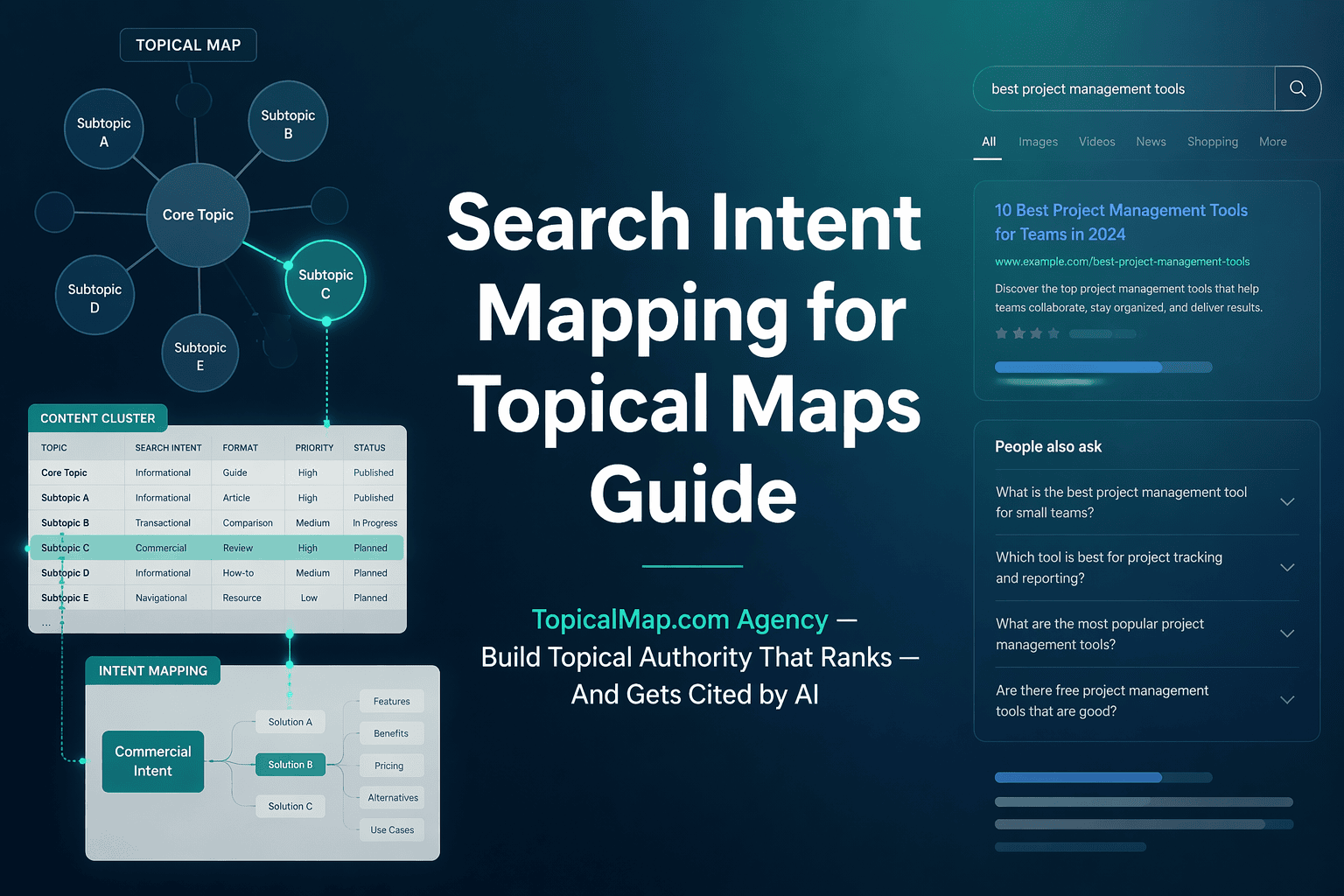
Search intent mapping for topical maps assigns the why behind each page so the map does more than group keywords. For heads of content, SEO leads, and agency teams, the hard part is keeping educational, comparison, and conversion pages from collapsing into the same URL. In plain terms, it ties each node to one dominant search need and one business job, so the final plan is easier to brief, link, and ship.
The sections below cover core and mixed intents, ambiguous keywords, SERP evidence, page type matching, and an intent-based internal-linking template. Expect practical rules for spotting cannibalization, using People Also Ask as a signal, and mapping keywords into spreadsheet fields that writers can actually use. That includes a clean way to label journey stage, page format, and link targets before production starts.
TopicalMap.com Agency readers usually care about reducing research time without losing control over quality, especially in SaaS and e-commerce workflows where overlap gets expensive fast. A mixed keyword cluster can become one primary page, one supporting page, and one clear link path instead of three competing drafts. The next sections give a working structure you can apply to topical blueprints with more confidence and less rework.
Search Intent Mapping Key Takeaways
- One page should serve one dominant search intent.
- SERP analysis should guide node assignment before writing.
- Mixed clusters need a primary intent and supporting pages.
- Exact intent matches belong on the same URL.
- Intent labels should set page type, depth, and links.
- Internal links should move by journey stage, not guesswork.
- Clear intent mapping reduces cannibalization and planning drift.
What Is Search Intent Mapping In Topical Maps?
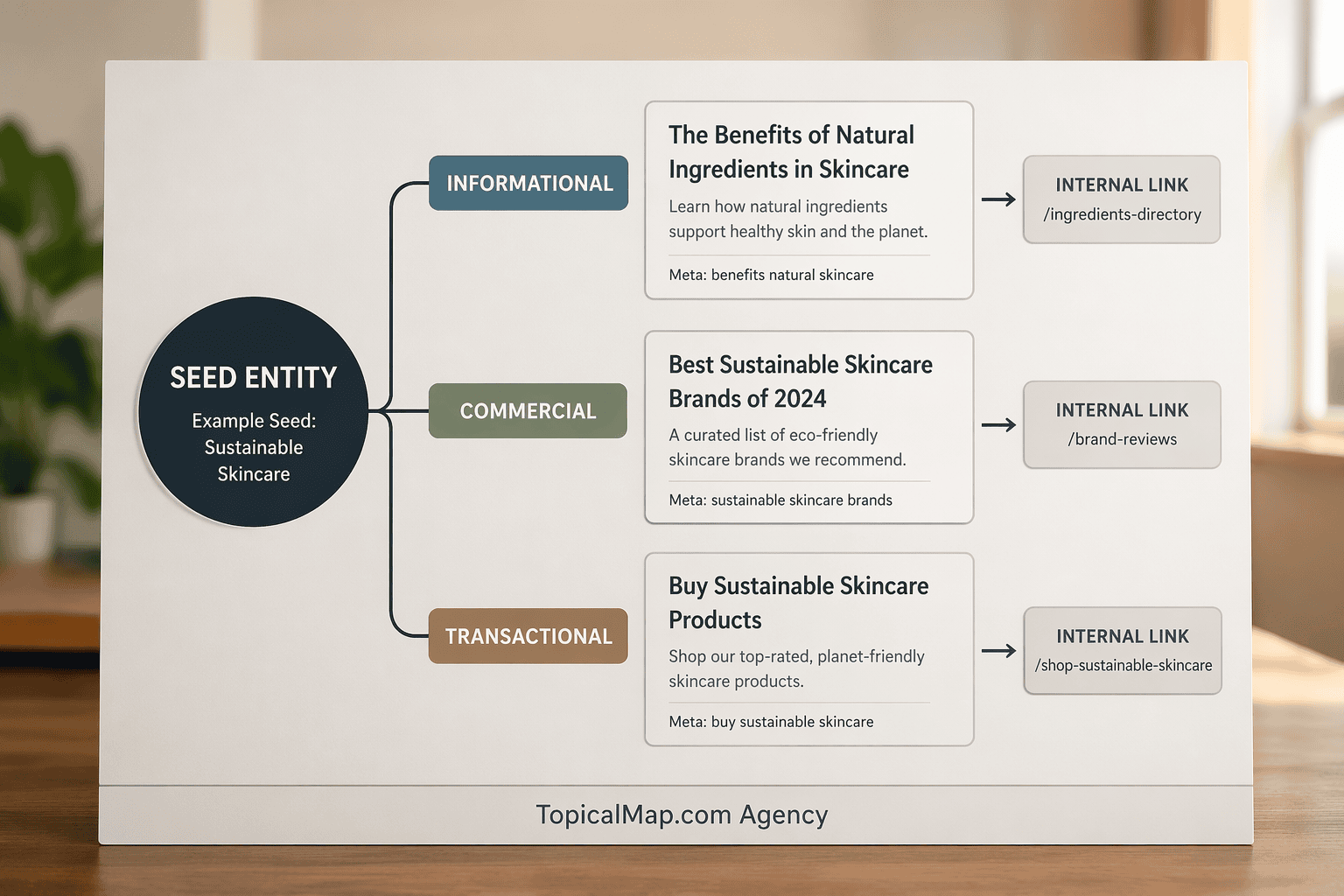
Search intent mapping is the process of assigning the “why” behind each node in a topical map so every page has a clear job. A page can educate, compare, support, or convert, but it should not try to do all four at once. In Search Engine Optimization (SEO), that means each page serves a specific user need and business outcome, not just a keyword list.
The intent layer also connects journey stage to content format, angle, and depth. Informational pages need plain explanations and broad context. Commercial pages need comparison language and tradeoff details. Transactional pages need proof, fewer friction points, and a clear next step. A process for building topical maps end to end works best when those fields stay separate in the spreadsheet so intent does not blur across the buyer journey.
That separation closes coverage gaps and reduces cannibalization risk. Strong intent mapping flags clusters that lean too hard on education, URLs that chase the same question from different angles, and missing pages near the decision stage. It also helps you build topical authority because each page owns one dominant purpose instead of competing with its neighbors.
The practical rule is simple:
- One question: Each node should answer a single primary question.
- One intent: Each page should support one dominant search need.
- One path: Internal links should stay within the same topic family and move readers to closely related subtopics.
That structure keeps topical maps tight and usable. It also prevents one URL from drifting into another page’s job, which is where a lot of planning breaks down.
One broad topic can still support different stages without confusion:
Searcher need | Content format | Page job |
|---|---|---|
Learn the basics | Educational explainer | Build awareness |
Compare options | Comparison page | Support consideration |
Take action | Conversion-focused page | Drive leads or sales |
That is what turns search intent mapping into an export-ready blueprint for planning, briefing, and validation. You can check each node against the live SERP before production and keep every page tied to a real search intent, not just keyword coverage.
How Do You Classify Core And Mixed Intents?
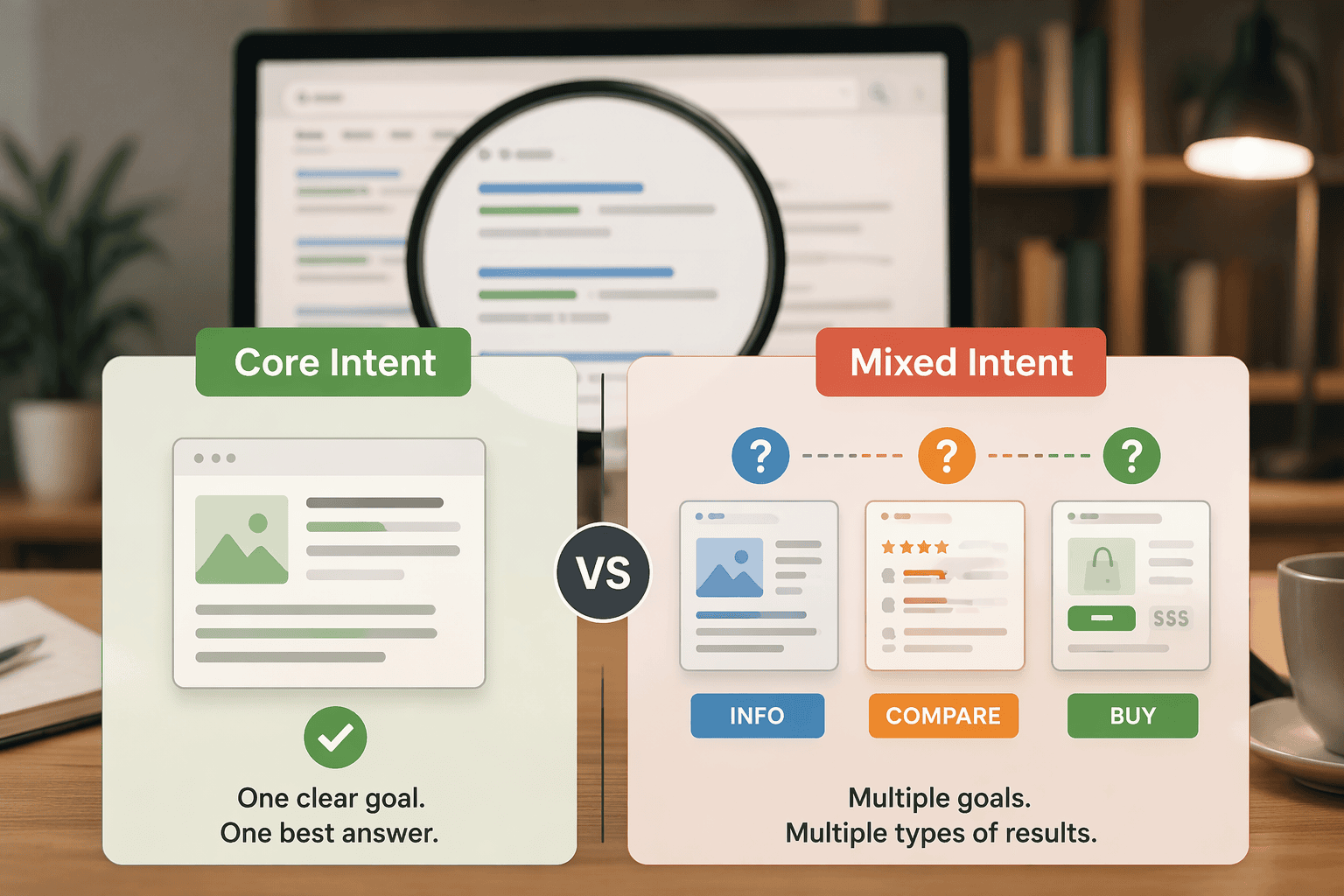
A clean topical map starts with one decision: each cluster gets one primary intent. When a keyword set clearly points to a single job, treat it as core intent and keep the page narrow enough to avoid internal competition and intent cannibalization.
The fastest way to classify that intent is to read the SERP and group terms by meaning and funnel stage. Semantic SEO works best when you separate true single-intent clusters from mixed ones, then label the smaller micro-intents inside broader informational or transactional buckets with more precision. That matters because search intent types often blur at the edges. A general informational cluster may hide a comparison query. A transactional cluster may hide a setup or pricing question.
A simple rule set helps:
Cluster type | What it means | What to do |
|---|---|---|
Core intent | One clear user goal | Build one page for that goal |
Exact intent match | Same meaning, different wording | Map variants to the same page |
Mixed intent | More than one real job | Pick one dominant page and support it with related pages |
Exact intent matches should land on the same node or page, not on separate articles. That concentrates topical authority and reflects how search engines handle near-identical synonyms and wording variants. Applying topic clustering techniques keeps overlapping URLs from creeping into the plan.
Mixed clusters are a planning signal, not a reason to split every variant. Choose the dominant intent for the primary page. Then use supporting pages and internal links for secondary needs so each URL stays scoped and useful.
Before publishing, run a strict cannibalization check. If two planned pages answer the same question in the same format, merge them, redirect one, or reframe the angle. That matters even more on entity-dense sites, where low intent variance can increase the risk of keyword cannibalization and make page ownership harder to separate (source).
Use the intent label to set format, depth, and link placement. Then revisit the map when accidental rankings or new SERP patterns show the query is broader or narrower than you first thought. That keeps your search intent, content structure, and keyword clusters aligned instead of drifting apart.
How Do You Handle Ambiguous Keywords?
Ambiguous keywords are easier to handle when you trust the SERP more than the phrase itself. A keyword can look simple on paper and still hide two different user goals in the live results. That is why SERP analysis should come before node assignment.
Read the results as evidence:
Signal | What it usually means |
|---|---|
Dominant page types | Guides usually point to informational intent. Product, comparison, and review pages usually point to more evaluative intent. |
SERP features | Featured Snippets and People Also Ask often favor a concise, answer-first page. Review stars, shopping modules, and list-heavy results suggest commercial research. |
Media mix | Image-heavy or video-heavy results usually need multimedia, not text alone. |
Query modifiers | “Best,” “review,” “pricing,” and “alternatives” tend to shift a query toward buying research. “How to,” “what is,” and “guide” usually stay informational. |
The trick is to see whether the intent stays stable across variants. If two long-tail keywords lead to the same search need, put them on one page and inside the same topical node. That keeps topical authority from getting diluted and reduces internal competition.
Use a simple split rule when the SERP gets messy:
- Group together: same intent, same page type, same search goal
- Split apart: similar wording, different user goal
- Hold in one node for now: mixed signals with no clear winner
When intent still feels fuzzy, compare neighboring keywords and the People Also Ask set. If Google keeps clustering them around one answer, treat them as one topic. If one cluster leans toward definitions and another leans toward product selection or troubleshooting, separate the map. That is the cleanest way to turn ambiguity into a usable content decision.
How Do You Build The Intent Mapping Template?
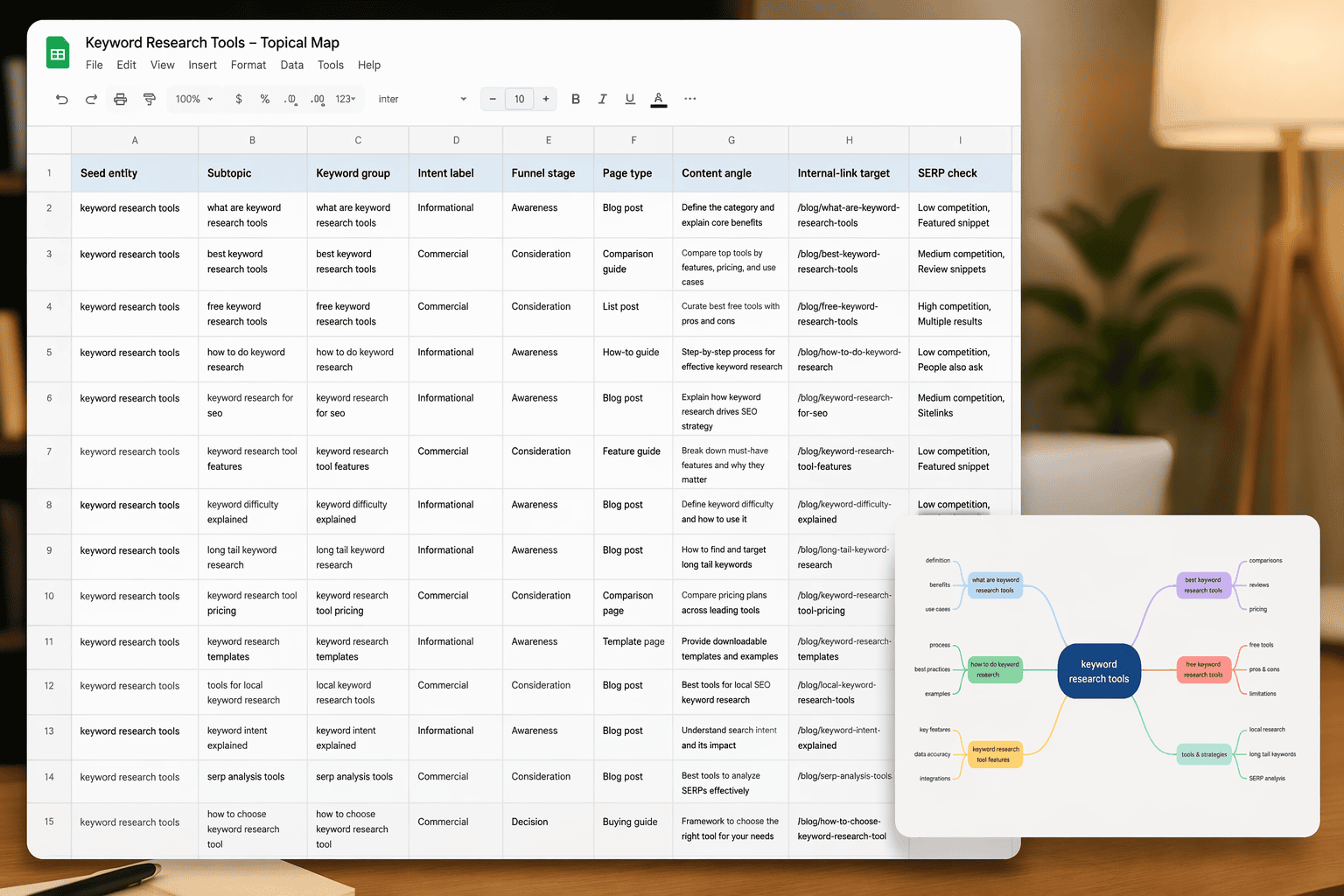
A useful template starts with one seed entity and branches the way real users think, search, and compare. That creates a true content hierarchy instead of a flat keyword dump, with a pillar core node, sub-pillars, and spoke pages that support one another. The cleanest starting point is keyword research for clusters, then shape the workbook around the jobs each page needs to do.
The workbook should be export-ready from day one so content teams and SEO teams can hand it to writers without rebuilding the logic. Strong columns usually include these fields:
- Seed entity: The central topic that anchors the map
- Subtopic: The narrower idea that fits under the seed
- Keyword group: The search terms that belong together
- Intent label: The user need behind the query
- Funnel stage: The stage from awareness to conversion
- Page type: The page format that should serve the need
- Content angle: The angle that makes the page distinct
- Internal-link target: The page that should receive relevance
- Temporary URL, draft title, status, update notes, SERP check: The working fields that keep the file live
That structure fits semantic SEO because it ties search intent mapping to page architecture, not just topic labels.
A simple rule keeps mixed intent from muddying the map. If two keyword groups answer the same need and fit one page without awkward section sprawl, keep them together. If the SERP shows different page types, different commercial pressure, or a clear split between informational, commercial, and transactional intent, split them into separate nodes and flag the overlap early. That is where intent mapping helps prevent cannibalization across content clusters.
The internal-linking layer is where the workbook becomes operational. Pillar pages link down to sub-pillars, sub-pillars connect across related support pages, and spoke pages point back to the most relevant commercial or conversion page. A SERP check column adds a reality check before production, so the team can spot missing commercial or transactional pages and over-weighted informational coverage. For e-commerce teams, a topical map for ecommerce SEO is a useful reference for product-led catalogs.
Make the sheet flexible enough for live sites and new builds. Temporary URLs, draft titles, status fields, and update notes keep the topical map useful as evidence changes and the plan evolves. That gives you one source of truth for topical maps, search intent mapping, and the next round of content clusters.
Which Page Types Match Each Intent Stage?
The right page type should match the job the searcher is trying to get done. When you align format to search intent types, your cluster is easier to plan, easier to link, and less likely to cannibalize itself.
A simple mapping works well in production workflows:
Intent stage | Best page type | What it should do |
|---|---|---|
Informational | pillar pages, broad guides, ultimate guides, encyclopedia-style explainers, and “what is” articles | Answer the core question, set the hierarchy, and anchor the overview content |
Investigational | comparison-led sub-pillars, “X vs Y” pages, pros and cons breakdowns, buyer’s guides, and case studies | Reduce uncertainty and move readers from research to shortlist |
Transactional | conversion-focused spokes, product pages, service pages, landing pages, review pages, and buying-guide pages | Make the next step obvious for searchers close to choosing |
Navigational | homepage, category hubs, support pages, login pages, pricing pages, and documentation | Catch brand or destination queries without wasting content on obvious routes |
Pillar posts do the heavy lifting for informational intent. They answer the broad question, define the topic, and support the cluster’s structure. For a keyword research cluster, “What is keyword research” belongs here.
Investigational content works best when people are comparing options. That is where product, service, and competitive pages earn their keep, especially when you need to show tradeoffs clearly. A phrase like “Best keyword research tools” usually sits in this middle ground before it turns fully transactional.
Transactional pages should remove friction fast. They suit readers who are close to choosing, and they often sit around product pages, landing pages, and buying-guide pages. They also help your internal linking plan by turning intent into a clear path.
Navigational pages only make sense when the query is brand- or destination-specific. That includes homepage, pricing, login, support, and documentation pages. The approach behind local seo topical maps follows the same logic.
Capture the mapping in a spreadsheet or mind map, then reuse it in production. That’s how keyword clustering supports topical authority without overlap, confusion, or wasted content.
How Do You Build Intent-Based Internal Links?
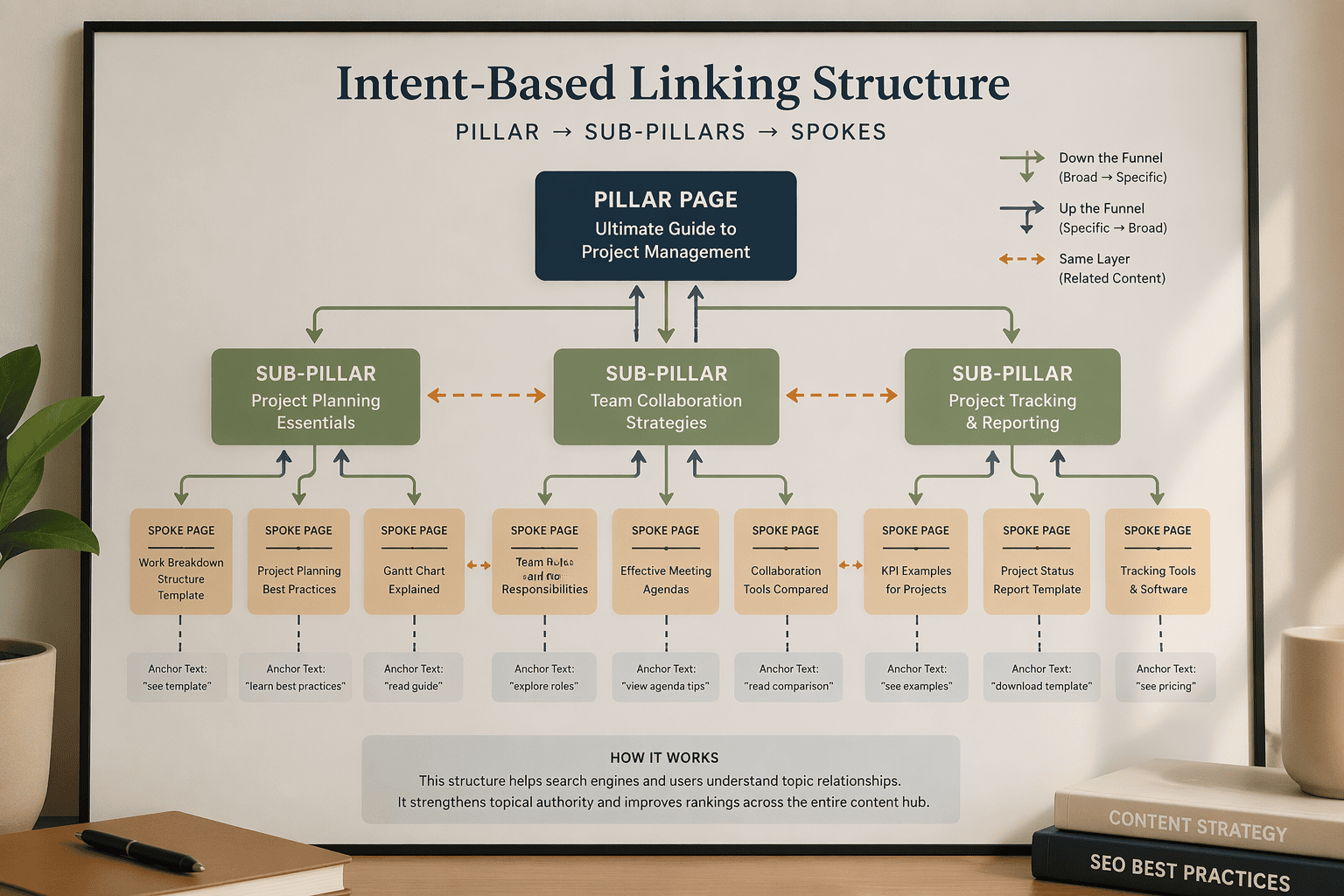
Intent-based internal linking works best when the path is obvious. Your content hierarchy should move one level at a time, from pillar pages to subpillars and then to spoke pages. That keeps content clusters clean, helps search engines read breadth and depth, and gives readers a clear route from broad education to narrower intent without skipping levels.
Before you connect pages, label each URL by search intent. A page may serve learning, comparing, buying, or a brand-specific query, and that label should shape both the page type and the link direction. Informational pages should point to the next useful step when they answer a follow-up question. Transactional pages should point back to supporting education when readers need context, proof, or comparison detail.
A simple rule set keeps internal linking consistent and easy to scale:
- Down the funnel: Link problem-focused articles to deeper commercial pages when the reader is ready for a solution or more detail.
- Up the funnel: Link money pages back to educational pages when the reader needs background, definitions, or a fair comparison.
- Across the same layer: Add horizontal links only between sibling pages or tightly related subtopics that share the same intent stage.
- One step at a time: If a page spans multiple stages, send readers to the next most useful destination instead of every possible option.
Anchor text matters as much as placement. Descriptive anchors should signal what comes next, not just repeat a keyword. Vary the phrasing so the pattern feels natural, and use generic language like “read more” only when nothing clearer fits.
Treat internal linking as a routing system for production work. Informational pages in content clusters usually deserve more links than commercial pillars, and money pages should receive natural links from problem-led articles. A spreadsheet or mind map makes those opportunities easier to track, cuts research time, and helps teams avoid cannibalization while keeping the content hierarchy intact.
How Do You Validate Intent With SERP Evidence?
Start with live SERP analysis before you lock the map. The page types already ranking, the mix on page one, and the layout patterns around them are the clearest signal of search intent and the format Google expects. If the SERP is full of guides, your plan should lean that way. If it is crowded with product pages, categories, or templates, forcing a blog post into that space usually creates friction.
Read SERP features as intent markers, not decoration. Featured Snippets and People Also Ask usually reinforce informational intent, so crisp answers, short definitions, and answer-first sections tend to fit. Review stars, comparison blocks, and list-heavy layouts usually point toward commercial investigation, where scannable content often works better than long prose. In commercial search patterns, AI and SERP results often reward structured content such as tables and lists, so page format should match the result type and the task the searcher is trying to complete (source).
Use the live results to sharpen sub-intent and cut overlap:
- Fold recurring People Also Ask questions into the page plan.
- Split keywords when related searches drift into pricing, comparison, how-to, or another distinct page need.
- Match the proposed page type to the current top-ranking results.
- Record the intent label, preferred format, and internal-link target for each cluster.
That last step keeps production from drifting. A keyword cluster for SAAS can share the same workflow as e-commerce, but only if the spreadsheet or mind map separates page purpose from topic theme. Revisit the map after the first pass, then update it when new question sets, ranking shifts, or generative search patterns show that the query moved or your first label was too broad. Google NLP, ChatGPT, and other AI systems all handle clean structure better than vague page intent.
How Do You Adapt Topical Maps For AI Search?
Start with one root entity, then break it into the subtopics real searchers ask about. That keeps the map aligned with AI search instead of flattening it into a keyword dump. AI brainstorming can widen the idea set fast, but search research should still decide which nodes stay and how they get grouped into intent-mapped pages.
Each node should read like a machine-readable chunk, not a rough note. A clean structure helps:
- Clear heading: one topic per page or section
- Intent label: informational, comparison, or transactional
- Concise answer block: the fastest useful response
- Supporting entities: related terms, examples, and semantic keywords
That matters even more in generative search, where the page needs to hand over a finished answer instead of raw scraps. ChatGPT and similar systems work better when the page gives them a clean unit they can parse, quote, and recombine. Google NLP also responds well when entity relationships are easy to spot.
AI-friendly assets help when the user needs to do something, not just read about it. The best ones stay tied to the topic hierarchy and include:
- Tables that compare options or definitions
- Copy-paste prompts for AI workflows
- Checklists that move work forward
- Calculators or generators that produce usable output
- Short comparison blocks that settle a decision quickly
A search-intent-to-topical-map matrix turns the system into something writers and SEO teams can actually use. Track the keyword, intent label, journey stage, page type, content angle, and internal link target for every node. That makes the workflow export-ready, cuts research time, and exposes gaps before you ship.
Mixed intent needs clear rules, or cannibalization shows up fast. Keep related terms together when one page can satisfy the same outcome. Split them when the micro-intents diverge, even if the keywords look close on paper. Informational pages can support comparison or transactional pages through subtopics, but overlapping pages should only live together when the user wants one result.
The internal linking path should follow the journey too. Move from informational pages to comparison pages, then to transactional pages, and use anchor text that matches the next step. Structured data helps as well, especially nested JSON-LD with ItemList, DefinedTerm, hasPart, and isPartOf markup. Paired with clearly segmented sections, that can give AI systems cleaner signals by making topics, entities, and relationships easier to parse than unstructured page copy alone (source).
Search Intent Mapping FAQs
These FAQs tackle the practical questions teams ask before adding search intent mapping to a topical map. You’ll see where it fits, how it shapes content planning, and what matters most when the stakes are high.
1. How Often Should Intent Maps Change?
Review intent maps on a quarterly cadence, then refresh them sooner when Search Engine Results Pages (SERPs) shift, traffic drops, or a product, category, launch, rebrand, pricing update, or new feature changes how people search. Treat the map as a living layer, not a fixed document, and expand it when new search motives appear or retention-stage content is missing. If rankings weaken or grouped traffic starts drifting, recheck the page type, angle, and internal linking before cannibalization spreads.
2. Can One Keyword Map To Two Pages?
Yes, but only when the pages serve different intent. If the SERP, headings, and user expectation are basically the same, map one keyword to one page to avoid cannibalization and diluted topical authority. If one page serves a broad need and the other targets a narrower angle, format, or intent stage, split them, keep one primary keyword per page, and retarget the weaker URL to a different query set.
3. How Do You Spot Intent Shifts In SERPs?
Intent shifts usually show up in SERP features before they show up in rankings. If People Also Ask, Related Searches, or autocomplete start tilting toward new questions or modifiers, the query is moving. A featured snippet that flips from a definition to a list, video, or step-by-step answer, plus page-one swaps like videos, image packs, news, or sitelinks, is a strong sign that the intent mix is changing.
4. Does Intent Mapping Reduce Keyword Cannibalization?
Yes. When you give each page one clear intent, you stop multiple URLs from chasing the same query set and keep the map cleaner. Cluster-level intent mapping keeps informational, commercial, and transactional pages separate, and SEO hygiene matters here: one-intent-per-page, clean internal links, tighter titles and meta descriptions, consolidation, and pruning thin duplicates help search engines choose the right page to rank.
5. How Does Topical Mapping Start With Intent?
Start with one seed entity, then break it into the natural subtopics that show how the topic actually works, not just how people phrase searches. From there, group related keywords by semantic similarity and search intent so a raw list becomes usable topic clusters. An early intent-label pass then shows what belongs in a pillar page, what should stay as a supporting subtopic, and where a separate content path makes more sense, which helps you spot gaps and avoid splitting one intent across multiple pages.