Topical map keyword research is the process of turning a seed topic into a structured content plan with clear page roles, intent, and internal links. Content teams often know the subject they want to own, yet still end up with overlapping pages, weak clusters, and briefs that miss the real search demand. A seed topic is the broad subject area that anchors the map, and the right one gives you enough room to build authority without drifting off theme. The outcome is a cleaner research workflow and a publishable structure that writers, editors, and SEO leads can act on.
That process starts with defining the seed, then expanding it with SERP signals, clustering keywords by meaning, and scoring what deserves its own page. It also calls for a raw sheet and a clean sheet, intent labels, and a simple cutoff for when to keep a term, merge it, or fold it into a broader page. For teams building topical maps at scale, those steps create a repeatable template, a handoff-ready spreadsheet, and fewer cannibalization mistakes.
Heads of content, SEO leaders, and agency principals care about this because the plan has to hold up in the real work of publishing, linking, and reporting. One branch might start with a broad term like smart thermostats, then split into comparison pages, how-to pages, and support content that all point back to the same silo. When the structure is clear, the brief gets easier to assign and the final map is easier to defend with evidence, which is the standard this process is built to meet.
Topical Map Keyword Research Key Takeaways
- Start with a seed topic broad enough to support multiple subtopics.
- Use SERP signals, competitor nav, and Autocomplete to expand branches.
- Clean raw exports before clustering to remove noise and duplicates.
- Cluster by meaning and intent, not exact keyword wording.
- Score clusters with intent and business value before volume.
- Map each cluster to a page type and internal-link path.
- Keep the spreadsheet and mind map updated as search behavior changes.
How Do You Define The Seed Topic?
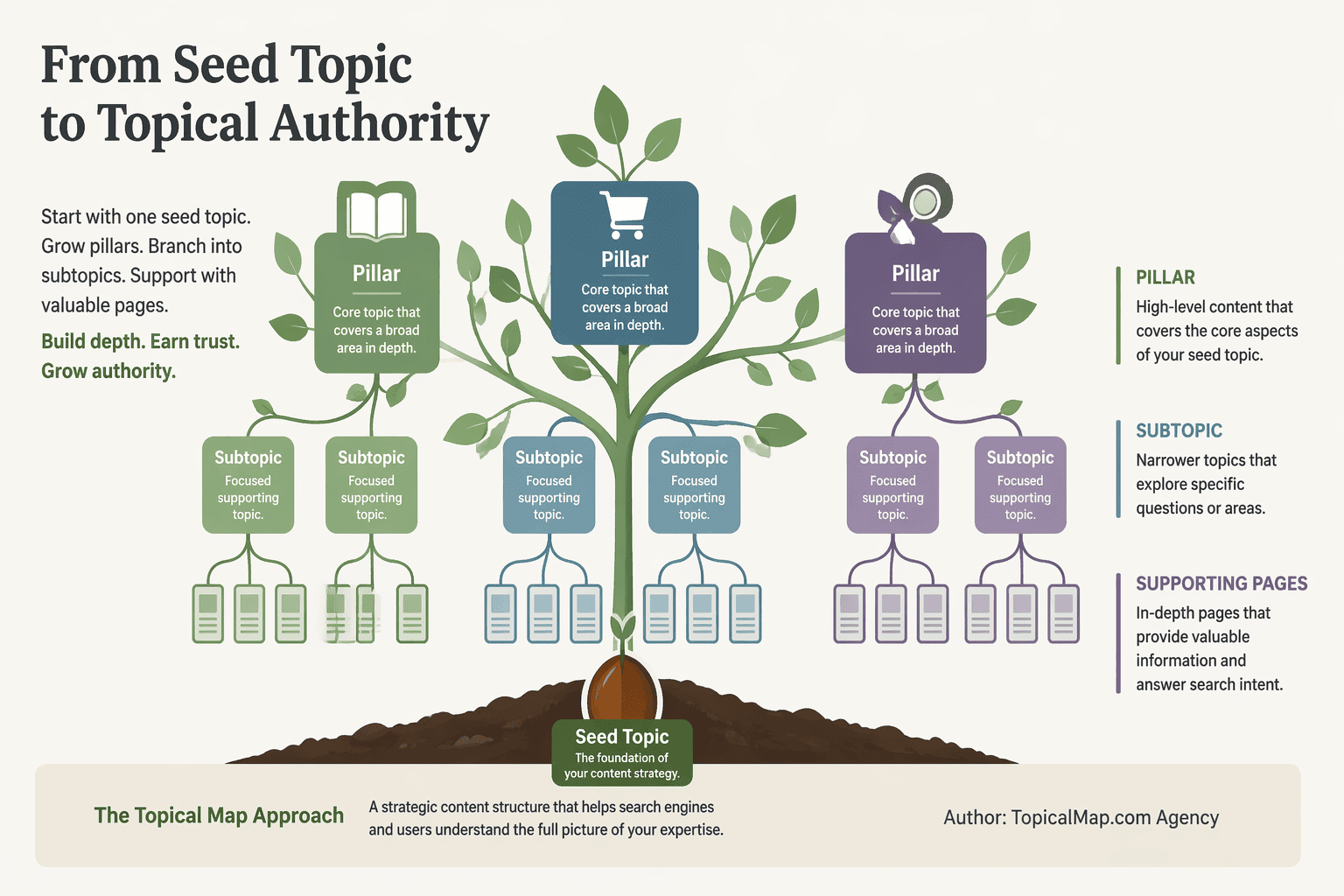
A seed topic is the broad subject area that anchors your topical map. It is not a single keyword. It should name a real knowledge domain that can branch into multiple subtopics while still pointing to one clear business theme.
The best seed topics sit where your offer, your expertise, and durable search demand overlap. That gives you room to serve commercial and informational intent without drifting off brand. If you want the full workflow, see how to develop a topical map before you commit to a seed.
The sweet spot matters:
- Too broad: "dogs" is so wide that topical authority is hard to build.
- Too narrow: "dog food for golden retrievers" leaves too little room to expand.
- Just right: "dog food" or "espresso coffee" gives you enough depth without losing focus.
A strong seed can expand into a pillar page, subtopic pages, and supporting content. Internal links should connect those pages so users and search engines can move through the topic in a clear structure (source, source).
A topic completeness check helps confirm that the seed can support enough breadth, depth, and coverage over time. It also helps you spot gaps before they turn into keyword cannibalization.
For Topic Clusters, the practical test is straightforward:
- Business fit: The topic matches your offer and audience demand.
- Depth: The topic can support subtopics and supporting content over time.
- Structure: The topic can grow without overlap.
- Room to grow: Competitors already cover related pillar pages, subtopics, and specific use cases.
On a smart home site, smart thermostats, smart appliances, smart security systems, and voice assistants are stronger seeds than a vague home automation label.
How Do You Expand Topics With SERP Signals?
Start with the widest SERP signals before you build a keyword list. Wikipedia, competitor navigation, ecommerce category trees, and AI tools can help surface likely subtopics and macro-branches during early research. Those signals should be treated as starting points, then checked against search data and SERP patterns before the final map is built (source, source).
A clean first pass usually looks like this:
- Wikipedia TOC: Use the table of contents to spot the main conceptual splits and the language around them.
- Competitor navigation: Study category menus, hub pages, and product taxonomy to see how the market groups related ideas.
- AI-surfaced subcategories: Ask ChatGPT or another AI tool for likely subtopics, then treat the output as a hypothesis, not a final answer.
The next layer turns structure into demand. Blend Google Autocomplete, People Also Ask, Related Searches, SEO tools, and niche forums to expand each branch with real search behavior. Question patterns and modifiers like how, why, best, versus, cost, and review usually reveal Search Intent better than a broad head term.
SERP analysis keeps the work grounded. When results repeatedly favor hub pages, deep subtopic coverage, repeat People Also Ask questions, or a specific format, let that pattern shape depth, intent, and page type. A comparison-heavy branch should not become a thin explainer, and a how-to cluster should not be forced into a product-style page.
Use a simple trust hierarchy when signals disagree:
Signal source | Best use | Trust level |
|---|---|---|
Wikipedia, competitor nav, AI-suggested categories | Set the macro structure | High |
Autocomplete, People Also Ask, Related Searches, forums | Refine wording and angles | Medium to high |
One-off SERP noise | Flag edge cases | Low unless repeated |
Every expanded keyword should be tagged by intent and role as you map it. Mark whether it is informational or transactional, then label it primary, secondary, or long-tail. That habit reduces keyword cannibalization later because each branch gets matched to the right page format.
Keep the full set in a working spreadsheet or mind map. A side-by-side view makes it easier to spot missing subtopics, prune false positives, and export a cleaner research base that reflects search behavior instead of random keyword variants.
How Do You Clean And Cluster Keywords?
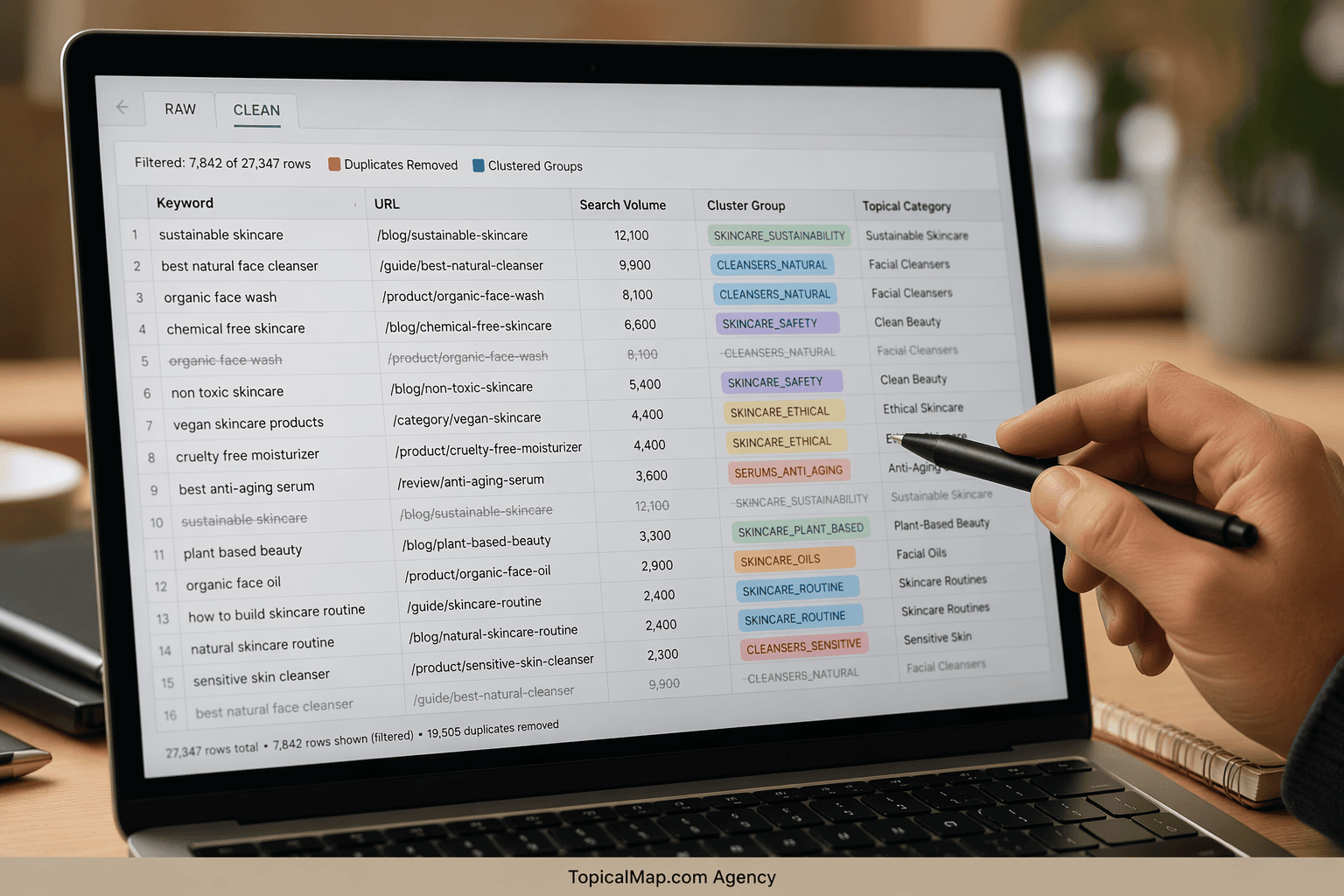
Start with one master keyword sheet. Pull every export into one workbook from Ahrefs, SEMrush, Moz, Keyword Explorer, Google Autocomplete, People Also Ask, and other discovery sources. Keep one raw tab untouched, then build a separate clean tab for sorting, filtering, and keyword clustering methods. That split keeps every term traceable when a cluster needs a human audit later.
Cleaning comes before clustering. Strip out broken phrases, stray fragments, off-topic terms, and duplicates that would distort the map. A cleaning pass should remove duplicates, near-duplicates, malformed phrases, and off-topic terms before clustering begins. That makes the sheet easier to audit and keeps the cluster list consistent with the raw exports (source, source).
A practical cleaning pass looks like this:
- Remove noise: drop malformed exports, orphaned modifiers, and irrelevant terms.
- Normalize variants: merge singular and plural forms, swapped word order, and near-duplicates.
- Filter for fit: keep only terms that match the seed topic and the search problem.
- Tag intent: mark informational, commercial, or transactional intent before grouping.
After that, cluster by meaning and intent, not by exact wording. One parent term can carry a set of close variations when a single page can satisfy the whole query set. That is where semantic SEO meets execution. If the data shows one article can cluster content cleanly, don't split it just to make the sheet look fuller.
SERP overlap should be your main signal. If the same top-ranking URLs keep showing up in the Top 10, those terms usually belong together. If the results split into different pages or intents, separate them even when the language looks similar. That check helps protect Topical Authority and reduces keyword clustering mistakes.
Automation can speed up first-pass grouping when the dataset is large, especially with tools like Keyword Insights, Keyword Cupid, or a custom script. AI-assisted grouping still needs human judgment. Review broad merges, odd splits, and mixed-intent clusters before you trust the output.
Use the final master sheet as a working blueprint:
Field | What it should capture |
|---|---|
Parent term | The main page target |
Supporting keywords | The grouped variants |
Intent | The search goal behind the group |
Content gap notes | Missing angles, subtopics, or internal links |
If a cluster is too broad, split it into smaller groups. If it is too thin, merge it with the closest semantic neighbor. That is how Keyword Research becomes a usable plan for SEO teams and search-first content strategy.
How Do You Score Which Keywords Make The Cut?
A strong keyword scoring system keeps page decisions consistent. It also gives you a defensible way to decide when a cluster earns its own page and when it belongs inside a broader hub.
Use your master keyword sheet to score each cluster against the same fields:
Factor | What to check | How it affects the score |
|---|---|---|
Monthly search volume | Demand size | Adds points when reach is meaningful |
Difficulty or competition | SERP strength and ranking barriers | Subtracts points when the result page is crowded |
Business value | Revenue fit, lead quality, or product relevance | Raises the score for high-value offers |
Search Intent | Informational, commercial, or mixed | Acts as a gate before scoring continues |
Content-gap fit | What your site does not cover yet | Lifts terms that fill real content gaps |
Weight the factors deliberately and make search intent and business value the first filters. Volume and difficulty can help rank opportunities after fit is confirmed, but they should not override poor intent match or weak business relevance (source, source).
Intent works best as a gate instead of just another point total. The search intent classification process helps separate informational, commercial, and mixed-intent queries so each page has one clear job. That keeps you from stuffing unrelated keyword variations into one article or publishing thin pages that compete with each other.
Coverage matters just as much. A keyword deserves a higher score when it opens a format, subtopic, or People Also Ask angle your site does not cover yet. If a cluster only repeats a point you already own, keep it inside the broader cluster page or consolidate it. That is how you avoid keyword cannibalization while preserving useful nuance.
A simple cutoff rule keeps the map clean:
- Standalone page: enough related terms, solid volume, manageable competition, and a clear content model
- Cluster support term: useful detail that fits better as a subsection, FAQ, or supporting paragraph
- Fold into a broader page: low intent, fragmented phrasing, or only marginal keyword lift
SEO judgment closes the loop. A lower-volume term can still win if it supports a high-value product path. A larger keyword can still lose if it distorts the topical map. The final call should reflect what already ranks, what the SERP rewards, and whether your site can cover the topic better than the current pages.
How Do You Turn Clusters Into A Topical Map?
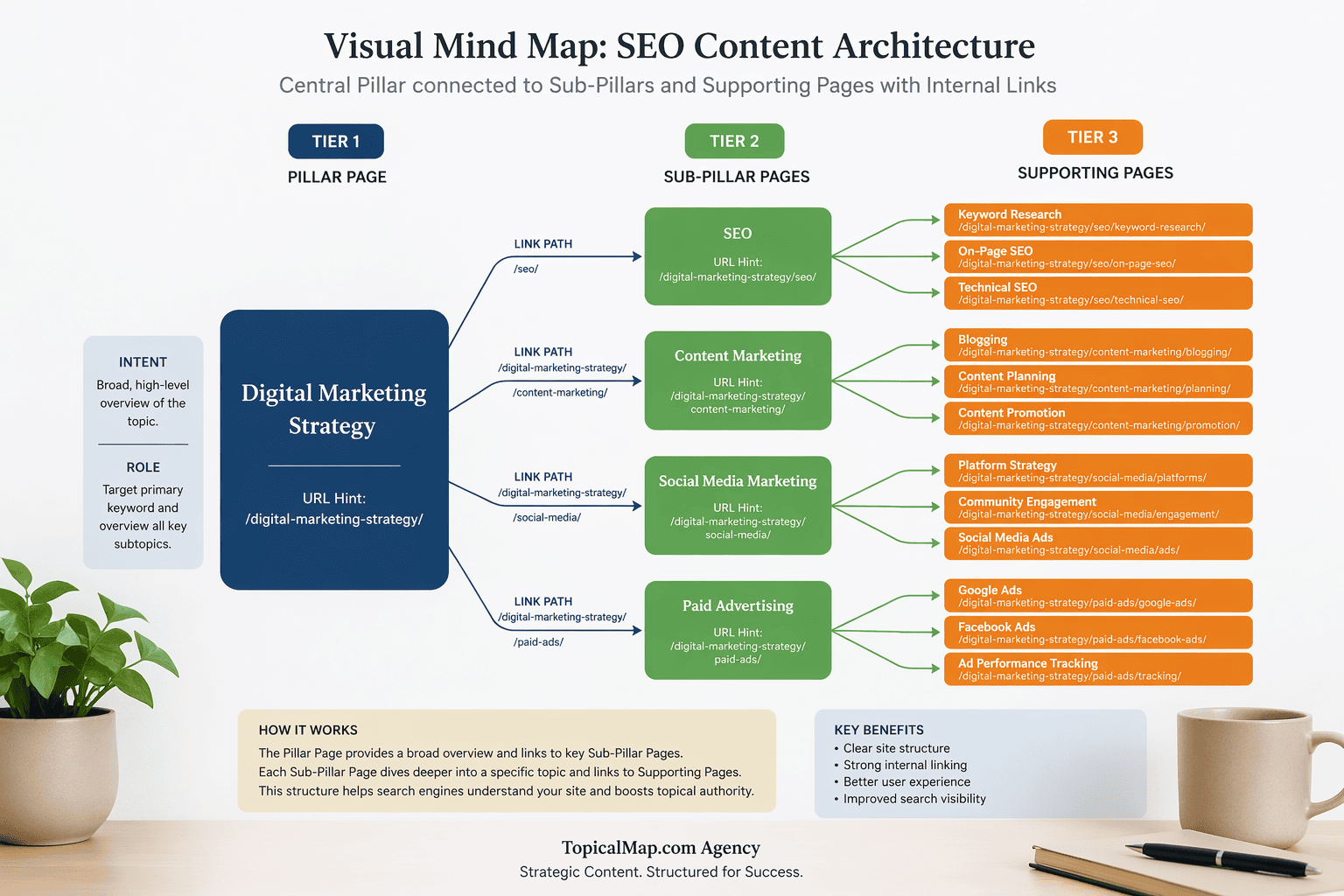
Turn each cleaned cluster into a site structure with one clear job. A topical map can move from a pillar page to narrower subtopic pages and then to supporting articles. Clear internal linking and page roles make the structure easier to plan and help search engines understand how the pages relate to one another (source, source).
Search intent should come before titles or URLs. Pillar pages should handle broad informational intent, sub-pillars should narrow the topic into a defined macro-theme, and supporting pages should answer comparisons, questions, or problem-specific searches. That order keeps Topic Clusters from cannibalizing each other and gives every page a clear role in the map.
A simple tier model helps you sort the work:
Tier | Page type | Intent | Role in the system |
|---|---|---|---|
Tier 1 | pillar pages | Broad informational | Frame the main topic and point to related silos |
Tier 2 | Sub-pillar pages | Focused informational | Narrow the topic into a defined subtopic |
Tier 3 | Supporting pages | Specific intent | Answer one question, comparison, or scenario |
The site architecture works best when related topics stay inside logical silos. Supporting pages should link up to the sub-pillar and back to the pillar through internal linking. The pillar should link down into the deeper pages. That mirrors how search engines surface hierarchical content and gives SEO teams a practical blueprint instead of a loose list of keywords.
The map should stay alive, not frozen in a spreadsheet from last quarter. Use a spreadsheet as the source of truth, then mirror it in a mind map or diagram so the hierarchy is easy to scan. Track cluster name, target URL, intent, and status so you can adjust for seasonality, trend shifts, or SERP changes without rebuilding the whole system.
Practical navigation cues make the plan usable for writers and SEO leads alike. Add these details to each row or node:
- Category names: so the silo is obvious at a glance
- URL structure hints: so drafting stays consistent
- Link-path notes: so internal linking stays deliberate
- Status fields: so production moves without confusion
Tools like MindMeister, Miro, Ahrefs, SEMrush, Moz, Google Keyword Planner, Google Autocomplete, People Also Ask, AnswerThePublic, SEO Scout, Keyword Insights, and Natural Language Processing tools can help organize and visualize the map. The process in how to build a topical map for seo is easiest to execute when every row or node says what to create, what it must cover, and where it sits in the broader system.
Treat the Topical Map as a production brief, not a keyword dump. That approach helps you avoid keyword cannibalization, build one silo at a time, and give writers a clear path from brief to published page. It also gives your team a cleaner route to Topical Authority because the structure itself does part of the work.
How Do You Prioritize Publishing And Maintenance?
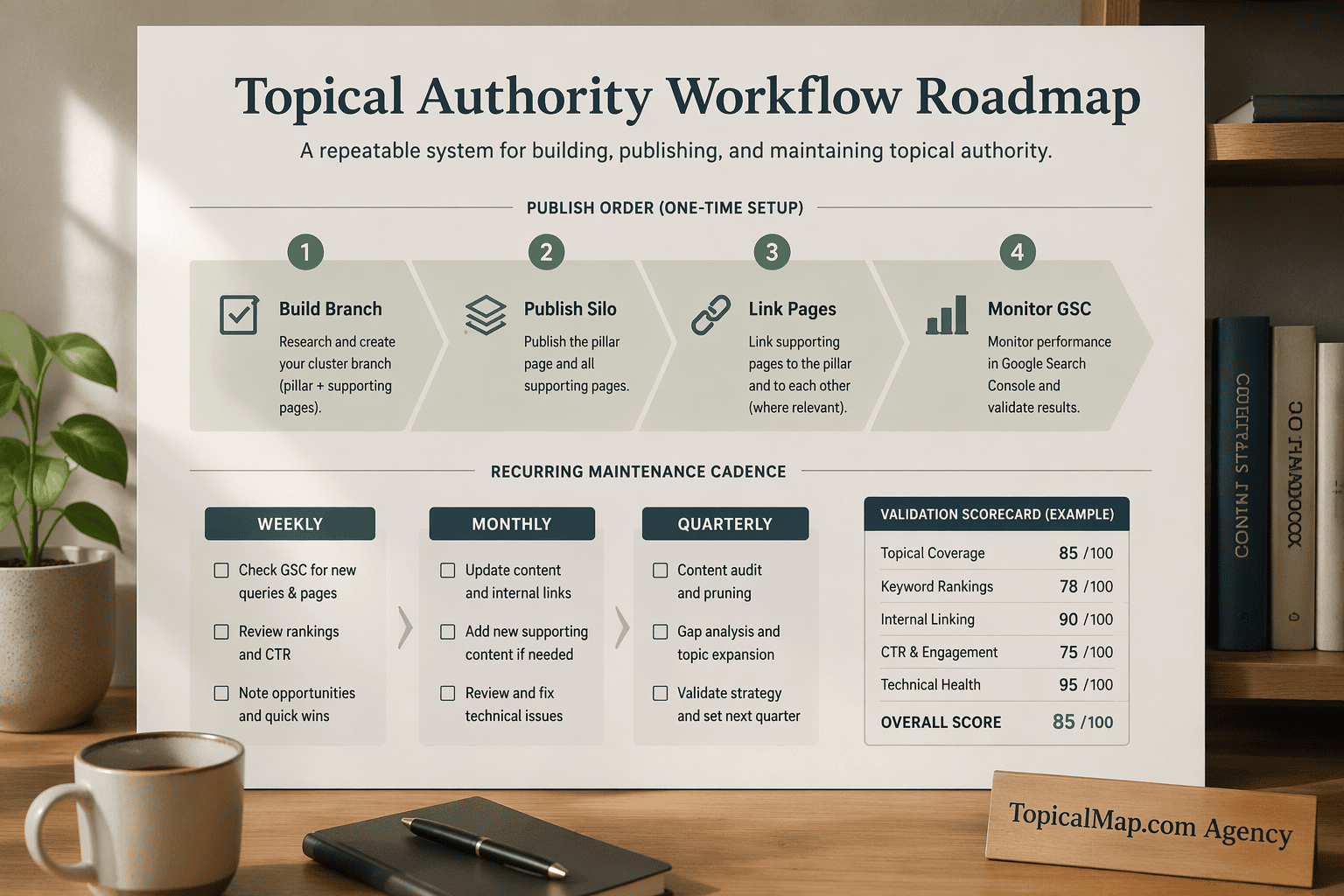
Publishing order should follow demand and structure, not instinct. Start with low-competition, high-intent long-tail keywords inside one branch if the goal is to validate demand before broader pages go live. That sequence can make early performance easier to measure and can reduce the risk of building around the wrong topic area (source, source).
A clean launch sequence keeps the work defensible:
- Build the full sub-category branch first, with Tier 3 clusters and supporting pages at the front of the queue.
- Publish the branch as a complete silo before moving to the next topic family.
- Link each page back to the parent pillar and across to sibling pages so the topical map reads as finished, not fragmented.
- Hold broader pillar content until the branch has enough depth to support it.
That order matters because SEO signals get stronger when the cluster looks complete. A half-built branch can rank, but it often leaves gaps that slow trust, raise cannibalization risk, and make your content strategy harder to scale.
A simple validation scorecard makes the publishing queue easier to defend. Use a pass or fail rule, or a weighted ranking, so each page earns its spot instead of getting pushed by opinion.
Factor | What to check |
|---|---|
Search volume | Is there enough demand to justify the page now? |
Difficulty | Can the page compete with the current site authority? |
Intent match | Does the query align with the page's job? |
Business value | Does it support revenue, leads, or retention? |
Topical gap | Does the page fill a missing cluster node? |
Treat the topical map as an operating system, not a static list. Your master sheet should track seed topic, macro-category, cluster, sub-pillar, intent, priority, target URL, internal link targets, and content status. That makes handoff cleaner for writers, editors, and SEO leads because everyone works from the same source of truth.
After launch, keep monitoring light but consistent. Review Google Search Console on a regular cadence for rising queries, impressions, clicks, and pages pulling in adjacent terms. When those signals appear, expand the cluster with new pages and refresh internal links so the branch keeps strengthening as it grows.
The real value comes from iteration, especially in fast-moving niches. Mark each item as draft, in progress, or published. Keep the spreadsheet synced with the mind map so gaps stay visible when products, trends, or search language change.
When a page begins ranking for unexpected related queries, fold those terms back into the branch. Update the content brief or the supporting pages, then re-score the cluster if the new demand changes priority. That keeps your content strategy tied to live search behavior instead of stale assumptions.
A practical maintenance rhythm looks like this:
- Weekly: Check Search Console for new query clusters and page-level movement.
- Monthly: Revisit internal links, status labels, and priority scores.
- Quarterly: Refresh branch coverage, add new subtopics, and confirm the map still matches the market.
That cadence keeps the map useful, the branch complete, and the next publishing decision easy to justify.
Topical Map Keyword Research Process FAQs
These FAQs cover the practical questions teams ask before building a topical map keyword research process, from scope and clustering to workflow choices and review steps. If ChatGPT is part of your process, the answers below show how to use it without losing strategic control.
1. What Is Topical Mapping In SEO?
Topical mapping in SEO also helps teams group related content around one core subject instead of chasing keywords one by one. A strong Topical Map shows how a Tier 1 pillar page, Tier 2 sub-pillar pages, and Tier 3 supporting articles connect through internal links, so users and search engines can see your knowledge structure and depth. That interconnected setup supports comprehensive coverage, semantic keyword use, indexing, and the signals search engines use to judge topical authority.
2. What Are The Seven Map Elements?
A strong map has seven parts: a pillar page that anchors the theme, sub-pillars that narrow it, clusters that support specific questions, one clear search intent per page, internal-linking rules, visualization, and schema. Internal links should move Tier 3 pages up to Tier 2 and Tier 2 up to Tier 1, with relevant anchor text inside each cluster. A organizing clusters into structure shows the hierarchy in a spreadsheet or mind map, and schema reinforces the entity relationships search engines use to read it.
3. How Many Keywords Should One Cluster Hold?
A practical cluster usually stays small to mid-sized and centers on keywords you can answer with one page, not one article per phrase. Start with semantic similarity and shared search intent, then widen or tighten the group based on site authority, topic breadth, and SERP overlap. Stronger sites can support broader clusters and deeper subtopics, while newer sites, mixed-intent keywords, or clear cannibalization risks usually need tighter groups built around parent keywords and close variants.
4. Can You Build A Topical Map From One Seed?
Yes, one strong seed can anchor a topical map if it is broad enough to branch into several subtopics and still specific enough to match your business goals and search intent. Start with the pillar topic, then pull related questions, modifiers, and SERP patterns to build the first cluster around the clearest child topics. Treat that first version as a working draft, prune weak or off-intent terms as intent gets clearer, and widen the pillar if the hierarchy starts to feel forced.
5. What Makes A Topical Map Example Strong?
A strong topical map example shows a complete hierarchy with one clear pillar, logical clusters, and supporting pages that cover the topic without obvious gaps. It also makes the internal linking path easy to follow, so pillar, cluster, and subpages pass relevance cleanly. The best examples cover informational, comparison, and problem-solving intents, while also surfacing missing questions and preventing overlap or cannibalization by keeping one primary page for each subtopic.