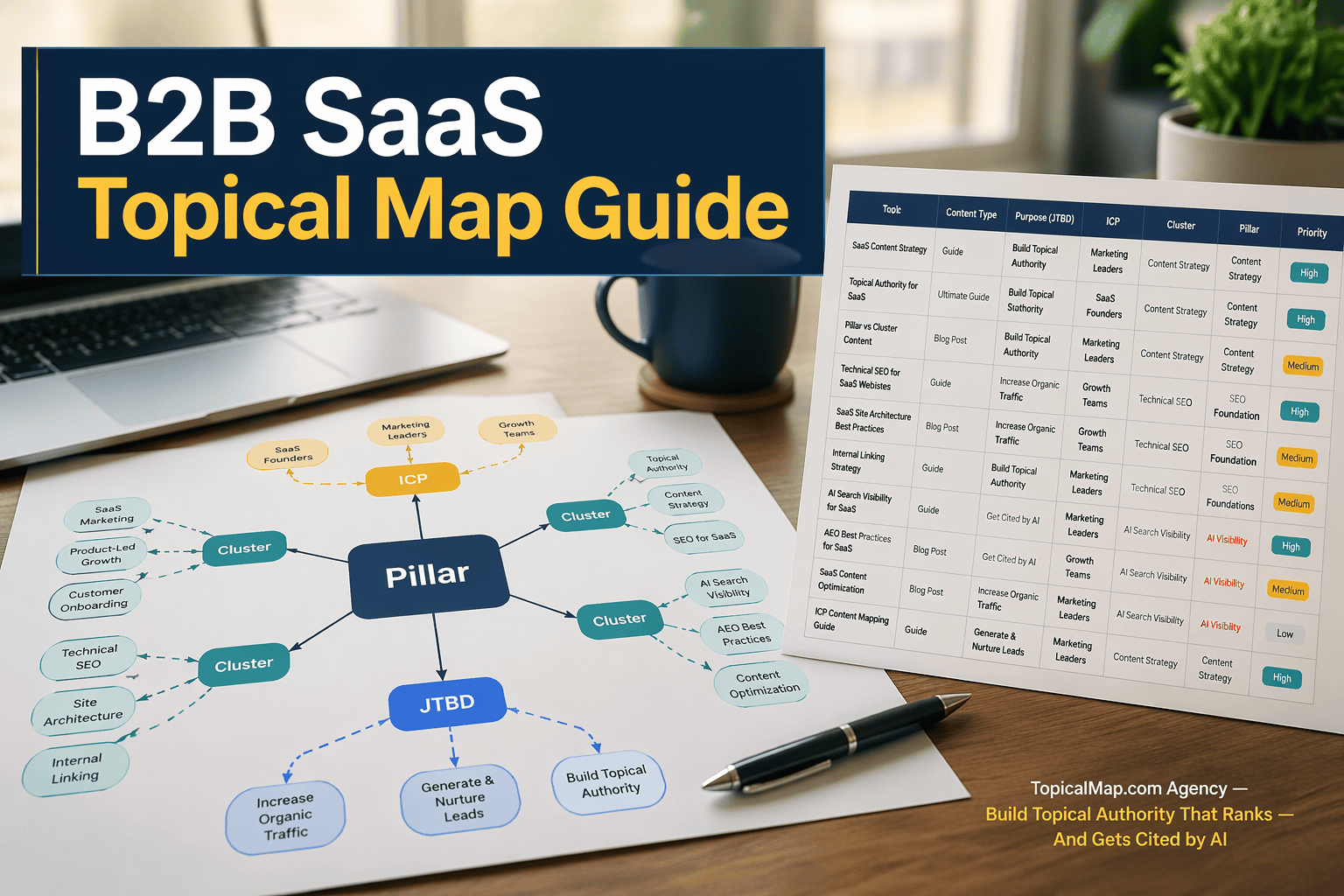
A B2B SaaS topical map guide shows how to turn scattered SEO ideas into a structured content blueprint that supports topical authority. Many content teams have the keywords, but still struggle with pages that compete with each other, miss key buyer questions, or fail to connect with the product story. A topical map solves that by organizing themes, subtopics, and internal links into a clear site plan that can be handed off to writers and strategists.
The article covers how B2B SaaS maps differ from simple keyword lists, how ICP and jobs to be done shape the pillar and cluster structure, and what a usable SaaS architecture includes across product, problem, buyer, and trust content. It also shows how to build the map in spreadsheets and mind maps, how to set internal linking rules, and how to tie pages to metrics like leads and trial-to-paid conversion. Readers also get a practical view of what to publish first, how to avoid cannibalization, and how to keep the structure current after launch.
For Heads of Content, SEO leads, and product marketing teams, the value is a cleaner planning process that supports both search visibility and cross-functional handoffs. A payroll SaaS example in the article shows how one pillar can branch into contractor payouts, compliance, pricing, and implementation pages without blurring intent. That kind of structure makes editorial planning easier, gives product teams a shared language, and keeps the site aligned with revenue goals.
B2B SaaS Topical Map Key Takeaways
- A topical map groups SaaS content by meaning, not isolated keywords.
- Strong maps follow the customer lifecycle from awareness to retention.
- Start with one ICP and one core job to be done.
- Pillar pages anchor broad themes while cluster pages cover specific intent.
- Internal links should move up, across, or down the hierarchy.
- Use spreadsheets and mind maps to track titles, intent, and links.
- Measure success by leads, trials, conversions, and assisted pipeline.
What Is A B2B SaaS Topical Map?
A B2B SAAS topical map is a structured content blueprint that groups your site by meaning, not by isolated search terms. It shows how the subject areas fit together, which helps you cover the full space buyers care about and build topical authority over time.
That’s different from a keyword list. A keyword list collects disconnected phrases, while topical mapping organizes main themes, subtopics, and supporting pages into a hierarchy that users and Search Engine Optimization can follow.
For a Topical map for B2B SAAS, the structure should reflect the full customer lifecycle. The content needs to support:
- Awareness and problem recognition
- Evaluation and vendor comparison
- Activation and first use
- Retention and expansion
- Referral and revenue
SAAS context changes the shape of the map, too. B2B SAAS is cloud-based, subscription-priced, and delivered through the web with ongoing product updates. That is why the strongest themes are usually problem-led, industry-led, product-led, and role-led, not generic category pages alone.
The practical value is straightforward. Your Topical map becomes the operating blueprint for SAAS SEO. It shows which pillar pages act as hubs, which cluster pages support them, and where internal links should connect. That makes it easier to spot gaps, reduce cannibalization, and export a clean plan in spreadsheets or mind maps.
A simple working structure looks like this:
Map layer | Role in the site |
|---|---|
Pillar page | Core hub for a major theme |
Cluster page | Supporting page that goes deeper on one subtopic |
Internal link | Path that connects related pages |
Gap | Missing topic or page buyers still need |
This is the backbone of your B2B SAAS content strategy. The REST of the guide shows how to build the map around your ideal customer profile and jobs to be done, turn it into cluster architecture, and connect it to leads and trial-to-paid conversion.
How Does A B2B SaaS Topical Map Differ?
A B2B SAAS topical map is built to prove depth, not just volume. A flat editorial calendar or loose keyword list spreads effort across disconnected posts. A strong Topical map typically organizes 3 to 5 primary pillars, with each pillar supported by a focused set of cluster pages to build real topical authority rather than isolated hits (source).
Pillar pages sit at the center of that structure. They work like hub pages. Each one covers a broad theme at a high level, acts as an ultimate guide or directory, and points readers into narrower cluster content. Each cluster page then links back with clear, descriptive anchor text. The topical map for enterprise SEO format keeps that structure easy to hand off to writers, SEOs, and product marketers.
The bigger shift is meaning. Generic blog systems sort posts by keyword alone. An entity-aware topical map organizes topics, subtopics, and the relationships between concepts. That helps search engines and large language models (LLMs) interpret the site more accurately, and it improves the odds of showing up in AI-generated answers. That matters for Generative Engine Optimization (GEO), where connected coverage usually beats scattered publishing.
Strong maps also use strict up-and-across internal linking. Sibling cluster pages should connect in a logical sequence so readers can move through related workflows, product questions, or use cases without a dead end. That creates a cleaner journey and gives search systems a stronger signal about how the content fits together.
The most effective pillar themes usually fall into four buckets:
Pillar theme | What it captures |
|---|---|
Problem-focused | Pain points and urgent fixes |
Industry-focused | Sector workflows and constraints |
Solution or product-focused | Use cases, features, and implementation paths |
Role or persona-focused | Needs by function, title, or team |
Problem-led and jobs-to-be-done clusters work especially well when they include industry workflows, role-based pain points, and high-utility assets such as templates or checklists. Those pages are easier to share, capture long-tail demand, and perform better in AI-driven search because they answer a task, not just a topic.
How Do You Build One Around ICP And JTBD?

A strong topical map starts with one ICP, not a broad market segment. You define the buyer role, company size, pain points, objections, and the stage-specific questions that show up before a purchase. That buyer-journey view keeps Topical mapping tied to real search behavior instead of a generic industry taxonomy.
JTBD, or Jobs-to-Be-Done, helps you choose the pillar topic first. The pillar should match the job behind the purchase, not just the product category. For a new or growing SAAS site, start narrow. Own one problem first, then expand into supporting questions, comparisons, alternatives, and nearby intent after the core page has earned trust. That same logic works well for Product-led growth content because the job is usually specific, measurable, and tied to product use.
A practical build order looks like this:
- Define the ICP: Capture the role, company stage, pain points, objections, and the questions asked at awareness, consideration, and decision.
- Set the job: Use JTBD to name the core problem the product solves, then make that problem the pillar theme.
- Build cluster topics: Turn the surrounding questions, comparisons, alternatives, and related tasks into Cluster topics.
- Validate demand: Check each idea with keyword research and entity research in Semrush, Surfer SEO, or Topical Map AI, then use People Also Ask research to spot real subtopics and phrasing.
- Trim the draft: Merge or drop topics that show weak demand, thin relevance, or no clear entity support.
Map element | What to include | Why it matters |
|---|---|---|
Pillar page | Core job, main keyword, primary entity set | Gives the map a center of gravity |
Supporting pages | Related questions, comparisons, alternatives | Covers intent without overlap |
Spreadsheet fields | Title, content type, journey stage, priority | Makes the plan handoff-ready |
Mind map view | Parent topic, branches, gaps, risk areas | Exposes cannibalization and missing coverage |
The hierarchy should move from broad to specific. Supporting pages need to link back to the pillar and to each other where intent overlaps. That structure turns Keyword clustering into site architecture, not just a research exercise.
The topical map building workflow gives you the sequence, while seed keyword discovery helps you validate the inputs before you publish.
From there, prioritize by intent and opportunity. Teams often launch the lowest-difficulty, highest-relevance pages first, then sequence remaining content by buyer stage so awareness, consideration, and decision pages land in a logical order to support the funnel (source). Treat the first version as a living draft, keep one silo focused at a time, and refine the map as you find gaps, seasonality shifts, and new questions from the ICP.
What Should Your SaaS Cluster Architecture Include?
A SAAS cluster architecture works best when every page has a clear job and follows a clear pillar hub branch structure. The pillar page sits at the center of the topic. It defines the commercial and informational boundary, then routes readers to the right supporting pages instead of trying to rank for every query itself.
That structure gets easier to build when you use buyer intent mapping. The same logic applies to Content clusters and Cluster topics. Search behavior is rarely flat, so your content architecture should mirror how buyers move from problem awareness to shortlist, then to purchase and adoption.
A practical SAAS map usually breaks into four macro-buckets:
- Product-led: Feature and module pages, integration ecosystem pages, and technical docs that reflect how the software works in practice
- Problem-led or JTBD: Pages that explain the job to be done, the pain point, and the use cases behind the search
- Buyer-led or evaluation: Comparison pages, alternatives pages, pricing pages, and proof that supports a decision
- Trust, scale, and authority: Security, compliance, glossary, and case-study assets that reduce friction and answer high-stakes questions
Each bucket should be shaped by SERP evidence and semantic grouping. That keeps you from missing adjacent questions or stuffing unrelated ideas into one article. It also helps SEO and product marketing teams handle Pillar pages for SAAS without turning the map into a keyword dump.
The page types matter just as much as the buckets. Awareness pages should define the problem and show common use cases. Consideration pages should compare approaches and selection criteria. Decision pages should support shortlisting with pricing, ROI, and alternatives. Post-purchase pages should help customers adopt the product well, which is where Product-led growth content often does its best work.
The architecture should also include entity pages for the people, processes, and objects that define the category. These pages capture semantic variants and adjacent questions without forcing everything into one generic post. A good ROI calculator for SAAS can sit beside pricing, while integration pages and API or developer docs cover webhooks and REST queries that technical buyers search for. This mix can provide wider coverage across the funnel, stronger topical authority, and fewer blind spots when moving from strategy to production, though results depend on implementation quality (source).
What Does A Real B2B SaaS Topical Map Look Like?
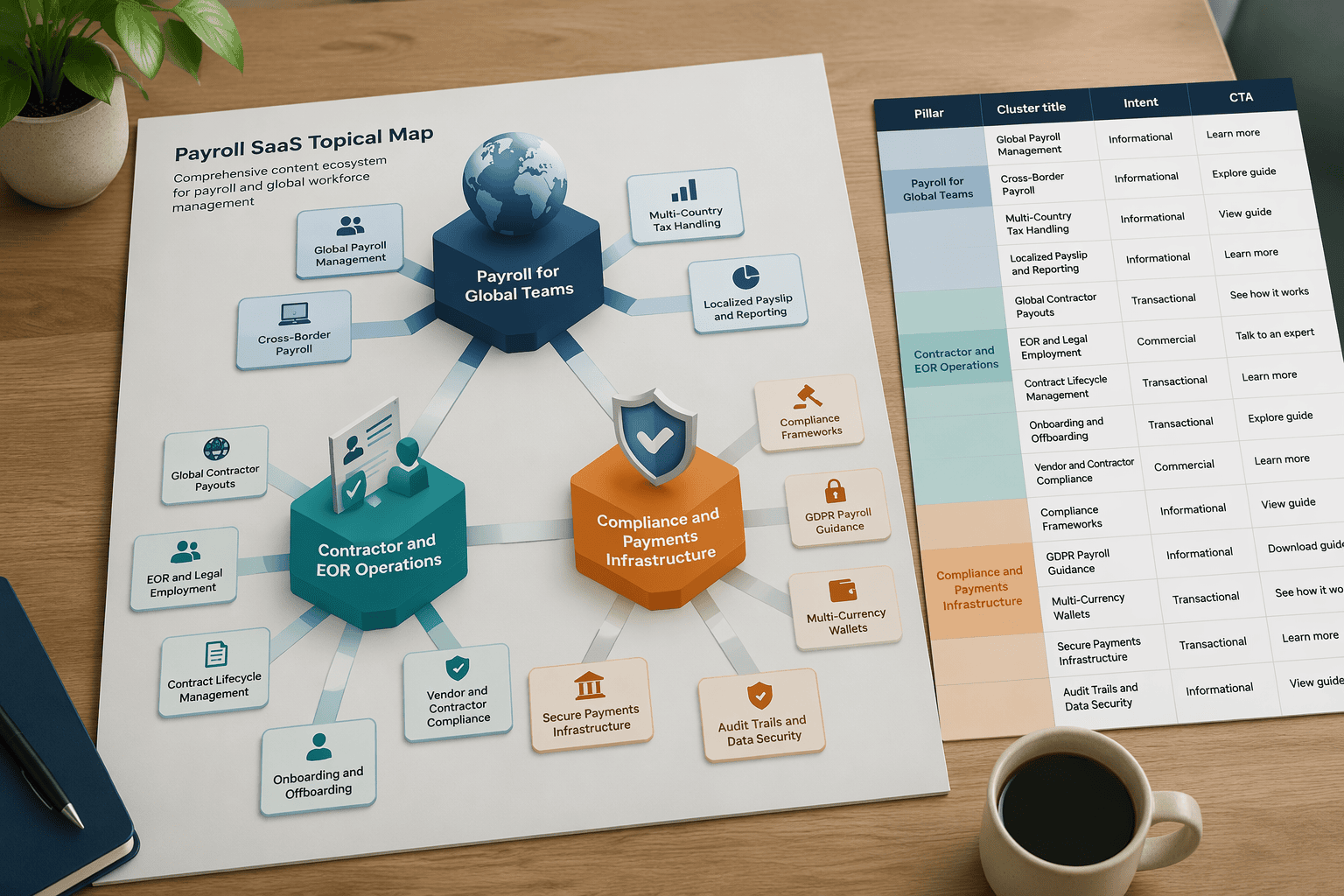
A real Topical map for B2B SAAS starts with one narrow ICP, not a generic keyword bucket. For this example, you’re building an HR payroll SAAS map for fast-growing U.S. companies hiring remote contractors and employees across LatAm and Europe. That creates a clean funnel from awareness through evaluation, demo or trial, activation, retention, and expansion. It also shows why GEO-ready topic maps have to support both search and pipeline.
The map should be built around three directory-style hubs, not three isolated articles. Those hubs are your Pillar pages for SAAS, and each one should link to every child page in its cluster.
- Payroll for Global Teams
- Contractor and EOR Operations
- Compliance and Payments Infrastructure
From there, the cluster layer gives the map depth. A strong Topical map for B2B SAAS often includes 10 to 20 pages that mix education, comparison, and trust content, though the exact number depends on the complexity of the product and market (source). For this ICP, useful cluster titles include:
- Global Contractor Payouts
- Multi-Currency Wallets
- Global EOR Basics
- Remote Onboarding Workflow
- Hiring Developers in LatAm
- Cross-Border Payroll Compliance
- What Is a Form W-8BEN?
- GDPR Payroll Guidance
- Payroll Software vs Deel vs Remote
- Best Global Payroll Software
- Payroll Pricing Guide
- How to Switch Payroll Systems Without Disrupting Pay Runs
The internal-link structure should stay simple enough that a writer, SEO, or PMM can execute it without guesswork. Each pillar links to every cluster page with descriptive anchors. Each cluster links back to its pillar with matching topic language. Related clusters should cross-link when intent overlaps.
- Comparison pages should point to pricing, compliance, and implementation content.
- Compliance articles should point back to the compliance pillar and relevant product pages.
- Workflow pages should point to activation, support, and onboarding resources.
- Problem pages should connect to demo, trial, and product solution pages.
That structure keeps pages from becoming orphan content. It also makes the hierarchy obvious to users and search engines. For a cloud-delivered, subscription-based product, that matters because the site has to feel active and current, not like a static blog.
Cluster title | Intent | Journey stage | Best next link |
|---|---|---|---|
Global Contractor Payouts | Educational | Awareness | Contractor and EOR Operations |
Payroll Pricing Guide | Commercial | Evaluation | Demo, pricing, and comparison pages |
How to Switch Payroll Systems Without Disrupting Pay Runs | Decision | Activation | Implementation and support pages |
Best Global Payroll Software | Commercial | Evaluation | Product, pricing, and comparison pages |
What Is a Form W-8BEN? | Educational | Awareness | Compliance and Payments Infrastructure |
Blogs and webinars usually capture early demand. Demo pages, free trial pages, activation guides, support articles, retention content, and expansion pages keep the map tied to business metrics like leads, trial-to-paid conversion, and customer retention. That’s the difference between topical authority and a pile of loosely related articles.
Copy this blueprint into a spreadsheet or mind map:
- Pillar
- Cluster title
- Intent
- Journey stage
- Primary keyword
- Internal-link targets
- Call to action
- Key performance indicator
AI-assisted drafts are reviewed and edited by a senior strategist before delivery. Results vary by site, industry, and implementation, and past performance does not guarantee future results (source).
How Do You Structure Internal Links And Governance?
Your internal linking strategy should mirror the map’s content architecture. Pillar pages should point to the closest cluster pages, and sibling pages should connect only when the relationship is obvious. Random cross-silo links make the structure harder to read, while a clean setup helps search engines and humans see which page owns which idea.
The simplest rule is to move one level up, across, or down at a time. From a detail page, link up to the parent topic. From one cluster page, link across to a closely related sibling. From a broader page, link down to a specific subtopic. Jumping several levels at once usually adds noise, and it can blur the hierarchy you want search engines to interpret.
Anchor text should sound natural, not mechanical. Descriptive phrases work best because they signal what the destination page covers. Variety matters too, since repeated exact-match anchors can look forced. Vague labels like “read more” or “click here” should stay rare, because they waste context when a better phrase is available.
Before you publish closely related pages, lock the canonical and taxonomy rules in place:
Decision area | What to lock down |
|---|---|
Primary page | One URL owns the main theme |
Taxonomy | Category and subcategory labels stay consistent |
Cannibalization | Adjacent pages do not compete for the same intent |
Platform clusters | Salesforce, Microsoft 365, Azure, Amazon Web Services, and Google Cloud follow the same rule set |
CRM coverage | Related CRM pages map to one clear primary target |
A single tracking sheet keeps the system usable after launch. Put every URL, page intent, target anchor text, internal-link targets, canonical status, taxonomy bucket, and content owner in one Google Sheets source of truth. That sheet becomes the governance layer for audits, handoffs, and future edits.
A light Content maintenance cadence keeps the structure honest. Review new pages for broken paths, duplicate targets, and misplaced categories. Update the tracker whenever content moves, merges, or expands. That way, the Internal linking strategy stays current, defensible, and easy for content teams to operate.
How Do You Measure Pipeline Impact From Topics?
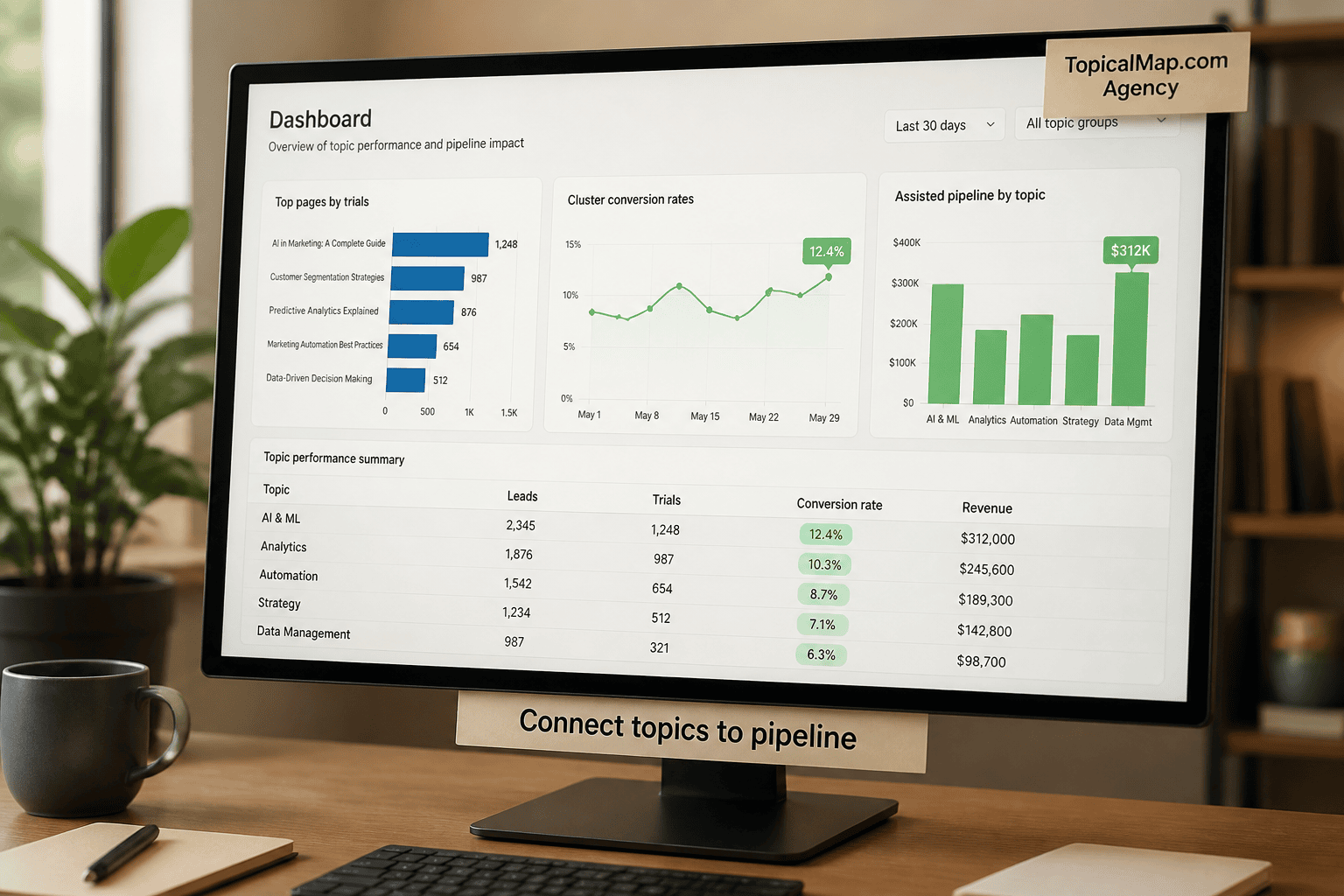
Measurement works when you connect topic pages to pipeline, not just sessions. The cleanest stack has two layers. One layer tracks visibility for SEO. The other tracks revenue outcomes. On the visibility side, watch cluster rankings, topical authority, featured snippets, and organic sessions. On the business side, connect each topic page to sales-qualified leads, demos, trials, influenced revenue, customer acquisition cost payback, and content-to-trial conversion so your SAAS SEO work is judged by pipeline contribution.
A practical way to organize the reporting is by the four macro-buckets in your topical map:
Page type | Primary metrics | What good looks like |
|---|---|---|
Product-led pages | Product-intent clicks, trials, activation rate | More visitors move from interest to real use |
Problem-led or jobs-to-be-done pages | Engaged sessions, demo or consultation requests | Readers raise their hand for help |
Buyer-led or evaluation pages | Comparison-page assists, demo starts, assisted pipeline | Pages support decisions, not just visits |
Trust, scale, and authority pages | Conversion lift, return visits, revenue influence | High-consideration visitors keep coming back |
This structure gives product marketers and SEO teams one shared language. It also keeps Keyword clustering honest, because each cluster gets judged by the action it should drive. If a page type is supposed to generate trials, but it only earns time on page, the gap is obvious.
The dashboard should show page, cluster, and funnel stage in one view, and the exact metrics should depend on the business model (source).
The most useful panels usually include these views:
- Top pages by sales-qualified leads, trials, and demos
- Cluster-level conversion rates by topic group
- Assisted pipeline by topic and page type
- Payback period trends by content cohort
That setup makes it easier to see which clusters shorten the sales cycle and which ones only create shallow engagement. It also surfaces evaluation pages like versus pages, alternatives pages, pricing pages, and best-tool pages, which usually influence demos, trials, and revenue more directly than awareness content. In practice, those pages often deserve their own reporting slice.
Attribution should stay practical. Early-stage content usually deserves first-touch or assisted-conversion reporting. Comparison and pricing pages often fit multi-touch or linear attribution better. High-intent pages can use last-touch plus assisted revenue so the cluster gets credit across the journey instead of only at the final click. A good ROI calculator for SAAS should reflect that reality, because one page rarely closes the loop alone.
Benchmarks matter, but vanity averages do not. Competitor guidance suggests disciplined topical mapping can help reach featured snippets and outrank larger brands, but specific timelines and growth rates vary widely, so teams should set internal benchmarks for traffic growth rather than relying on unverified industry claims (source). Those figures are directional, not promises. Your internal benchmark should focus on lead quality, content-to-trial conversion, activation rate, customer acquisition cost, and sales-cycle acceleration. A Case study SAAS should also be read in context, because the lift usually reflects the full topic system and implementation quality, not one isolated page.
Priority should follow demand and commercial intent, not publishing volume. Validate each cluster with keyword and topic tools before launch, then split dashboard views for product comparisons, alternatives, pricing, and best-tool pages. Surfer SEO can help with page-level optimization, but GEO matters when you want content to show up in AI answer surfaces. The real question is simple: which topics move prospects closer to revenue, and which ones only make the chart look busy.
B2B SaaS Topical Map FAQs
These FAQs cover the questions teams usually ask when shaping a B2B SAAS topical map, from structure and scope to handoff details. They’re a fast read once your People Also Ask research starts surfacing patterns.
Teams often start with 3 to 5 pillar pages and about 8 to 12 Content clusters total to build a coherent map without stretching resources too thin (source). A practical Content maintenance cadence often starts with a monthly check of published, draft, and in-progress pages, followed by a quarterly review of every cluster to catch broken links and cannibalization (source).
1. How Many Clusters Should You Start With?
Start with 3 to 5 pillar pages and about 8 to 12 Content clusters total if you need a coherent map without stretching research, writing, and internal linking too thin. That gives you enough structure to build a coherent map without stretching research, writing, and internal linking too thin. If a cluster is hard to research, write, and connect well, narrow the scope and begin with lower-difficulty topics that can earn early organic traction around problem, industry, solution, and role-based hubs.
2. Which Page Types Belong In A SaaS Map?
A strong SAAS map starts with pillar pages for the core product, the problem, and the solution, because those pages anchor topical authority across the site. From there, you layer in awareness content for problem education, consideration assets like white papers, case studies, and comparison guides, and decision pages such as product demos, service pages, testimonials, free trials, and contact forms. You should also add product-led pages for feature or module breakdowns, integration pages like a [Your Software] + Salesforce integration, ecosystem pages for connected tools, API and developer docs including REST API docs, webhooks, and setup guides, plus glossary pages and lead magnets like checklists, calculators, templates, and downloadable guides.
3. How Often Should You Update The Map?
A practical Content maintenance cadence also includes quarterly reviews of every cluster with SEO demand signals so you can compare rankings, traffic, and topic coverage before gaps spread. Each quarter, review every cluster with SEO demand signals, then run crawl audits and internal-link checks after major site changes to catch broken links, orphan pages, duplicate coverage, and cannibalization. Refresh sooner when intent shifts, new product use cases appear, or CTR, rankings, or conversions slip, and keep the process light by tracking topic status, performance, and update dates in one place.
4. Who Should Own The Topical Map?
Make SEO and content the day-to-day owners, while product marketing checks ICP, jobs-to-be-done, and positioning so the map matches search demand and the category story. Keep a single source of truth in a disciplined Google Sheets tracker that records owners, status, intent, URLs, internal links, and maintenance. Engineering, sales, and product marketing should add template limits, objection language, niche choices, and adjacent artifacts, while a simple SLA keeps updates moving after launches, page changes, and topic gaps.
Sources
- source: https://kasradash.com/seo/seo-frameworks/topical-map-framework/
- source: https://topicalmap.ai/blog/how-to-create-a-topical-map
- source: https://authorityspecialist.com/guides/how-to/how-to-create-a-topical-map-seo
Top SERP Competitors Used
- B2B SaaS Customer Journey Mapping Guide: https://rampiq.agency/blog/b2b-saas-customer-journey-mapping/
- The Complete Guide to Topical Maps for SaaS Companies …: https://topicalmap.ai/blog/auto/topical-map-for-saas-companies-guide-2026
- help me build Topical cluster for a SaaS B2B project: https://www.reddit.com/r/b2bmarketing/comments/1u2w491/help_me_build_topical_cluster_for_a_saas_b2b/
- Best AI Tools for SaaS Keyword Clustering (2026): https://www.therankmasters.com/insights/ai-content/best-ai-tools-saas-keyword-clustering-topic-maps
- The Complete Topical Map Toolkit: A Step-by-Step Guide …: https://yoyao.com/topical-map-toolkit/
Search Queries Used by the Researcher Agents
- topical map pillars clusters per pillar
- how many cluster pages per pillar topical map SEO
- 3 to 5 pillars 15 to 25 clusters topical map authority
- launch lowest difficulty highest relevance pages first buyer stage topical map
- sequence awareness consideration decision content logical order topical map
- prioritize low difficulty pages buyer stage SEO strategy
- wider coverage funnel stronger topical authority fewer blind spots architecture mix
- SaaS cluster architecture wider coverage funnel authority blind spots
- mix gives wider coverage funnel stronger authority blind spots strategy production
- B2B SaaS topical map 10 to 20 pages education comparison trust
- how many pages in B2B SaaS topical map education comparison trust
- 10 to 20 pages B2B SaaS topical map
- topical mapping 20 to 40 percent traffic growth per quarter study
- 150 to 300 percent organic traffic growth 12 to 18 months topical mapping study
- featured snippets outrank larger brands three months topical mapping study
- topical mapping traffic growth benchmarks study academic
- dashboard page cluster funnel stage view payback period trends content cohort
- topical map dashboard panels payback period trends content cohort
- SaaS dashboard payback period trends content cohort benchmark
- start with 3 to 5 pillar pages 8 to 12 Content clusters total
- how many Content clusters total start topical map B2B SaaS
- 3 to 5 pillars 8 to 12 clusters topical map
- Content maintenance cadence monthly check published draft in-progress pages quarterly review cluster
- practical Content maintenance cadence monthly check quarterly review topical map
- monthly check draft in-progress pages quarterly review cluster topical map
- AI-assisted drafts reviewed edited senior strategist before delivery results vary
- past performance does not guarantee future results AI drafts senior strategist
- AI-assisted drafts senior strategist review results vary