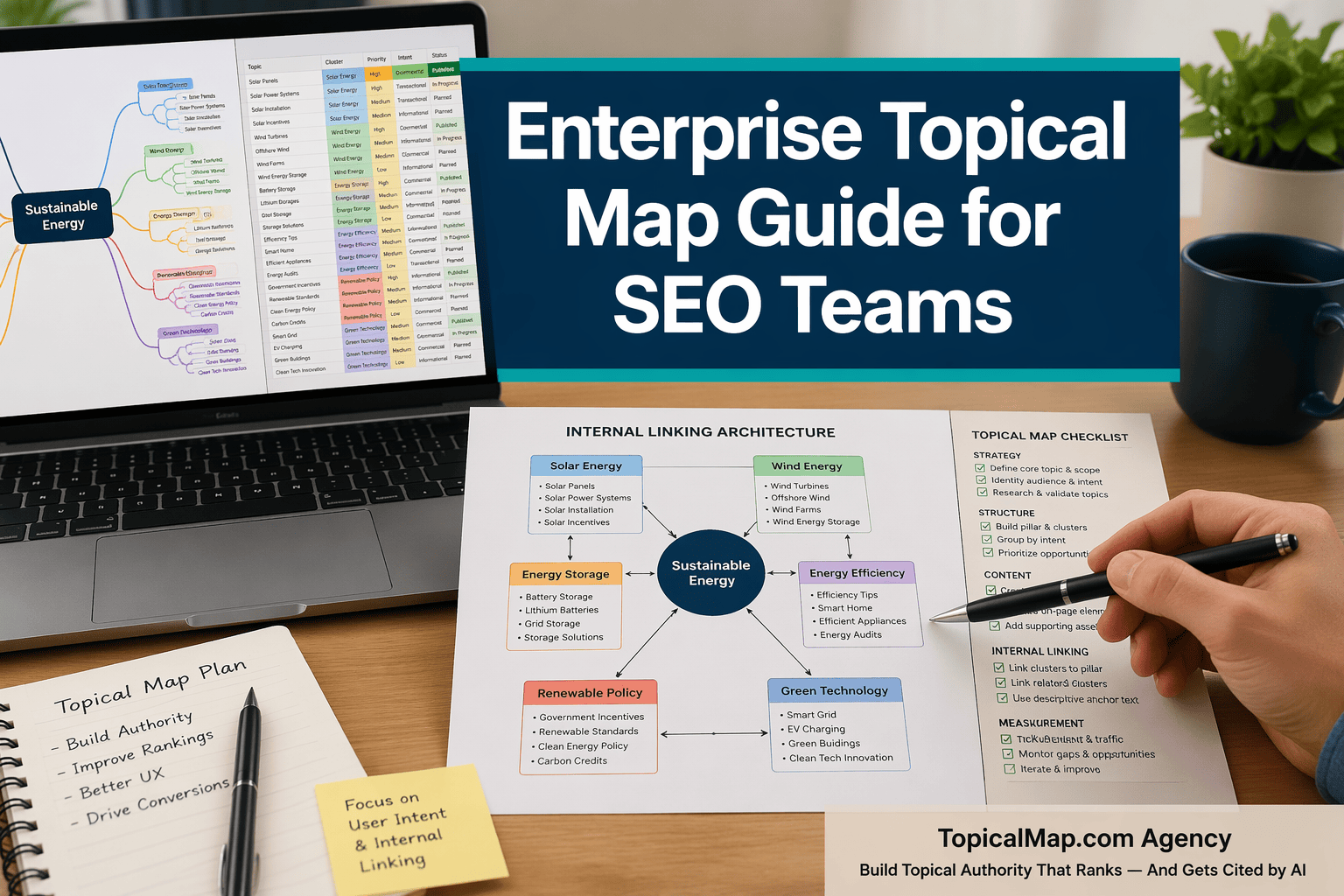
Enterprise topical map planning helps SEO teams turn a large site into a clear system of pillars, clusters, and supporting pages. Senior SEO consultants, agency principals, and product marketing directors usually feel the strain when content keeps growing but the site still looks fragmented, with overlap, weak internal links, and no clean path for editors or engineers. An enterprise topical map is a structured blueprint that groups related entities into a hierarchy your CMS can actually use, so the work comes out as a spreadsheet, a mind map, and a linking plan that teams can execute with confidence.
The sections ahead cover how pillars, Tier 1 hubs, and Tier 2 pages fit together, how to score topics by brand relevance, business potential, and traffic potential, and how to audit live URLs for gaps and cannibalization. It also shows how to align taxonomy, URL patterns, and governance so content, SEO, engineering, and compliance are working from the same rules. Expect practical checkpoints for prioritization, internal linking, and maintenance, plus a simple framework for deciding what to keep, merge, update, or create.
For teams building enterprise content systems, the value is in repeatability and proof, not just better organization. A B2B SaaS site can use the map to separate product features from comparison pages, while an e-commerce team can keep category coverage from colliding with support content. When that structure is right, writers waste less time on guesswork, and the site sends cleaner signals to search engines and AI systems alike.
Enterprise Topical Map Key Takeaways
- Enterprise topical maps organize a macro-topic into pillars, clusters, and supporting pages.
- Entity mapping helps teams group products, services, problems, and questions into coherent themes.
- Pillars and hubs should connect through deliberate, descriptive internal links.
- Topic prioritization works best when relevance, business potential, and traffic potential are scored.
- CMS taxonomy and URL structure should mirror the topical hierarchy.
- URL audits should flag overlap, orphaned pages, and missing intent coverage.
- Governance needs clear owners, review cadences, and rules for merges or retirements.
What Is An Enterprise Topical Map And Why Does It Matter?
An enterprise topical map is a strategic blueprint for a large site. It organizes one macro-topic into pillars, subtopics, and supporting pages, so you plan coverage as a system instead of chasing isolated keywords. For enterprise search engine optimization (SEO), that matters because search engines reward thematic depth, not just repeated phrases. Teams that want a repeatable topical map construction process can lean on it to keep large builds consistent.
A strong topical map starts with entity mapping. You group products, services, problems, industries, and related questions into thematic clusters. That approach strengthens content organization and makes the site easier to interpret at scale.
A well-structured topical map can help teams organize broader and deeper coverage, reduce overlap between related pages, and create clearer internal signals about how a subtopic is covered (source, source).
For enterprise SEO, the map becomes more than a planning exercise. It shapes content hierarchy, URL structure, navigation paths, and internal links that connect broad themes to narrower pages. It also needs to fit your CMS taxonomy, so the work is export-ready in spreadsheet and mind-map form and detailed enough for writers, editors, engineering, and compliance to follow with human sign-off.
A well-built enterprise topical map gives you a repeatable way to grow without losing control. It makes your site easier to extend, easier to trust, and easier for both search engines and large language models to treat as a reliable source.
How Do Pillars, Clusters, Entities, And Internal Links Work?
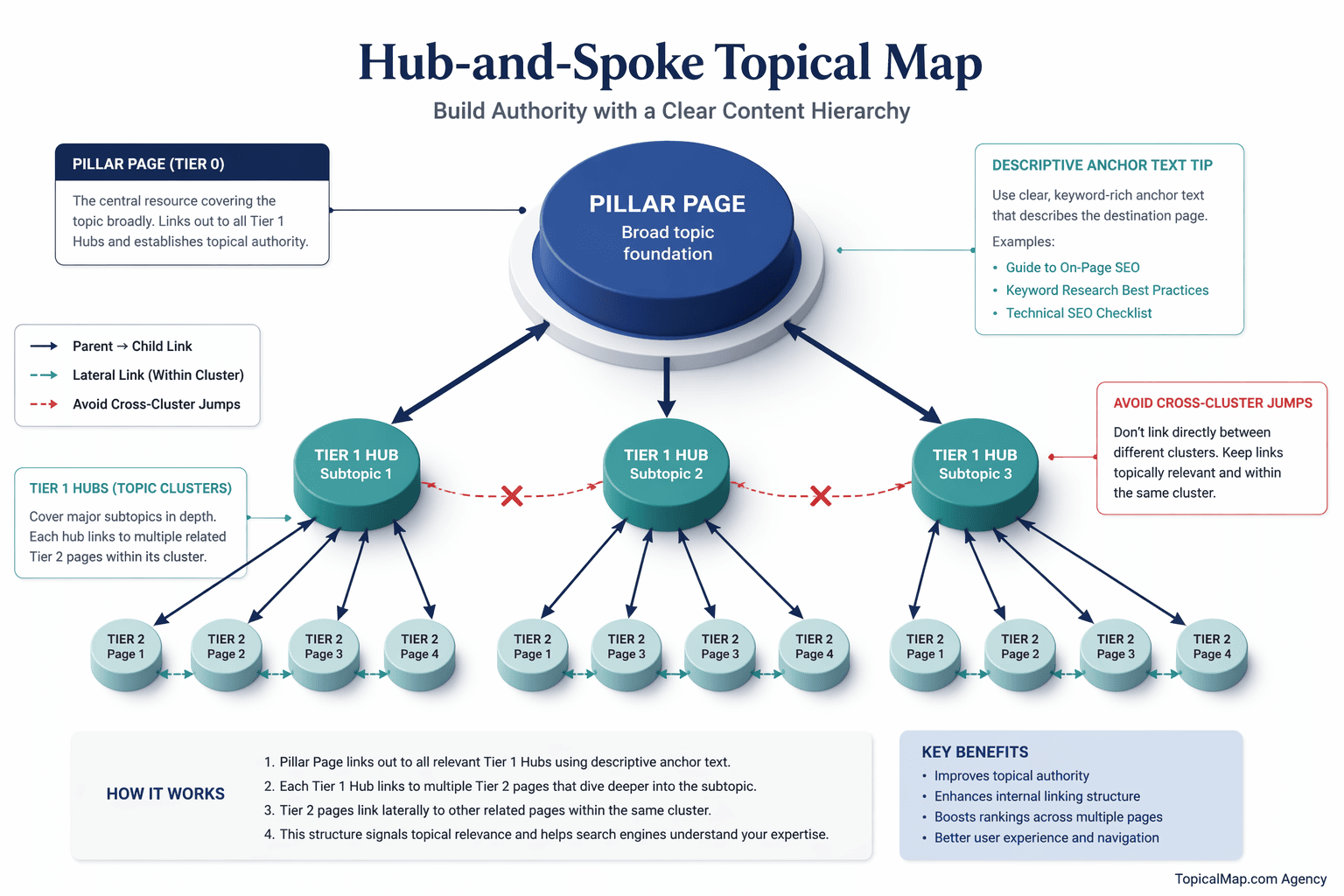
The cleanest way to think about this is a layered system, not a pile of pages. Your core pillars usually sit on [pillar pages], which cover the main business category or entity. Tier 1 child hubs split that subject into major parts. Tier 2 pages go deeper into subtopics, long-tail questions, how-tos, and closely related sub-entities. Getting this layering right comes down to structuring topic hierarchy before you scale.
The [hub-and-spoke model] works best when it is obvious in the [internal linking structure]. A pillar or child hub should link out to its supporting pages, and each Tier 2 page should link back to its parent hub. A clear pillar-and-cluster structure can help search engines and users understand which pages belong together. Strong internal linking can also reinforce the central hub page and the related pages around it (source, source).
Tier | Role | Link behavior |
|---|---|---|
Tier 0 | Business or category pillar | The home page and major navigation feed authority into it |
Tier 1 | Child hub | Sends readers into narrower topic clusters and gets links back from them |
Tier 2 | Support page | Covers specific questions and links upward to the hub |
Entity coverage matters as much as keyword coverage. Your content clusters should use related terms, modifiers, and real-world entities that fit the topic family. That is how topic clusters stay aligned without creating duplicate intent or thin overlap. A strong cluster feels like one subject examined from several useful angles.
Linking rules should stay tight. Tier 2 pages should use descriptive anchor text when linking one level up. Closely related Tier 2 pages can link laterally, but only when the connection helps the reader or improves crawl discovery. Avoid cross-cluster jumps unless there is a strong semantic reason, and do not skip levels in the hierarchy.
The map itself should make the flow obvious. The home page distributes authority to the core pillars, the pillars funnel users into child hubs, and the full structure helps search engines read both breadth and depth across the site. That is how topical maps stay legible, efficient, and useful at scale.
How Do You Build An Enterprise Topical Map?
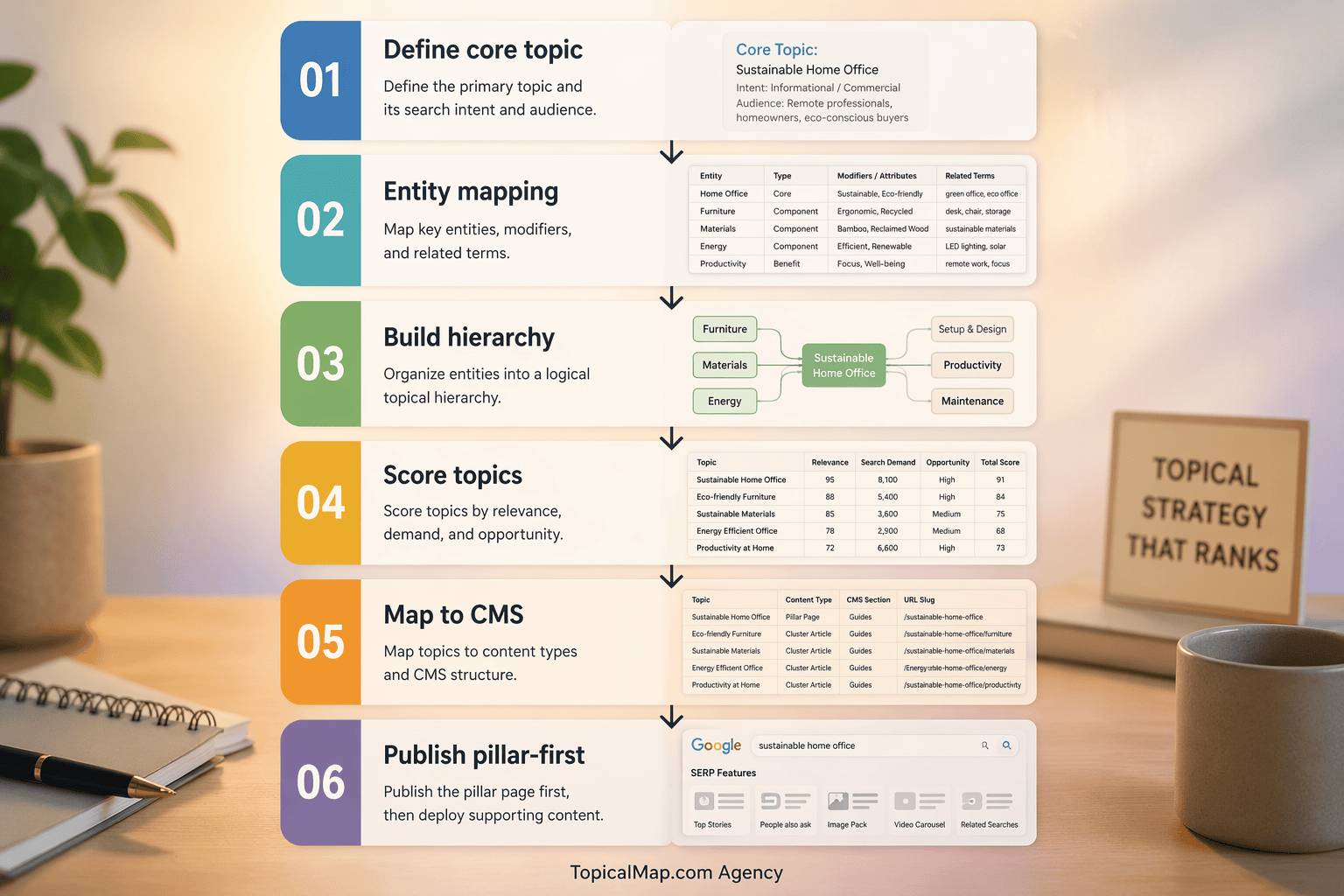
A strong enterprise map starts with meaning, not volume. You begin by defining the core topic, then use competitor pages, Google's Knowledge Graph, SERP features, and your own site data to shape entity mapping, user intent, and the keyword variations people actually use. That first pass gives you a cleaner read on the subject before you split it into subtopics.
The next step is to turn those entities into a hierarchy you can actually use. Broad pillars sit above narrower topic clusters, and each cluster needs a clear role in the journey. This is where clustering topics at scale pays off across a large site. Some content clusters support research, while others support comparison or conversion. That separation keeps adjacent pages from fighting over the same demand.
A practical scoring model helps you decide what to publish first. A practical topical map workflow is to sort topics into priority bands so the highest-value pillars are planned first and lower-value support work follows after the core structure is set (source, source).
Use this scoring frame:
- Brand relevance: How closely the topic matches your positioning and expertise.
- Business potential: How likely the topic is to support pipeline, revenue, or qualified demand.
- Traffic potential: How much useful search demand and reach the topic can capture.
Topics that score well on at least two dimensions deserve first attention. That keeps the plan tied to business value instead of vanity coverage.
From there, translate the map into CMS taxonomy and site architecture. Each pillar, cluster, and URL pattern should map to the right content type, folder, tag, or section so editorial, SEO, and engineering teams can execute at scale. Build the internal linking structure at the same time, then roll out silo by silo so the site sends one clear authority signal instead of scattering coverage across unrelated pages.
A pillar-first sequence usually works best:
- Publish the pillar page first.
- Ship the most important supporting article next.
- Add cross-links where they improve discovery.
- Expand into neighboring cluster pages once the core silo is live.
Treat the topical map as a living planning document. Refresh it when seasonality shifts, new entities appear, or performance data exposes gaps. Static maps age fast, but your SEO goals keep moving.
How Do You Audit Existing URLs And Find Content Gaps?
A solid URL audit starts with a full inventory of what already exists. Put every live page into one spreadsheet or mind map, then map each URL to its target topic, cluster, and user intent so you can see the real coverage pattern before adding anything new. That structure makes serp intent mapping for topical authority easier to apply at scale.
From there, compare each cluster against the full intent mix. You want informational queries, commercial queries, transactional pages, and navigational pages represented in the right balance. A cluster can look busy and still miss key demand when a few strong pages crowd out weaker but necessary angles.
Overlap is the fastest way to find waste. Look for URLs that target the same primary intent, close keyword variations, or the same entities. Mark each conflict for merge, retargeting, or de-optimization. That cleanup can improve site organization and may reduce overlap between pages that target similar intent (source, source).
Score coverage at the cluster level, not just the page level. Use AI-assisted checks to flag gaps, but keep the final judgment human-led so partial coverage does not get treated as complete.
- Keep: the page is aligned, current, and needed as-is
- Update: the page needs new subtopics, entities, or a clearer intent match
- Merge: two or more URLs are serving the same role
- Retire: the page should redirect because it no longer earns its place
- Create: there is a true gap with no live URL to cover it
Tie each action to your CMS taxonomy. Keep existing and planned slugs in the same template. Prioritize gaps that improve topical authority and crawl efficiency together, especially in important clusters with weak intent fit or internal overlap.
How Do You Govern An Enterprise Topical Map?
Enterprise governance works best when every page type has a named owner and a clear job. In practice, you give each pillar, cluster, and micro-topic a business owner, a content owner, and a reviewer. One team also needs accountability for duplicate coverage and content cannibalization, because that is where enterprise content strategy usually slips.
Your topical architecture should match the CMS taxonomy and URL structure. A clean pattern like /core-topic/sub-topic/micro-topic keeps navigation, categories, templates, and page hierarchy aligned. When titles, slugs, and anchor text follow the same naming rules across teams and regions, internal linking stays consistent and easier to govern.
A living SEO governance cadence keeps the map from going stale. Use fixed review intervals, then update for new launches, market shifts, seasonality, and topics that overlap or no longer deserve a place in the plan. Merge or retire pages when coverage starts to blur.
The operating rules should be simple and repeatable:
- Topic intake: Validate which ideas belong in the map before production starts.
- Entity selection: Score each entity by business value and intent fit.
- Coverage thresholds: Define when a topic is complete enough to support the next layer.
- Internal linking: Point pillar pages to clusters, and let cluster pages reinforce the hub.
- Map maintenance: Merge, retire, or redirect content that overlaps or has gone stale.
A strong enterprise content-gap workflow starts with a full URL inventory. From there, map each page to an intent and an entity, flag orphaned or competing pages, and rank new work in spreadsheet-based scoring bands. That gives teams one governed system for existing pages and future builds, which can help keep content organized instead of scattered across disconnected page sets (source, source).
How Do You Measure Topical Authority, Crawl Health, And Business Impact?
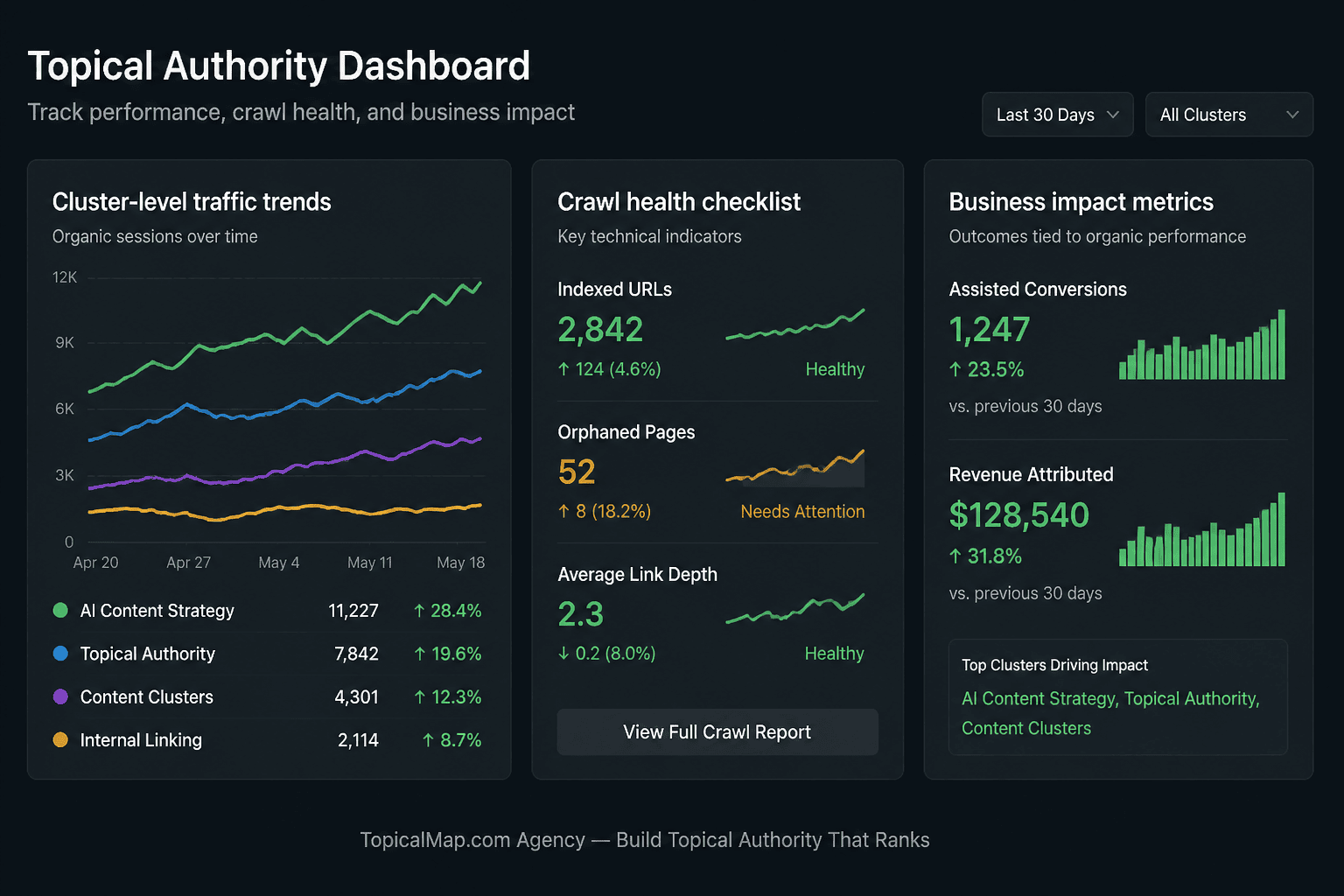
Measure topical authority at the cluster level, not just on single pages. A silo can look thin in isolation and still build real strength across dozens of target queries, especially when long-tail visibility keeps rising. Google Analytics 4 content groups let you segment traffic by silo and compare trend lines over time.
A simple score keeps prioritization honest:
- Brand relevance: the topic fits your offer and search identity.
- Business potential: the topic supports demos, trials, qualified leads, or revenue.
- Traffic potential: the topic has enough demand to matter.
Clusters that score well on at least two filters usually deserve priority. Tie each one to the conversion path that matters most, and judge SEO by contribution instead of traffic alone.
Crawl health tells you whether search engines can make sense of the map. Recheck these signals regularly, especially after major content or taxonomy changes:
- Index coverage: priority URLs are indexed as expected.
- Orphaned pages: important pages are not left without internal links.
- Internal link depth: key assets sit close to the cluster core.
- Discoverability: priority pages can be reached through the topical structure.
Business impact needs trend lines, not screenshots. Use before-and-after comparisons for cluster traffic, assisted conversions, and revenue paths. Check whether new or reorganized pages support high-converting areas like product features, integrations, and vendor comparisons. Review performance monthly for reporting and quarterly for strategic resets. Compare each cluster against a baseline period and watch for less content cannibalization as overlapping intents separate more cleanly.
Directional benchmarks can add context, but teams should validate results against their own baseline because outcomes vary by site, topic, and implementation (source, source).
Enterprise Topical Map FAQs
These FAQs address the questions enterprise teams usually raise before they commit to an enterprise topical map. They focus on scope, governance, and how the work fits into SEO, content, and cross-functional execution.
1. How Large Should An Enterprise Topical Map Be?
An enterprise topical map should match your business scope, not an arbitrary page count. A focused program often fits 30 to 50 entities, while broader coverage can reach 50 to 150 across the main topics and subtopics. Each pillar should stay tightly bounded and expand into intent-led pages for features, pricing, comparisons, and use cases, as these b2b saas topical maps show. Once the map grows into dozens of entities, stricter naming, overlap, linking, and CMS rules help you avoid cannibalization and duplicate coverage.
2. What Tools Help Build Enterprise Topical Maps?
Ahrefs is the best first stop for keyword discovery and topic grouping, especially when you need finding keywords for topic clusters, while Semrush is a solid choice for competitor gap analysis. From there, use AI tools for topical mapping like ChatGPT, SEO Minion, and Keywords Everywhere to mine SERP language, then crawl with Screaming Frog or Sitebulb, build the structure in Miro, MyMap, or XMind, and check entities with Wikipedia and Google’s Natural Language API. Visual tools for SEO and platforms like TopicalMap.AI can speed the work, but human judgment still has to turn the raw inputs into a usable enterprise plan.
3. How Do You Prioritize Topics By Revenue?
Score each topic on brand relevance, business potential, and traffic potential, then rank the ones that best support revenue first. In an Ahrefs-style model, give business potential the highest weight, followed by brand relevance and then traffic, and put the formula in your SEO topical map sheet so each subtopic gets a repeatable score. From there, turn the score into execution bands with band 5 at the top, map the highest-priority topics to the conversion path they should support, and apply the same rules to both new and existing content as business goals and search demand change.
4. Can One Map Work Across Multiple Regions?
Yes, one topical map can work across multiple regions when you keep the core topic model centralized and localize only what changes by market, such as language, currency, regulation, or regional intent. Shared global hubs fit evergreen “what is” and “how to” pages, while region-specific nodes handle local proof, services, compliance, and demand patterns that vary by country. A clean CMS taxonomy like /global/core-topic/, /us/core-topic/, or /uk/core-topic/ makes the hierarchy clear and helps you avoid cannibalization when the intent is the same.