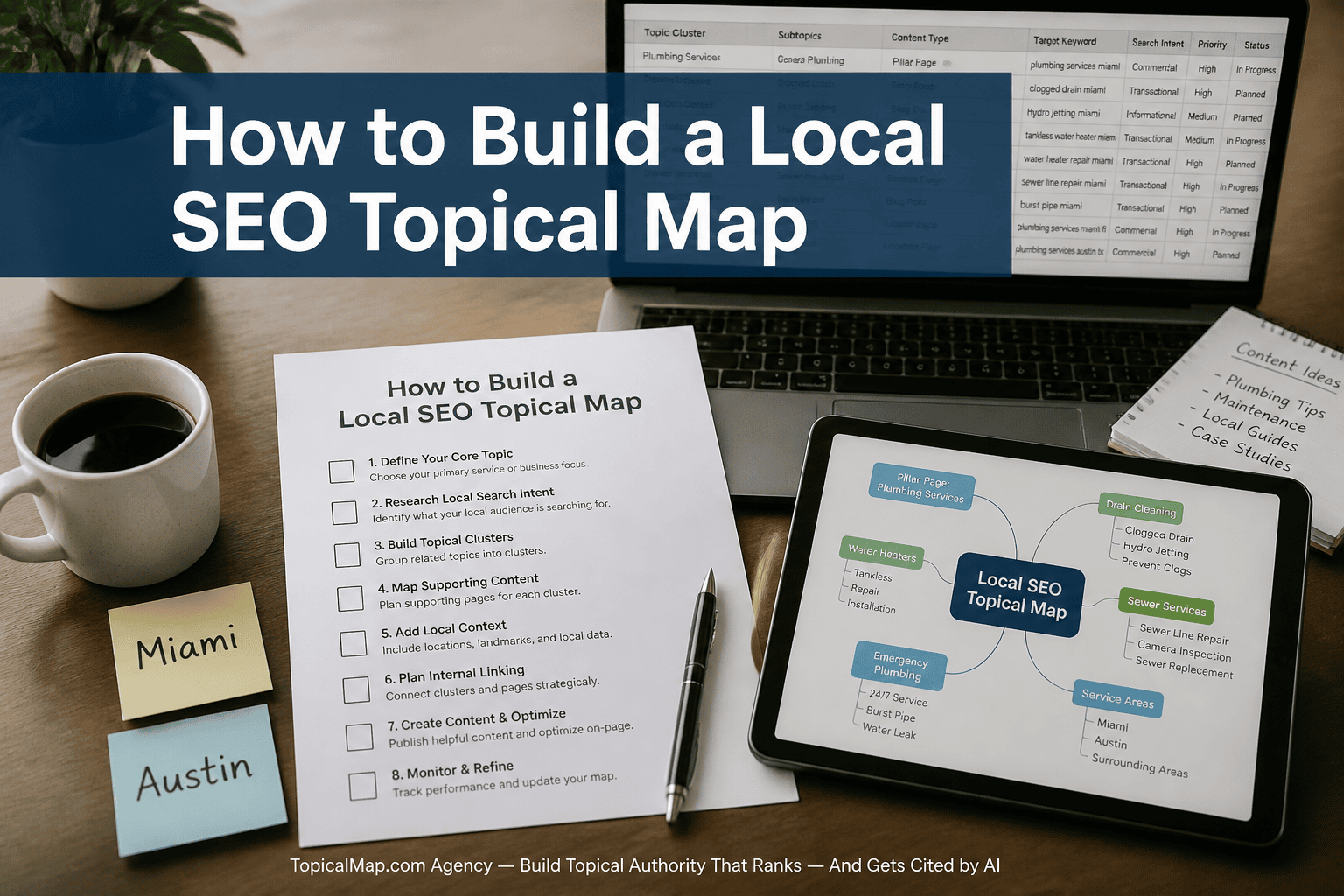
Local SEO topical maps turn service pages, location pages, and supporting content into a structured plan for search visibility. For local teams, the usual tension is clear coverage versus messy overlap, where duplicate pages compete for the same queries and weaken results. A topical map is a content roadmap that connects what you sell with where you sell it, so the site can earn clearer local relevance and fewer cannibalization issues.
This article covers how to prioritize service and location pages, map local entities, build internal links across silos, and audit an existing site before launch. Expect a practical spreadsheet framework, a simple scoring approach for page priority, and a clean way to assign one intent to each URL. The goal is a handoff-ready plan that writers, editors, and SEO teams can actually use.
Local business owners, in-house marketing managers, and SEO consultants will get the most value from the structure because it reduces guesswork and makes reporting easier. A service like tree removal in Miami, for example, can move from a vague keyword list to a clear set of city, neighborhood, and support pages with linked priorities. That kind of setup helps the right page rank, makes implementation cleaner, and keeps the content plan defensible.
Local SEO Topical Map Key Takeaways
- Build one hierarchy for services, locations, and supporting articles.
- Start with a seed matrix of services and target areas.
- Score pages by relevance, value, volume, competition, and intent.
- Map local entities with landmarks, ZIP codes, and trust signals.
- Link homepage, hubs, child pages, and supporting content deliberately.
- Track one primary intent per URL to prevent cannibalization.
- Audit live URLs in a spreadsheet before adding new content.
What Is A Topical Map For Local SEO?
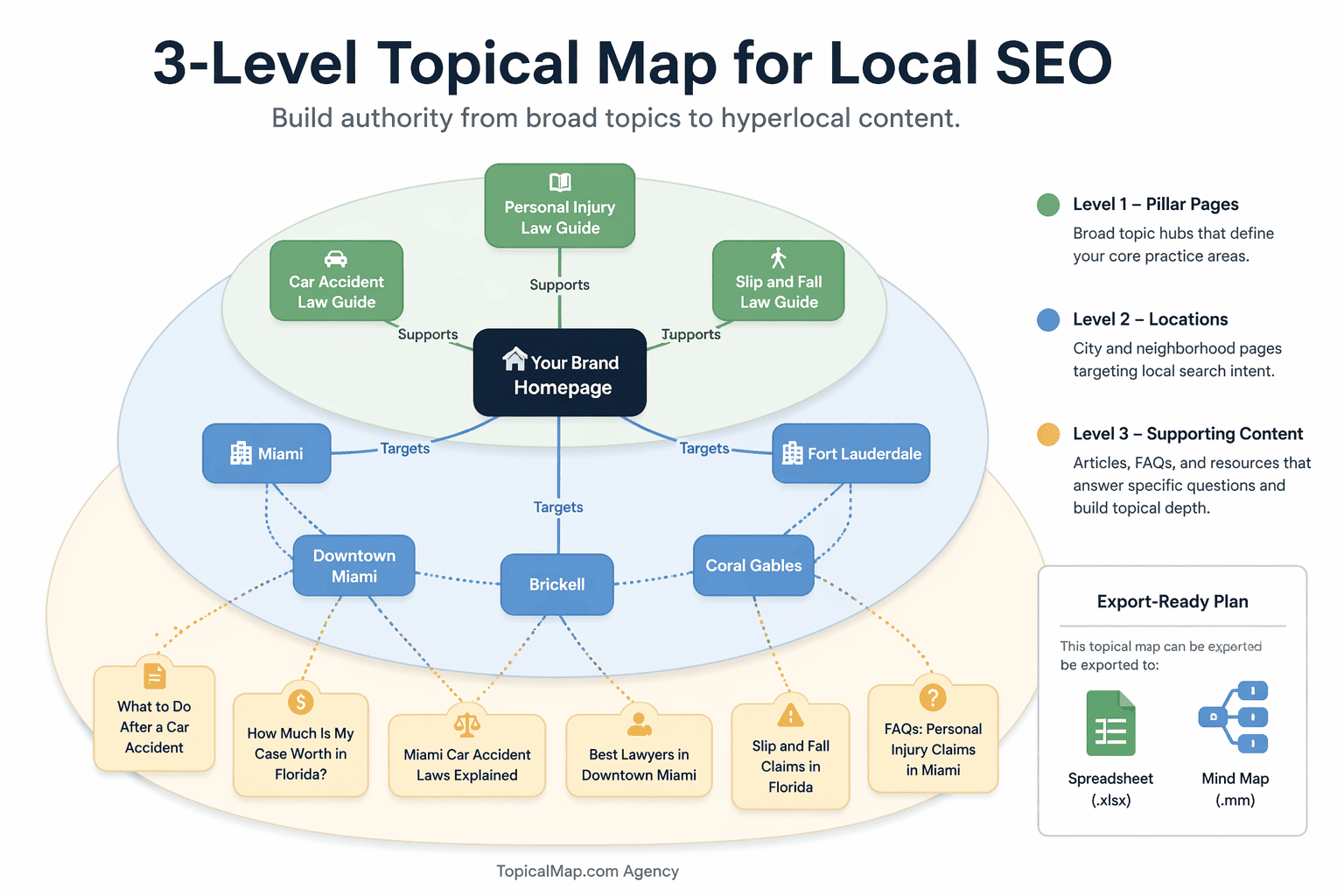
A Topical map for local SEO is a structured content roadmap that organizes your service pages, location pages, and supporting articles into a clear hierarchy. A Local topical map connects the “what” of your offer with the “where” of your city, neighborhood, or service area, so search engines can match pages to local intent with more confidence. That is the core of a practical Local SEO strategy, and it gives your site a cleaner path to Topical authority than a random pile of posts.
The structure usually has three levels:
- Top layer: Pillar pages for your brand and main services
- Middle layer: Geographic silos for cities, neighborhoods, or service areas
- Bottom layer: Supporting Content clusters that answer related questions, use cases, and local concerns
As the site gets deeper, each page should get narrower. Broad topics belong near the homepage. Subtopics sit one step down. Keyword-level detail sits below that, which is why the work to build a complete topical map feels organized instead of flat.
In practice, an export-ready plan is usually built in a spreadsheet and a mind map. A Topical mapping template makes the hierarchy easier to visualize, hand off to writers, and translate into URL structure and internal links. The payoff is simple: users find the right page faster, search engines crawl and index the site more clearly, and you reduce cannibalization from competing pages.
How Do You Prioritize Service And Location Pages?
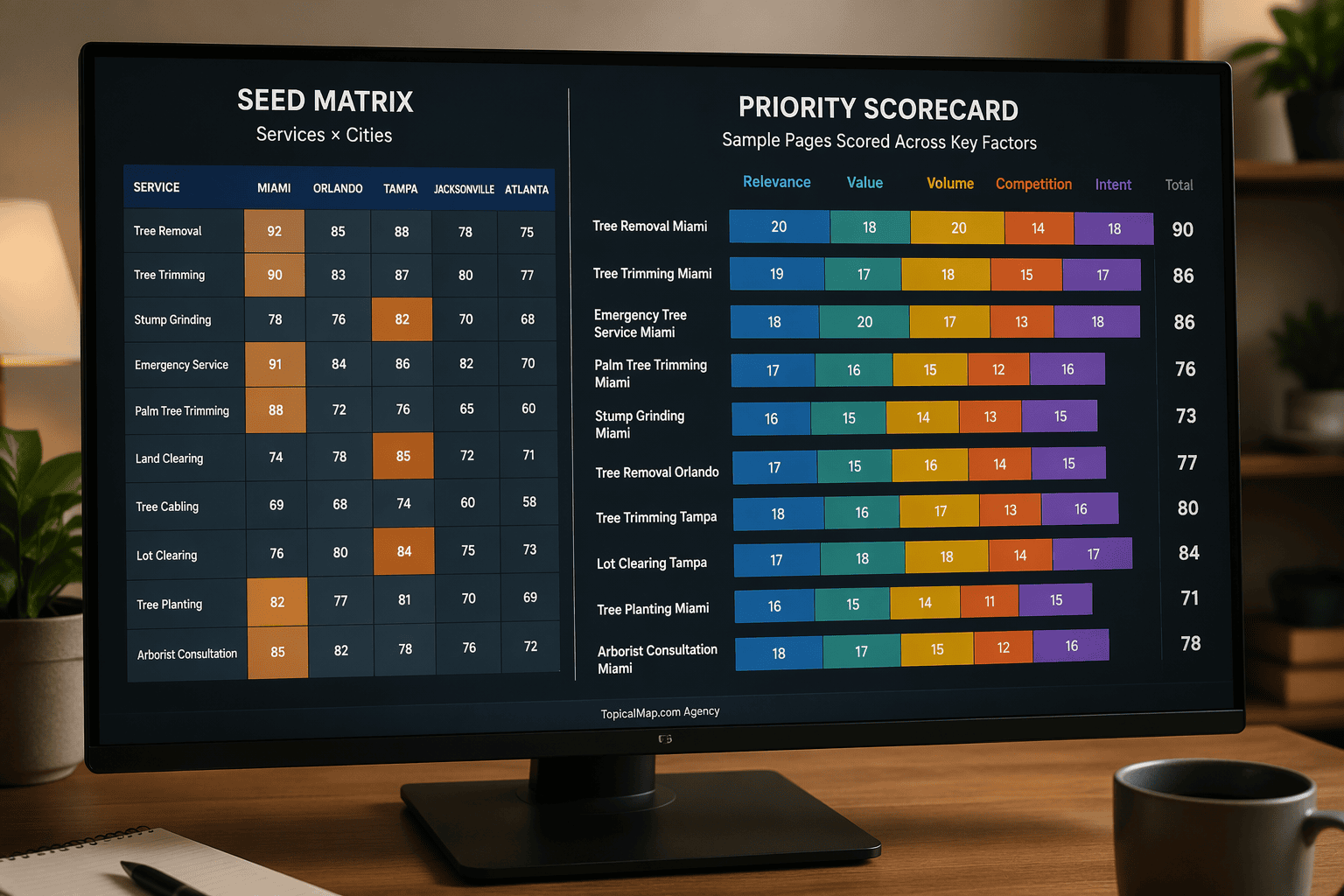
Start with a seed matrix that pairs each core service with each target city or neighborhood. That gives you every permutation before you score demand. Running local keyword research turns that raw list into a workable Local SEO strategy.
Use a simple scorecard that weighs brand relevance, business value, local search volume, competition, and proximity to the customer. Pages that perform well on at least two of those dimensions usually deserve a higher place in the plan. Search intent should stay in the filter, too, because pages closest to purchase intent usually convert better than educational posts.
A clean priority stack looks like this:
- Main service pages: Highest-value offers with the strongest revenue potential
- Service-specific location pages: Best fit when a service and city both matter
- Location pages: Broad coverage for cities, suburbs, and service areas
- Informational blog topics: Lower priority unless they support conversion or internal links
Long-tail phrases can beat broader terms when they show buying intent. “Cheap tree removal in Coral Gables” can outperform a wider query if it matches local demand, and Tree Removal Miami may still deserve a page if the market is large enough.
Competitor review tightens the map. Semrush and Link Clump help you spot missing sublocations, service variants, and repeated page patterns. From there, sequence by revenue potential first, then expand only when the market justifies the next layer.
How Do You Map Local Entities For Each Page?
A strong local page starts with one clear service and one clear place. Each page should speak to a single intent, such as plumbing in Austin or roof repair near downtown Denver, then reinforce the match with the city, nearby neighborhoods, and recognizable landmarks. Location pages work best when they answer both the “what” and the “where” without sounding stuffed.
The best pages build a small semantic cluster instead of a raw keyword dump. Semantic SEO and Geo-targeting get stronger when the copy naturally connects the business type, service variants, neighborhood names, ZIP codes, nearby cities, and questions about access or travel radius. Service-specific location pages should also carry trust signals where readers expect them, and that supports E-E-A-T in a way search engines can read.
A practical local entity map usually includes these pieces:
- Place signals: neighborhoods, landmarks, ZIP codes, nearby towns, and phrases like “near Union Square” or “within 5 miles”
- Trust signals: consistent name, address, and phone details, location-specific testimonials, and references to legitimate local resources
- Decision signals: FAQs about parking, weather, service radius, and whether nearby suburbs are covered
- Technical signals: schema markup, mobile-friendly design, and clear buttons for calls or directions
That mix gives you a page that feels local, reads naturally, and supports both ranking and conversion.
How Do You Build Internal Links Across Local Silos?
A strong local internal linking structure starts broad and gets specific. Your homepage should point to Pillar pages that represent each core service line, then those pages should connect to sub-service pages and location pages so search engines can read the path from broad intent to local intent. That hierarchy supports Semantic SEO and keeps each page from feeling like a lone asset.
The main rule is simple. Every sub-service page, location page, and piece of Supporting blog content should link back to its main commercial hub. That upward flow concentrates authority on the money page, improves crawlability, and keeps the structure easier to manage as the site grows. It also reinforces topical authority because the page relationships stay obvious.
Use cross-silo links with restraint. An Austin hail damage article should link to the matching service page, such as /roof-repair-austin, but only when the match is real. Frequent jumps across unrelated Content clusters weaken focus and blur meaning.
A practical plan looks like this:
- Parent-child links: Homepage to hub, hub to child pages, and child pages back to hub
- Relevant cross-links: Only between closely related services, locations, or events
- Trust signals: Reviews, case studies, and reputation pages into the right service or location page
- Horizontal links: Limited to nearby topics inside the same silo
This kind of Internal linking mirrors your topical map and keeps your local site tight, credible, and easier to rank.
How Do You Audit And Launch Your Local Map?
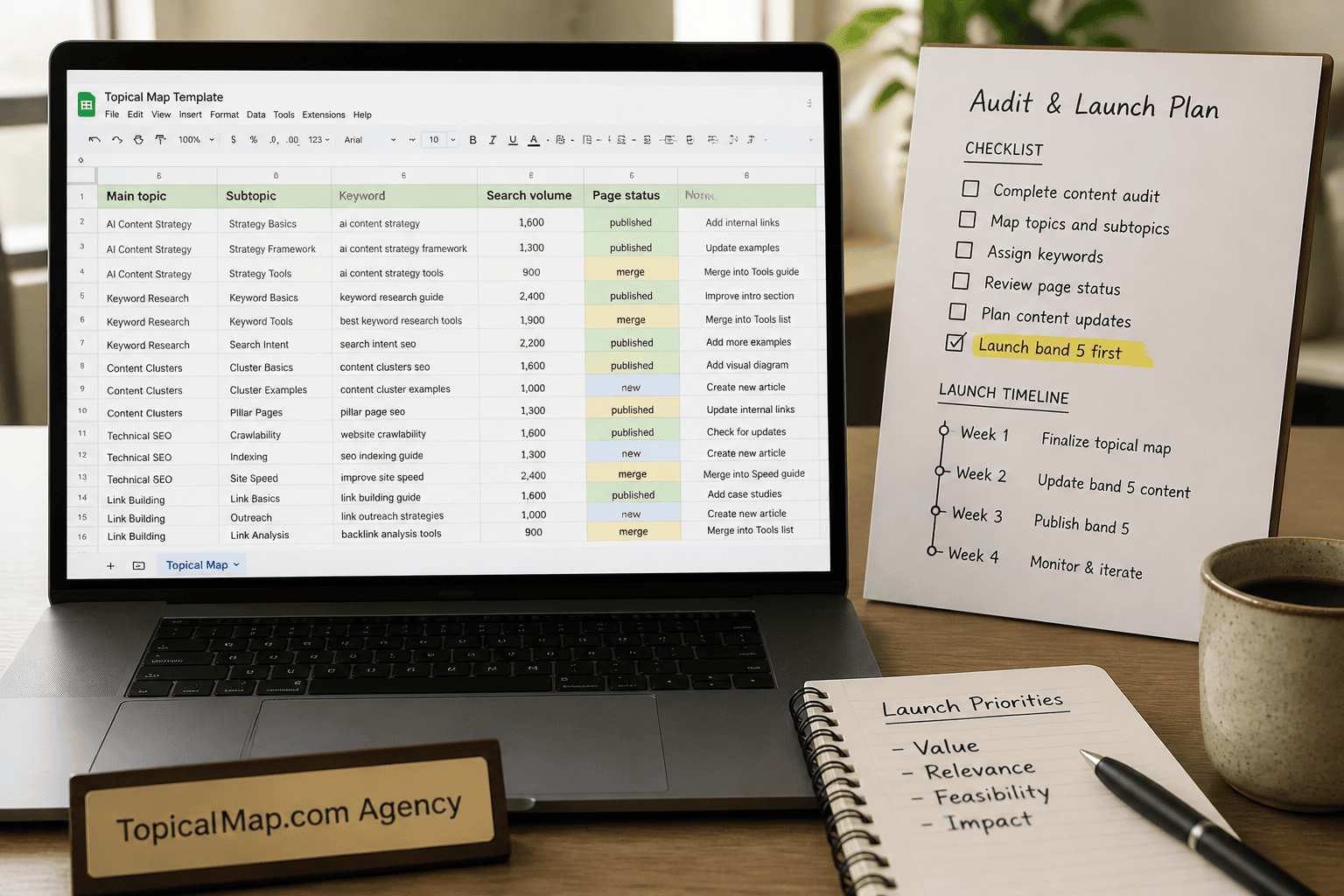
Start with a fresh topical map before you touch the old site structure. A Spreadsheet topical map template should work as your live inventory, not a static planning doc. Put every live URL in one file, assign each page one target topic, and make the gaps, overlap, and cannibalization visible before legacy content starts steering the strategy.
A Topical map for local SEO also works best with clear parent-child relationships and a few non-negotiable fields. Build it as a Topical mapping template with these columns:
- Main topic
- Subtopic
- Keyword
- Search volume
- Page status
- Notes
Mark published URLs directly in the file so new-build, update, and merge decisions stay in one export-ready view. That makes Content gap analysis much easier because you can see what exists, what is thin, and what still needs coverage.
The consolidation rule should stay strict. Keep one page per primary intent. Merge thin or duplicate pages into the strongest URL. Reserve new content for gaps that support the business model, not every related phrase that shows up in research. That is how a Local topical map stays focused instead of bloated.
Prioritize the launch queue with a simple scoring matrix. Rank service pages, city pages, and neighborhood pages by revenue potential, local demand, difficulty, and proximity. Then convert those scores into bands in Google Sheets or Excel, with band 5 as the highest launch priority.
A practical launch order can look like this:
Priority band | Typical page type | Action |
|---|---|---|
5 | Core service and high-value city pages | Launch first |
4 | Strong neighborhood pages | Launch next |
3 | Supporting blog clusters | Build after core pages |
2 | Lower-demand expansions | Hold or refine |
1 | Weak-fit ideas | Drop for now |
For each location page, map the local entity layer before launch. Include landmarks, neighborhood names, service-area phrases, local citations, chamber-of-commerce references, and community signals. That is basic Geo-targeting, and it keeps the page from feeling like a recycled city-name swap.
Launch with Internal linking that connects the homepage, service pages, location pages, blog topic clusters, and trust pages. Add legitimate local external references where they fit. Grounding the rollout in mapping local search intent keeps each page aligned to what nearby users actually want, and the rollout logic stays consistent across markets.
Set internal targets based on your current baseline, then measure impact over time.
- Indexation
- Ranking movement for priority terms
- Organic visits to target pages
- Conversions or leads from service and location pages
Use those results against your baseline before you expand the map or revise the launch.
Topical Map For Local SEO FAQs
These FAQs cover the practical questions that come up when you build a topical map for local SEO, from service and location clusters to what to publish first. They give you a clear starting point before research becomes an internal linking plan and content roadmap.
1. How Many Local Pages Do You Need?
A practical rule is to start with one page for each major service, then add location pages only where there’s real demand, coverage, or lead potential. For a service like Tree Removal Miami, that usually means core service pages first, then city, district, or neighborhood pages only when the business genuinely serves those areas and competitors already target them. Strong local plans often follow a three-level structure, which comes down to organizing local content silos, with supporting local content added only when the page can earn ROI.
2. Should You Make City Or Service Pages?
Use service pages when conversion matters most. They go deep on one offer and usually match stronger bottom-funnel intent than broad location pages. Use city or location pages only when you truly serve distinct areas and need local coverage, geo traffic, or neighborhood signals, and combine both only when it adds value, such as a service that changes by area. Keep the leaner structure when maintenance, cannibalization, and duplicate content become the bigger risk.
3. How Do You Avoid Local Keyword Cannibalization?
Map every local page before you publish. Give each URL one target topic, one parent-child role, and one search intent, then track existing pages, new slugs, and status in a spreadsheet or mind map so overlaps show up early. When two pages chase the same query, consolidate them into the strongest URL and reshape the weaker page around a different intent. Use canonical tags only when both pages must stay live, and redirect any merged or retired URL to the best match while updating internal links.
4. What Schema Fits Local Topical Maps?
Use LocalBusiness schema on each location page, and add Organization when the brand needs broader context. Pair Service schema with the main offering on service pages, then connect each page to the right location so search engines can see what’s available where. Keep GeoCoordinates, address, name, phone, opening hours, and sameAs details aligned with the page, Google Business Profile, maps, and citations, and only mark up FAQs or review snippets when they appear on the page so your local Search Engine Optimization (SEO) stays clean and credible.
5. How Often Should You Update Local Maps?
Review your local topical map every quarter, then move to monthly checks in fast-changing service areas, competitive markets, or seasonal periods. Watch Google Analytics 4, Google Search Console, Ahrefs, SEMrush, and Rank Tracker for falling clicks, slipping rankings, and rising impressions that do not bring traffic, and keep an eye on the map pack and seasonal search shifts for new questions or service modifiers. Refresh pages when the topic still fits but needs stronger local proof, fuller coverage, or tighter internal links, and consolidate pages when two URLs are competing for the same local intent.
Sources
- source: https://moz.com/learn/seo/seo-metrics
- source: https://www.semrush.com/blog/local-seo-strategy/
Top SERP Competitors Used
- How to Build an SEO Topical Map (With Template): https://ahrefs.com/blog/seo-topical-map/
- How To Create A Topical Map For Local SEO: https://osbornedm.com/how-to-create-a-topical-map-for-local-seo/
- How to Create a Local Topical Map for SEO: https://www.linkedin.com/posts/behzad-hussain_seo-topicalmap-koraysframework-activity-7358061150476918784-e4SI
Search Queries Used by the Researcher Agents
- SEO benchmark timeline 30 90 days indexation ranking
- SEO measurement timeline 30 to 90 days industry standard
- local SEO benchmark timeline 30 90 days
- SEO ranking movement timeline 30 90 days study
- “three-level structure” local SEO plan ROI
- “three-level structure” topical map local SEO
- local SEO plan structure three levels ROI
- “earn ROI” local content page structure study