
Teams face constant pressure to scale content without creating chaos or cannibalizing rankings. A topical map aligns search intent, topic clusters, entity extraction, and internal linking to business goals so planning becomes auditable and repeatable. A topical map is a prioritized blueprint that prevents cannibalization, builds topical relevance, and aligns pages to conversion pathways.
This launch kit walks through research, mapping, briefing, automation, and measurement with concrete handoffs and templates. Included are export-ready spreadsheets, visual mind maps, internal-link plans, automation recipes, and ROI models that turn research rows into publishable tasks. Hub and spoke refers to a central pillar page linked to supporting cluster pages, and a topic cluster groups related queries and formats into a single launchable unit.
Content leaders and senior search teams will find ready-to-use deliverables and governance rules tailored to publishing workflows. Expect a staged timeline from discovery to measurable SEO movement and a practical example where a three-piece rollout recovered 295% traffic for a B2B SaaS. Read on to get the export-ready assets and the rollout checklist needed to launch a topical map program confidently.
Building a Topical Map Key Takeaways
- Topical maps prevent keyword cannibalization by assigning one canonical URL per target term
- Deliverables include CSV exports, Google Sheets templates, and visual mind maps for handoffs
- Research in timed sprints produces 8 to 12 validated seed topics with intent labels
- Cluster scoring uses intent match, traffic potential, difficulty, and business alignment weights
- Briefs must include title, intent, target keywords, H2 outline, internal-link map, and KPIs
- ROI modeling uses conservative CTR curves, conversion scenarios, and documented assumptions
- Maintain maps with monthly checks, quarterly audits, and a versioned change log
Five-Step Topical Map Blueprint at a Glance
Here are the key steps to creating great topical maps:
- Zero in on Your Core Topic: Map out main ideas and subtopics that align with your goal
- Keyword Research and Clustering: Gather terms your audience uses. Toss the noise. Cluster by search intent.
- Build the Topical Hierarchy and Internal Linking Strategy: Arrange clusters from broad to narrow. Link pages so bots and readers follow a clear path.
- Visualize the Topical Map: Use a spreadsheet for details. Draw a mind map for big-picture clarity.
- Monitor and Update the Topical Map: Track content performance. Refresh and refine to keep SEO sharp.
What Is a Topical Map? Executive Summary & Deliverables
A topical map is a strategic content architecture that links search intent, topic clusters, entity extraction, and internal linking to measurable business goals. We define it as a prioritized blueprint that prevents topic cannibalization, builds topical relevance for search, and aligns pages to conversion paths for both traditional Search Engine Optimization (SEO) and artificial intelligence (AI) answer signals.
Downloadable deliverables are provided as export-ready files for handoffs and stakeholder review, including formats and examples:
- Master CSV export with topics, intent tags, priority score, metadata fields, and suggested URLs.
- Prebuilt Google Sheets templates with seed topics, column definitions, editorial status, workflow fields, and example entries.
- High-resolution PNG and SVG site maps plus a GraphML topical-graph export for visual review or developer import.
Automation recipes and integrations ship with reproducible examples and setup guidance:
- Zapier and Make flows to sync keyword lists from Ahrefs or SEMrush into Google Sheets.
- Sample API calls and concise Python/bash snippets that pull entity data from Wikidata and refresh visual exports.
- Task pushes to project-management tools with priority labels and estimated effort.
ROI tools and tracking come as spreadsheets and KPI guidance to quantify impact:
- An ROI calculator modeling traffic lift, conversion-rate improvement, revenue per visit, and content effort hours.
- Primary KPIs to monitor: organic traffic, sessions-per-topic, rankings, conversion rate, and content velocity.
- Reporting cadence: weekly during month one, then monthly thereafter.
Expected timeline and outcomes follow a staged approach:
- Discovery: 1 week
- Topical map build: 2–3 weeks
- Template and automation setup: 1 week
- Initial measurable SEO movement: 3–6 months
Expected timeline and outcomes follow a staged approach: Discovery takes approximately one week, topical map build requires two to three weeks, template and automation setup takes one week, and initial SEO movement typically appears within three to six months depending on site authority, topic competitiveness, and publishing cadence (source).
Following best practices for topical map development reduces content overlap, speeds editorial decisions, and produces handoff-ready deliverables that improve organic discoverability. The topical mapping methodology documents data sources, scoring heuristics, known limitations, and optional large language model (LLM) augmentation so teams can reproduce and validate outputs.
Why Build a Topical Map Now?
Demand for well-structured topical authority has a clear business case: measurable market signals point to immediate opportunity for a Topical map for SEO.
Track these market signals to quantify urgency and link them to KPIs:
- rising query volume for clustered topics tied to search volume and click-through rate
- competitor product launches or regulatory changes that create new search demand
- seasonal spikes and share-of-voice gaps where lightweight pages rank but lack depth
Search intent is shifting from informational toward comparison and transactional queries, which forces change in Content planning and conversion paths.
- Audit top-performing queries and reclassify intent to find pages that should become comparison or product-intent assets
- Prioritize Semantic SEO by grouping related concepts and answer formats so artificial intelligence (AI) systems are more likely to cite authoritative pages
Organizational readiness turns strategy into published pages when owners and capabilities exist:
- required capabilities: content producers, subject-matter experts, editorial workflow, and analytics access
- deliverables and governance: documented timelines, content briefs, internal-link plans, and defined content silos
A focused topical map program typically prioritizes pillar pages, removes topic cannibalization, and improves internal linking to increase visibility. Timeline depends on team size, existing content volume, and tool maturity. Teams should establish internal baselines and measure progress monthly to adjust scope and resource allocation (source). We provide starter templates, an ROI prioritization framework, and reproducible automation recipes to make building a topical map operational and measurable.
Who Should Own a Topical Map?
Assign primary ownership of the topical map to the content or SEO lead so one team maintains taxonomy, maps search intent, and aligns briefs with publishing priorities.
Core role responsibilities are clear and actionable:
- Content / SEO lead: maintain the map, enforce editorial taxonomy, tag intent, and issue content briefs.
- Product marketing: accountable for topic selection tied to launches, approving prioritization, supplying product messaging, and flagging embargoed or high-priority pillar pages.
- Growth ops & analytics: consulted for experiment design, KPI selection, traffic and conversion analysis, and recommending topic pivots.
- Engineering & data teams: consulted for schema, URL strategy, internal-link automation, performance dashboards, and entity extraction pipelines.
Governance touchpoints prevent drift and content cannibalization:
- Use a RACI matrix to record who is Responsible, Accountable, Consulted, and Informed.
- Hold quarterly roadmap reviews and monthly syncs for prioritization and post-publish optimization.
- Define explicit handoffs for briefs, publishing, and cannibalization fixes so the topical map remains the single source of truth.
Document owners, cadence, and the RACI matrix in the editorial playbook for repeatable governance.
What Business Outcomes Should a Topical Map Drive?
A topical map should convert research into measurable business outcomes so leaders can prioritize work and measure impact. We expect the map to drive five outcomes that tie directly to revenue and retention.
Primary KPIs to prove value and prioritize clusters include the following metrics:
- Organic traffic and visibility:
- Organic sessions, impressions, and new users measured against a baseline and a time-bound target.
- Top-3 keyword targets and non-branded share-of-voice improvements.
- Conversion and revenue signals:
- Cluster-level form submissions, demo requests, transactions, and revenue per visit.
- Micro-conversion and macro-conversion rate tracking by cluster.
- Funnel and engagement metrics:
- Bounce rate, pages per session, click-throughs to product pages, and time-to-conversion for each content type.
- Topical authority signals:
- Ranking keywords per topic, topical relevance scores, SERP feature wins, and high-quality referring domains.
- Domain Authority–equivalent gains tracked over time.
- Production cadence and ROI:
- Pages published per cluster, average hours per asset, estimated traffic uplift, and a maintenance cadence to catch cannibalization.
Map content to funnel stages and set cluster-level success criteria so teams can optimize journeys and measurement. Use these cluster targets:
- Awareness clusters: impressions, new users, and featured snippet opportunities.
- Consideration clusters: pages-per-session, content-to-demo click-throughs, and micro-conversion lifts.
- Decision clusters: transactions, demo-to-close rates, and revenue per visit.
Set governance to protect value with a publishing cadence, monthly cannibalization checks, and quarterly reviews for ranking shifts and topical relevance updates. These outcomes make the topical map a clear, auditable input to investment decisions.
How Do You Research Seed Topics Quickly?
Researching seed topics quickly depends on a tight, repeatable routine that preserves signal quality while moving teams from idea to export-ready rows. We prefer short, timed sprints so research stays focused and high-value topics surface fast.
Seed topic research can be streamlined using a repeatable routine: conduct a primary keyword sweep to gather 8-12 high-level seeds with volume and intent labels, run a competitor gap check to identify missing subtopics and content formats, and apply validation signals such as SERP feature presence and trend trajectory. Batch these steps into 30-60 minute research sprints and review results weekly using impressions, clicks, and ranking movement (source).
Look for these gap types:
- Missing subtopics
- Outdated statistics
- Absent content formats (video, checklist, templates)
Populate each topical map row with five standardized fields so writers and tools can act immediately:
- Seed keyword
- User intent label
- Top 3 competitor gaps
- Validation score (0-3)
- Recommended content format
Batch these steps into 30-60 minute research sprints and review results weekly using impressions, clicks, and ranking movement. Prune low-performing seeds and document which gap types converted to refine priority tags and reduce cannibalization.
We provide a ready starter template as a Topical map generator that feeds the Topical Map Helper and accelerates content planning and briefing. Import the CSV, assign owners, and move approved rows into the editorial queue as the next step.
Get this right and you build a strong backbone for your topical map. Skip it and you get a jumble of disconnected ideas. Do it well, and you guide readers and bots to every corner of your site. For faster DIY workflows, there are AI-powered topical map tools like Floyi to perform topical resaerch, map topics and nail every angle.
How Do You Create Pillars?
Group related seed topics into a single pillar page that targets high-traffic, high-intent keywords and that links to cluster content to build topical authority and better conversion paths.
Say you sell shoes online. “Shoes” is too broad. Pick a category like athletic shoes. Then drill into subtopics: running shoes, golf shoes, women’s shoes, kids’ shoes. Trying to cover every SKU in one map is a monster job. Instead, build smaller maps per segment. Nested maps scale effortlessly. A solid plan now means faster growth later.
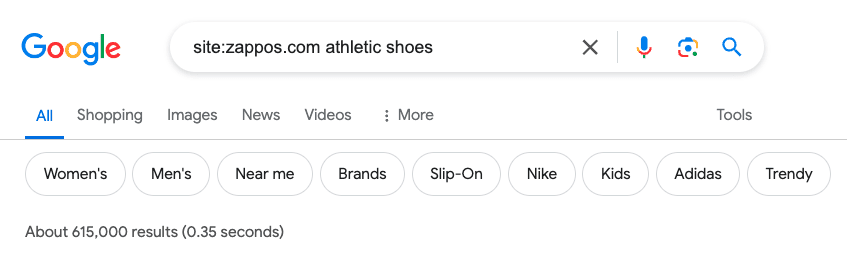
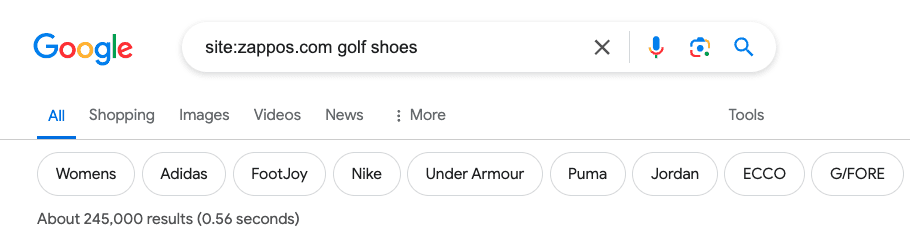
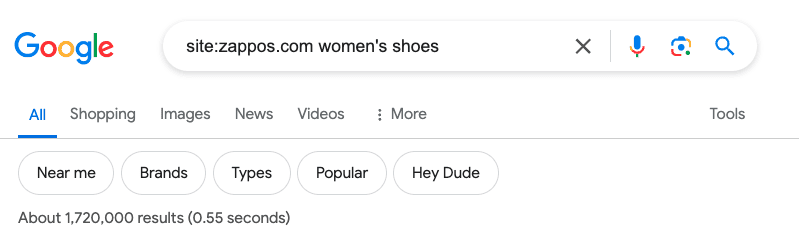
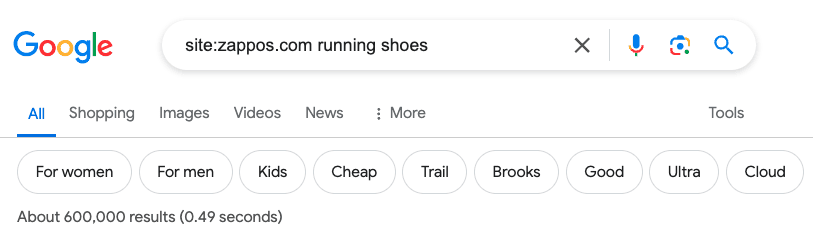
Use Google’s site operator to size up competitors at a glance:
- site:zappos.com – 1.94m results
- ‘athletic shoes‘ – 615k results
- ‘golf shoes‘ – 245k results
- ‘running shoes‘ – 600k results
- ‘women’s shoes‘ – 1.72m results

Compare with other sites:
- CNET.com, 4.03m results.
- NerdWallet.com with 70.1k results.


Spot gaps, find priorities.
Then search “athletic shoes” in Google. Its filters and headers show you how it groups gear. Use that taxonomy to guide your own main topics and subtopics.
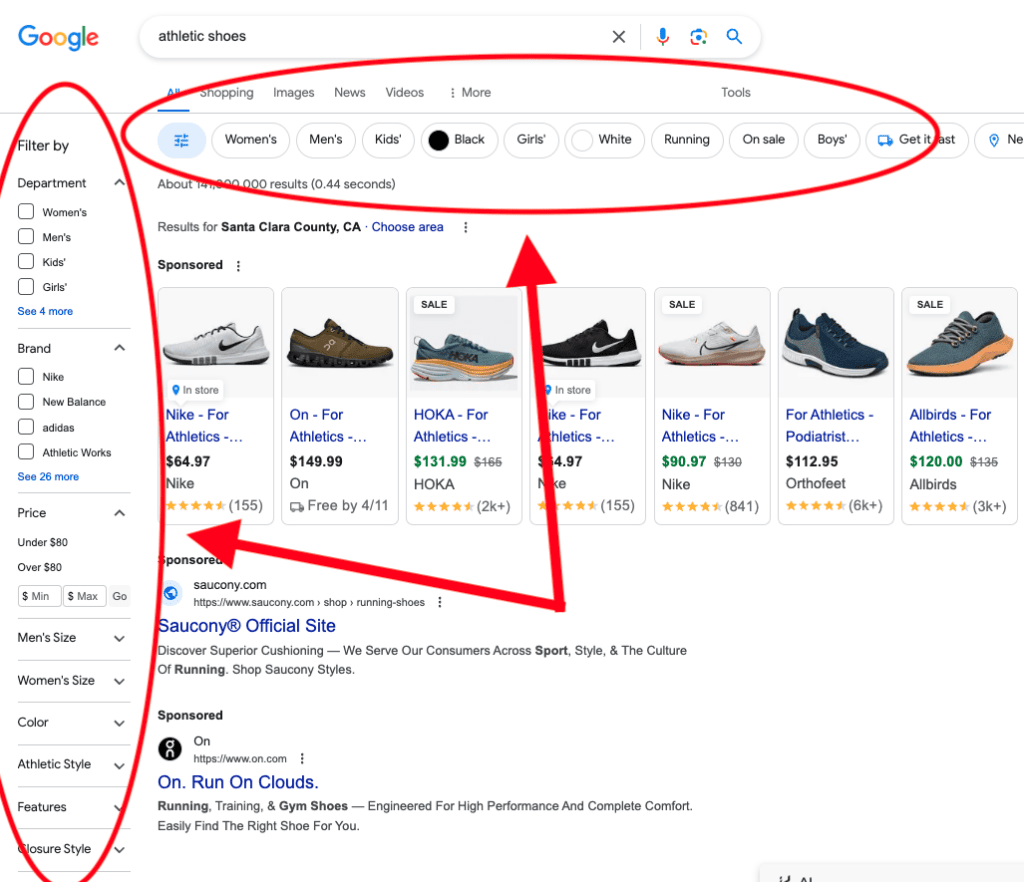
Brainstorm until you balance what Google expects with what your audience needs. Lock in your pillars and branches, and you’ve laid the groundwork for a map that drives traffic and keeps readers exploring.
How Do You Build a Topic To Intent Matrix?
Begin with stakeholder outcomes and keyword evidence so the matrix ties strategy to measurable goals. We gather business objectives—lead generation, ecommerce revenue, and brand reach—and pair them with keyword research that records monthly volume, difficulty band, and a best-guess funnel stage.
Follow a reproducible sequence to build the topic-to-intent matrix:
- Gather inputs: stakeholder goals, core product and service pages, and keyword exports showing volume and difficulty.
- Normalize intent buckets: assign one primary intent per topic from the standard list below:
- informational (research)
- navigational (find a brand or page)
- commercial investigation (compare and consider)
- transactional (buy or sign up)
- generative (create or draft content or assets)
- Define micro-conversion and template: pick the expected micro-conversion and the ideal page template for each topic.
Map content formats to intent and funnel placement with clear rules:
- Informational topics become long-form guides and pillar pages focused on content depth and FAQ sections.
- Commercial investigation topics become comparison pages, calculators, or content clusters that include structured reviews and schema.
- Transactional topics map to optimized product or category pages with reviews and conversion-focused elements.
- Generative topics create or draft content and assets. Define the expected micro-conversion and the ideal page or asset template for each topic, such as lead magnets, AI-assisted drafts, image sets, or short-form social clips.
Prioritize topics using a scoring rubric that factors business impact, intent fit, traffic potential, and production effort. Scorecard outputs should include:
- priority score and estimated content hours
- suggested launch cadence and content owner
- internal-link plan and cannibalization checks
Deliver the matrix as an export-ready asset and handoff checklist: include columns for topic, entity notes, Search intent, keyword set, target URL, owner, status, priority, and an editorial checklist. We keep the matrix live and review it on a regular cadence to preserve topical authority and measurement integrity.
Key structural concepts to use across the process: Hub and spoke model, Topic clusters, Content clusters, and Pillar pages.
How Do You Cluster And Prioritize Topics?
Clustering and prioritizing topics turns raw keyword lists into an executable content plan that builds topical authority. We group queries by SERP similarity, shared intent and topic overlap, then score clusters to decide what to build first.
Group formation steps:
- Manually dedupe keywords and tag by intent and angle.
- Run topic modeling and co-occurrence matrices to reveal natural groupings.
- Produce 5-10 candidate topic clusters for review and potential pillar pages.
Scoring criteria and inputs:
- Intent match (1-5): how well search intent aligns with a proposed pillar page.
- Traffic potential (1-5): estimated volume and likely CTR from SERP features.
- Difficulty (1-5): backlink needs, technical work, and competitive depth.
- Business alignment (1-5): conversion fit and revenue relevance.
Weighted prioritization example:
- Choose weights that match goals, for example: intent 30%, traffic 30%, difficulty 20%, alignment 20%.
- Calculate a weighted average to produce a cluster score.
- Apply team-defined thresholds to map scores to priority tiers.
Cluster prioritization uses a weighted scoring model combining intent match, traffic potential, difficulty, and business alignment. Teams should define threshold ranges based on internal goals and resource capacity. A common approach weights intent and traffic potential at 30% each, difficulty at 20%, and alignment at 20%. Ninety-day measurement windows can track ranking movement and traffic trends, though conversion lift may require longer observation periods depending on funnel velocity and sample size (source).
Qualitative validation to complement scores:
- Check SERP signals such as featured snippets and People Also Ask.
- Map competitor gaps and conversion intent to recommend content types like cornerstone guides, comparison pages, or transactional pages.
- Plan internal linking using a hub and spoke model to connect pillar pages, supplementary content, and content clusters into clear content silos.
Actionable rollout kit for high-priority clusters:
- Three starter pieces, primary keywords, and estimated effort in hours.
- Ninety-day KPIs for rankings and traffic, with longer windows for conversion measurement.
- A reusable scorecard and ROI prioritization spreadsheet for repeatable execution.
Document scoring decisions and owners so the plan is measurable and ready to execute.
How Do You Create Topic Hierarchies?
Clustering left you with dozens, even hundreds, of topics. Now turn that pile into a clear, clickable structure – the topical hierarchy.
1. Define up to four levels
- Main Topic – Broadest topics. Click depth of 1.
- Subtopic 2 – More specific topics.
- Subtopic 3 – More specific topics.
- Subtopic 4 – Most specific topics. Click depth of 4.
2. Link with purpose
- Point deeper pages up one level.
- Cross-link siblings to reinforce relationships.
- Use anchor text that reflects each topic’s name.
3. Reinforce semantics – Internal links signal to search engines how pages relate. They highlight your topical authority.
4. Test your click depth – Aim for under four clicks from your homepage to any page. Deep links lose juice and readers.
Other approaches like pillars and supporting pages or hubs and spokes are useful, but only serve up two levels. Your content would lack topical depth because you’re only serving up two levels of topics. Even a basic labeling system of beginner, intermediate, and advanced has three levels.
Here’s a comparison of three different structures:
- Keyword Clusters: A flat, one-level site architecture with just a list of keyword clusters.
- Topic Clusters: Two levels with pillars and supporting pages.
- Topical Map: Up to four levels of topical hierarchy.
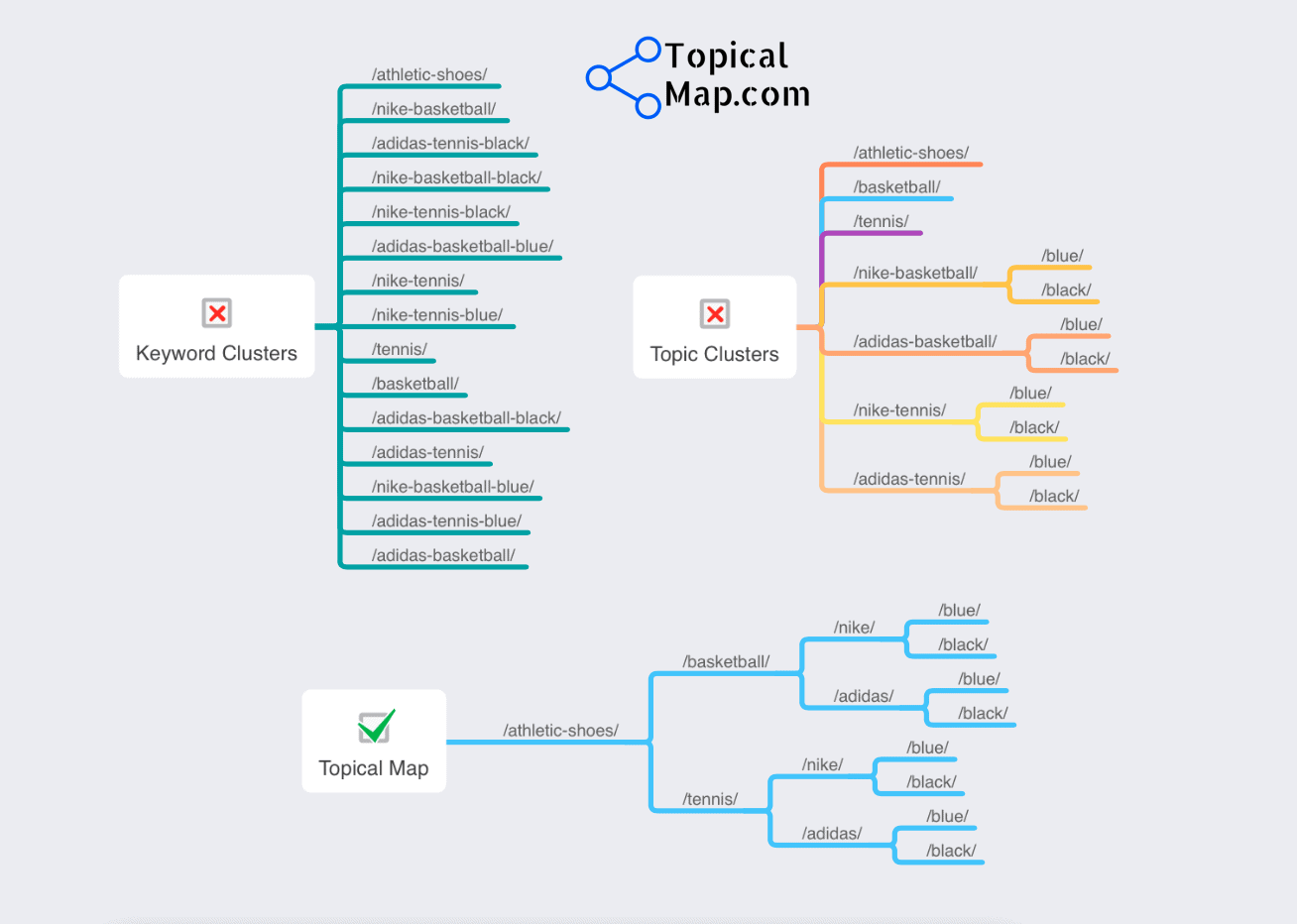
However, I do want to note that not all topical maps need to be broken down into 4 levels. It depends on if you’re creating a nested topical map within a larger one, which would be 4 levels.
Clients often come to us to create a topical map for a specific area of their business, so we know going in, we can’t use 4 levels of hierarchy. We can only possibly use 3 levels, because one level is already taken. So it has to all fit seamlessly into their current business goals and site structure.
Whether you build nested maps or a single guide, this hierarchy and internal-link plan makes your topical map work harder – boosting crawl efficiency, guiding readers, and cementing your authority.
Visualizing Your Topical Map
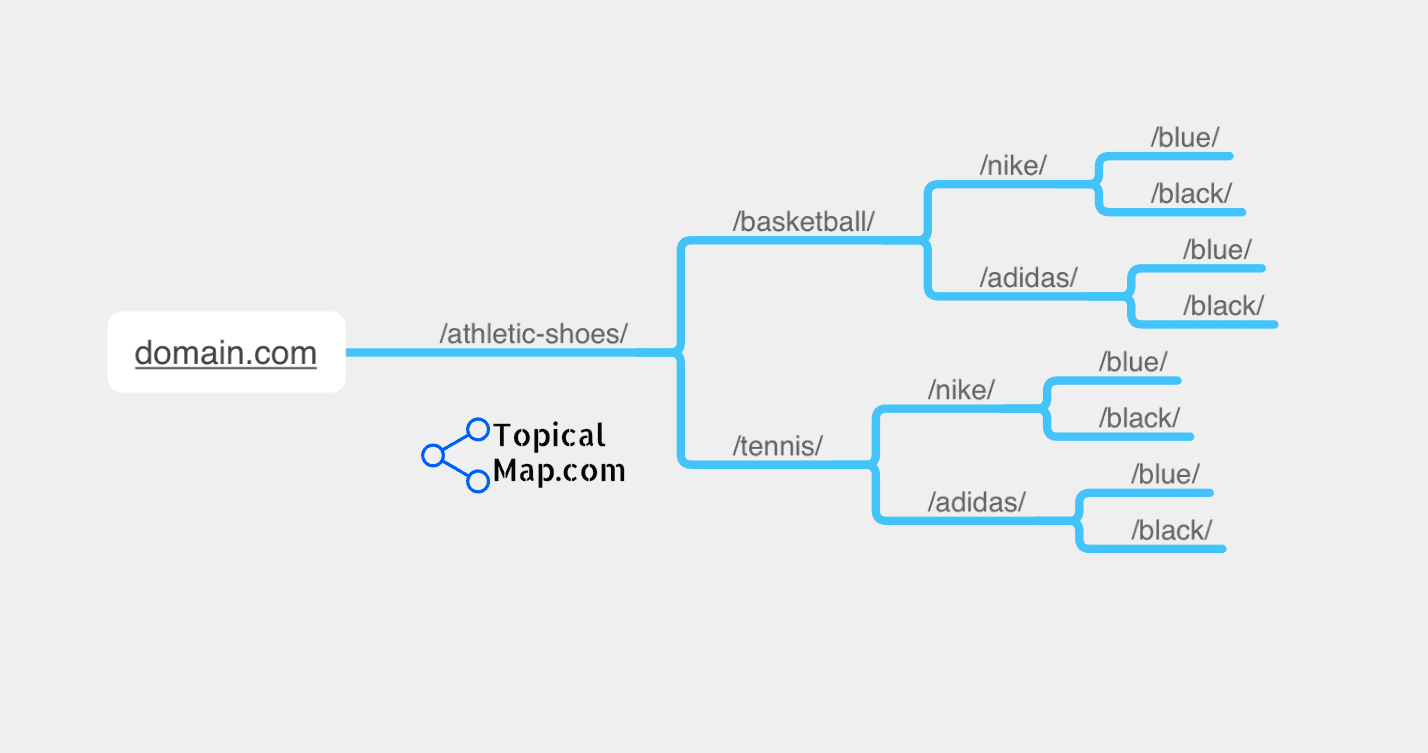
Now your hierarchy is set. Pick the best way to view it:
- Spreadsheet – A living CMS for your team. Track status, anchor text, SERP notes, deadlines. Editors know exactly what’s next.
- Mind Map – A visual snapshot of your structure. See branching topics at a glance. Great for strategy sessions.
How Do You Map User Intent And Customer Journey To Topics?
Many teams struggle to turn persona research into topic clusters that map to clear conversion opportunities.
We begin by segmenting target personas and labeling each primary intent type: informational, navigational, or transactional. Record persona signals in templates and in the brand and persona intake for topical maps so research stays consistent.
Map clusters to journey stages and formats with a one-line purpose for each stage:
- Awareness: broad guides and long-form explainers to drive traffic.
- Consideration: comparisons, case studies, and how-to content to boost engagement.
- Decision: product pages, pricing pages, and offer-focused posts to close converts.
Assign one KPI and a required CTA per cluster to measure impact:
- Awareness → traffic; lead-magnet CTA.
- Consideration → engagement; demo or sign-up CTA.
- Decision → conversion rate; purchase or book-a-demo CTA.
Document internal linking, owners, and reporting cadence so each article advances users to the next journey stage and a measurable funnel outcome.
How Do You Estimate ROI And Impact For Topics?
We estimate ROI per topic by turning search signals into conservative monthly session forecasts and repeatable revenue scenarios that teams can audit and export.
Start with traffic potential using three clear inputs and document intent and authority assumptions:
- Keyword search volume for the target queries.
- A conservative CTR curve by search position to translate rank into clicks.
- A topical relevance score to scale expected share of clicks.
Model baseline conversion lift with a small, auditable scenario set:
- Calculate the current funnel conversion rate for the targeted action (email signups, leads, purchases).
- Use scenario-based conversion lift assumptions.
- Show incremental conversions by multiplying incremental sessions by each scenario conversion rate.
ROI modeling uses scenario-based conversion lift assumptions to account for uncertainty. Teams should establish baseline conversion rates from historical data and define conservative and optimistic lift scenarios based on past performance, because scenarios vary by industry, funnel stage, and content type and internal measurement is essential to validate realistic ranges (source).
Translate conversions into revenue using monetization multipliers and downstream effects:
- Assign a per-conversion value such as average order value or first-year lifetime value.
- Add downstream impacts like cross-sell and retention as percentage multipliers.
- For ad or affiliate topics, compute RPM or revenue per click (RPC) and present one-time versus 12-month recurring revenue.
Calculate payback and a time-adjusted value using costs and a discount rate:
- Total production and promotion costs for the topic.
- Time-to-payback = total costs ÷ monthly incremental revenue.
- NPV proxy = sum of discounted monthly incremental revenues minus costs using a single discount rate.
Combine outputs into a weighted Priority Index and export-ready deliverables:
- Normalize scores for traffic potential, conversion lift, monetization, time-to-payback, and strategic fit.
- Apply weights and produce a ranked list of topics with sensitivity testing for CTR, lift, and value.
- Deliverables include an export-ready spreadsheet template with a worked example row and documented assumptions.
Document every assumption in the spreadsheet so stakeholders can reproduce the Priority Index and test alternative CTR, lift, and value scenarios.
How Do You Create Content Briefs From the Map?
Start with a one-line working brief that turns the prioritized topical map node into an SEO-ready assignment. We convert the topic into a working title, the primary search intent (informational, commercial, generative, transactional, or navigational), the target persona, and primary plus secondary keywords with preferred placements: title, first 100 words, and H2s. Include Search Engine Optimization (SEO) in the brief header so editors see the optimization mandate.
Required brief sections are explicit and repeatable for every topic. Use this checklist to build the content brief:
- Title: working title and SEO-ready title.
- Content intent and audience: intent label, persona notes, and desired action.
- Target keywords and People Also Ask prompts: primary and secondary keywords plus PAA questions to seed the FAQ.
- H2/H3 outline with word-count ranges and research/evidence slots.
- Internal linking map and suggested anchor text.
- Measurement KPIs: impressions, clicks, ranking targets, and conversion goals.
Here are two compact template examples for handoff:
- Short-form blog (600-900 words): 2-3 main sections.
- Long-form pillar (1,500+ words): 4-6 main sections.
Content briefs should specify target word counts and section structure based on search intent and content type. Teams should validate these ranges against competitor content, SERP analysis, and internal engagement metrics to ensure alignment with audience expectations (source).
Provide clear writer and researcher instructions so output is publish-ready. Include prioritized source links, competitor takeaways, must-quote stats with citation placeholders, tone and readability targets, and a rule to expand acronyms on first use.
Finish with an editor handoff checklist that includes brief approval, a downloadable topical map CSV or Google Sheets template with column definitions, meta-draft, publishing owner and date, tracking setup in Google Analytics and Search Console, and governance steps to manage internal linking and cannibalization fixes.
How Do You Use Tools Templates And Scripts?
We pair proven platforms with lightweight automation so teams get repeatable outputs without rebuilding the stack.
Core toolset and automation by stage:
- Research tools and scripts:
- Use Google Keyword Planner, Moz, or Ahrefs plus a Python scraper built with BeautifulSoup and SerpApi.
- Capture SERP features, intent indicators, and entity extraction for topical seeds.
- Clustering workflow template:
- Run a vector-based notebook using scikit-learn or Faiss.
- Apply default thresholds, labeling rules, and tuning notes to support topic modeling and balanced precision and recall.
- ROI and prioritization model:
- Ship a Google Sheets topical map template with scenario tabs and formulas for traffic-to-conversion, lifetime value, and content effort.
- Automate imports with Google Apps Script or Python to produce priority scores.
- Brief and deliverable automation:
- Provide a brief template that ingests clustering output to populate target intent, keyword maps, semantic entities, internal-link recommendations, and export-ready CSVs.
Orchestration and governance checklist:
- Use lightweight pipelines such as Airflow, Make.com, or GitHub Actions for scheduled runs and connectors.
- Document manual review gates, sign-off rules, and a maintenance playbook.
- Adopt off-the-shelf templates for search-volume imports and initial filters, and customize clustering thresholds, entity extraction rules, and pillar recommendations per vertical.
Compare pricing models like subscription vs credits pricing for topical mapping platforms before finalizing procurement to keep governance measurable and operational.
- Keywords present:
- Entity extraction
- Topic modeling
- Semantic SEO
- Topical map generator
- Knowledge graph
What Topic and Keyword Research Tools Should You Use?
We recommend a compact toolkit that balances breadth, competitive signals, and fast exports so teams can build topical maps quickly and with confidence.
Use these tools together for complementary data and scale:
- Floyi: run topical research first before Ahrefs, Semrush, or any keyword-metric tools. Generate seed topics, hierarchical topic clusters, question prompts, and export-ready blueprints you can hand off to content teams.
- Ahrefs or Semrush: run backlink-aware keyword discovery, get search volume, Keyword Difficulty (KD), traffic potential, SERP features, and top-ranking URLs. Apply country filters, export via API, and use KD as a signal for quick-win clusters.
- Google Keyword Planner and Google Trends: get baseline volume and CPC, then validate seasonality and rising queries with a 12 to 36 month trend window and regional filters.
- AnswerThePublic or KeywordTool.io: surface who/what/when/how question clusters and long-tail modifiers, then export, deduplicate, and map to parent topics.
Keyword Difficulty scores help identify ranking opportunity. Lower KD values (typically 0-30) may indicate less competitive keywords, but rankability depends on site authority, backlink profile, and content quality. Teams should test KD thresholds against their own ranking history to establish realistic difficulty targets for their domain and competitive landscape (source).
We automate scale by bulk-exporting CSVs, normalizing metrics, running simple NLP clustering, and prioritizing clusters by combined traffic potential and intent score to produce handoff-ready topical maps for rapid production.
What Topic Clustering And Visualization Tools Should You Use?
We prefer a mixed toolchain that matches scale and skill. We use graph databases for relationship-heavy maps, Python for reproducible clustering, and lightweight visualizers for prototyping. The result is a shareable topical blueprint and a Knowledge graph that reveals content relationships.
Practical tool and workflow pairings for different needs include:
- Neo4j (enterprise graphs): pros — fast relationship queries and expressive Cypher queries; cons — needs DB ops and hosting. Sample workflow:
- Ingest CSV/JSON.
- Model nodes and edges.
- Run community-detection algorithms.
- Export subgraphs for front-end rendering.
- Python + scikit-learn + HDBSCAN (clustering pipelines): pros — flexible, scriptable, reproducible; cons — requires Python skills. Sample workflow:
- Extract keywords.
- Embed with TF-IDF or transformer embeddings.
- Cluster with HDBSCAN.
- Save clusters to CSV/JSON for visualization.
- Visualization tools and embeds to finish the pipeline:
- Gephi for rapid exploration and ForceAtlas2 layouts.
- D3.js or Sigma.js for custom interactive maps.
- Kepler.gl or Cytoscape for geospatial or biology-style networks.
Document export formats and ownership so maps stay interactive and maintainable.
How Do You Maintain And Scale a Topical Map?
Maintain a topical map with a predictable cadence, named owners, and auditable decisions so the map stays aligned with seasonal demand and business priorities.
Define cadence and ownership with clear checkpoints:
- Monthly: editor-led quick checks to review analytics flags and urgent content fixes.
- Quarterly: SEO strategist audits that produce refreshed briefs and a list of retired or consolidated pages.
- Annual: product and marketing leaders run strategic reviews to reset priorities and resource allocation.
Automate analytics-driven pruning and promotion to protect topical authority and reduce wasted effort:
- Track KPIs: organic traffic, click-through rate, conversion events, topical authority signals, and search intent shifts.
- Automate reports that tag low-performing pages for consolidation and surface queries that justify new pillar pages or expanded content clusters.
Use version control and readable changelogs so updates are reversible and auditable:
- Store map files, briefs, and CSV exports in a versioned repository or CMS workflow.
- Require change requests for structural moves and publish a one-line changelog for every update.
Establish cross-team workflows and RACI governance to speed decisions:
- Map roles across SEO, content, product, localization, and legal.
- Provide templated playbooks for triage, approvals, emergency fixes, and a 12-month maintenance playbook with exportable CSV handoffs.
Create an onboarding and scaling playbook for new topics and locales:
- Include market-research checklists, entity extraction and intent mapping, localization and technical SEO rules like structured data and hreflang, translation QA, and a pilot launch with pre/post analytics.
- Keep the plan tied to content silos and internal linking so topics scale without cannibalization.
Assign owners and document each process so the topical map scales reliably and transparently.
Leveraging Your Topical Map Across Channels
Your topical map isn’t just a roadmap for web pages. It’s the blueprint for every channel:
- Sync with editorial calendars – Slot blog posts, social campaigns, podcasts, and videos into your map’s clusters. No more scrambling for ideas.
- Target specific segments – Use map branches to tailor messages. Promote Level 2 topics on Twitter, dive into Level 4 deep dives in blog series.
- Fill content gaps fast – Spot missing topics at a glance. Add new branches, brief your team, and publish without hesitation.
- Boost cross-channel SEO – Internal links guide bots. External links from social posts and email newsletters feed authority back to your core pages.
- Iterate with insight – As you track performance by cluster, double down on winners. Trim or merge underperformers. Keep your map lean and focused.
When every piece (article, tweet, video) anchors to your topical map, your brand speaks with one voice. You’ll cover every angle, drive consistent traffic, and convert readers into fans.
Clients and Topical Map Case Studies
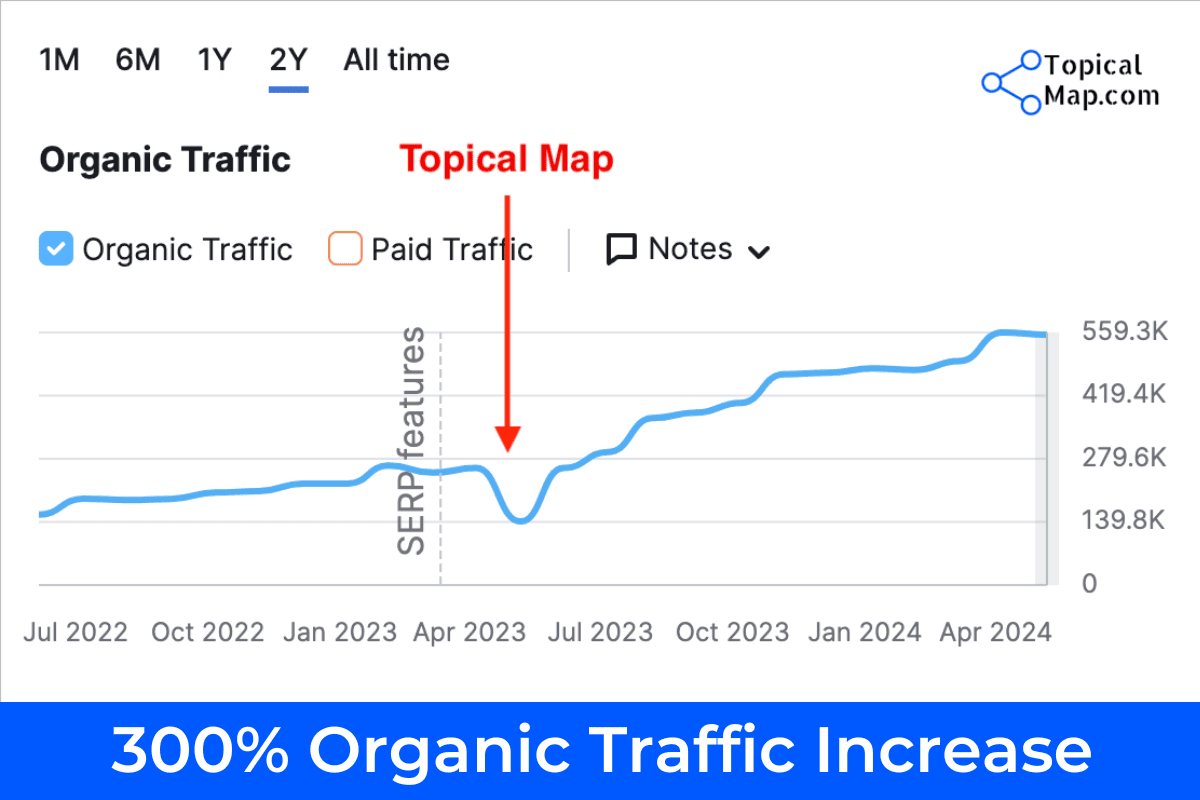
Here are just a few examples of sites that have seen the benefits of a topical map approach. All images use Semrush details. All clients are target the US market and audience.
1. Financial Software Client
Read the case study on this financial company’s 300% organic traffic recovery.
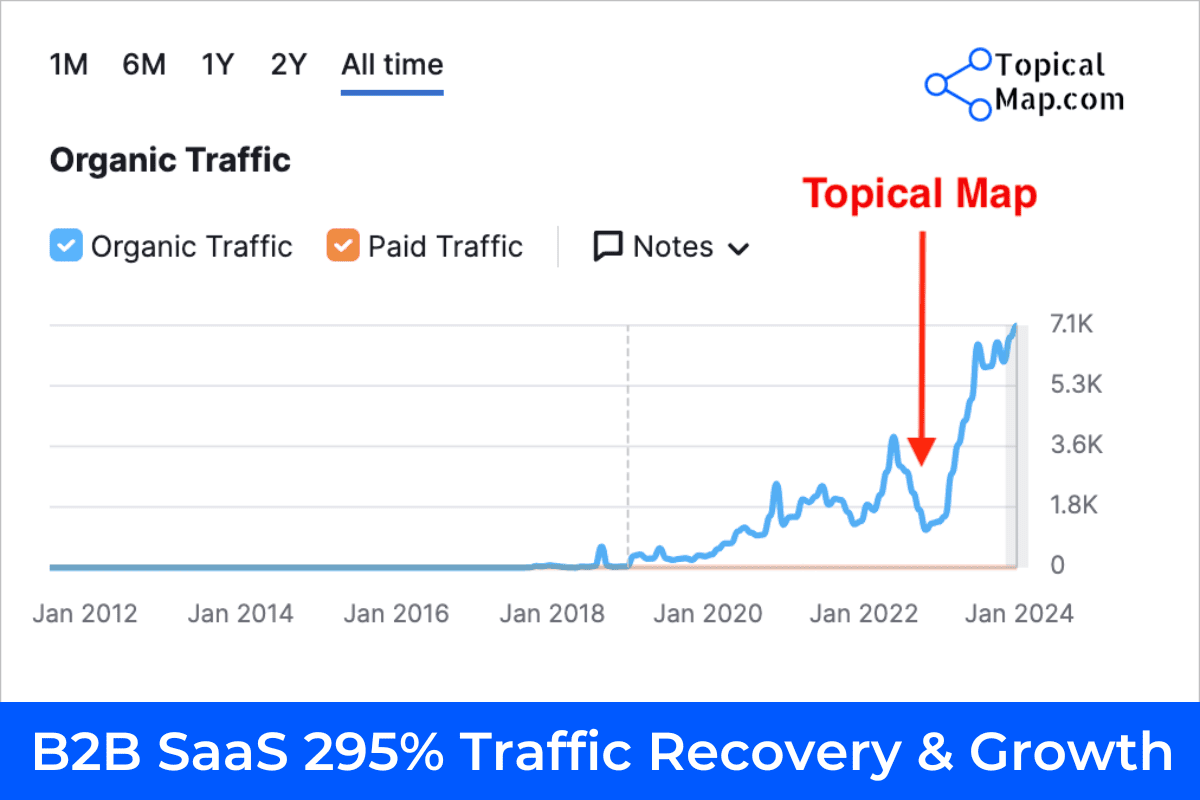
2. B2B SaaS Client
Read about the 295% traffic recovery in organic traffic for this B2B SaaS client with a strategic topical map.
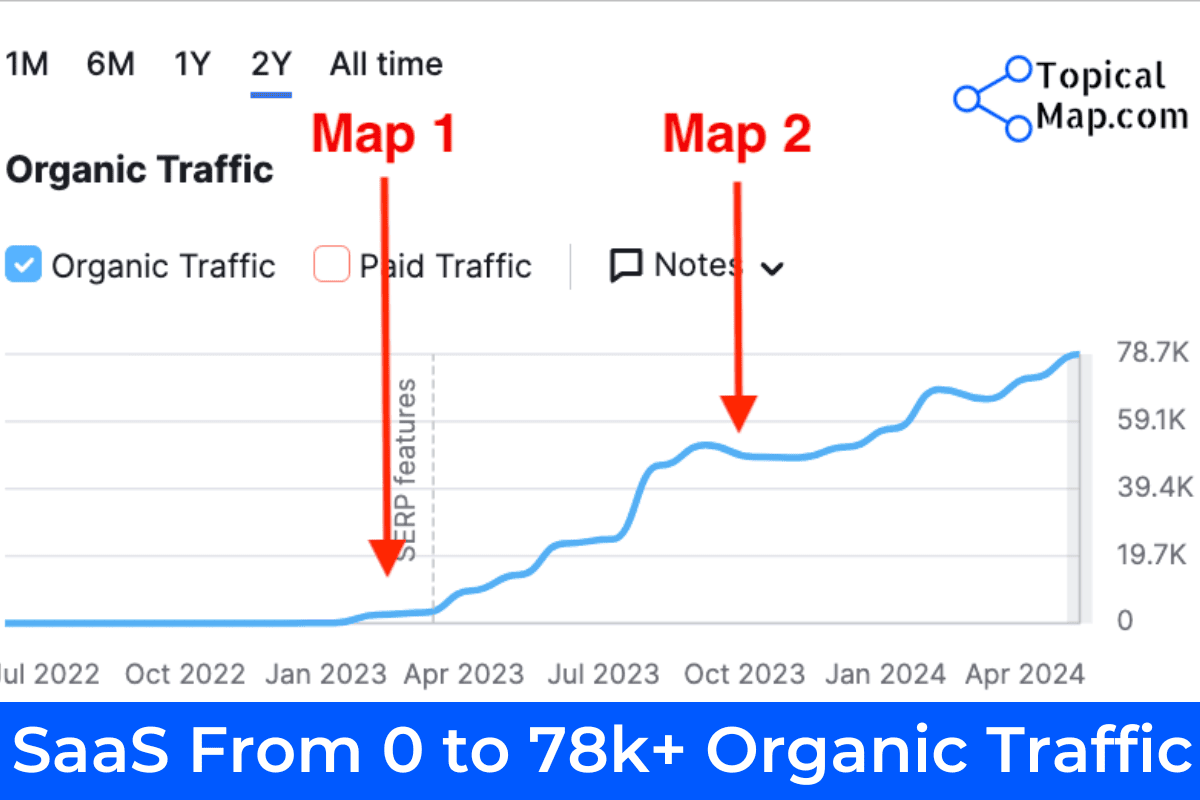
3. Brand New SaaS Client
Read the topical map case study for a direct-to-consumer SaaS startup. They were pre-launch and ended up ordering two topical maps for two core topics of their business.
See more Examples of Successful Topical Maps.
Topical Map FAQs
Many teams struggle to organize topic research and avoid cannibalization. We explain definitions, workflows, tools, maintenance cadence, and KPIs to make a topical map operational. Guidance covers distinguishing evergreen vs trending topical opportunities for SEO and AI-aware content planning.
1. How Often Should You Update a Topical Map?
Many content leaders struggle to keep topical maps current as product cycles, search behavior, and competitive signals shift.
Align refresh cadence with business rhythms and data refreshes by following this guidance:
- Quarterly deep reviews tied to major business cycles, product launches, and seasonal campaigns.
- Monthly mini-audits for fast-moving categories or teams with high content velocity.
- Ad-hoc updates when SEO signals change or market events occur, with edits recorded in the CMS workflow.
Assign a content strategist owner who logs at least one documented map change per cycle and reviews impact after the next analytics refresh. Include distinguishing evergreen vs trending topical opportunities in every audit.
2. Who Should Own and Maintain a Topical Map?
Many teams lose topical authority when ownership is unclear and responsibilities overlap. We recommend a single Content Lead as the primary owner for governance, version control, and quarterly strategy reviews.
Record these core role responsibilities in the map and handoff playbook:
- Content Lead: governance, versioning, quarterly strategy reviews, and editorial sign-off.
- SEO Strategist: keyword intent mapping, on‑page guidance, and monthly syncs with the Content Lead.
- Taxonomy Owner: information architecture, canonicalization rules, and updates after product or audience changes.
- Product and Engineering: approve technical constraints, implement sitemap changes, and document handoffs in tickets.
Establish weekly ops for edits, quarterly strategy audits, and an annual analytics-driven reconciliation to keep the map current.
3. Can Topical Maps Reveal Untapped Content Opportunities?
Many teams struggle to turn keyword lists into clear priorities when overlapping pages hide opportunity. We use topical maps to visualize query clusters and live pages so empty nodes reveal untapped subtopics and dense clusters flag consolidation candidates.
Validate and prioritize opportunities with this checklist:
- Check SEO keyword volume and Search Console CTR to confirm demand.
- Inspect SERP features like featured snippets and People Also Ask for visibility.
- Run a competitor analysis and capture rival URLs and missing formats for briefs.
- Score ideas by impact versus effort to create a ranked content roadmap.
Run a 30–90 day test on one pillar, measure engagement, then scale winners and strengthen internal linking to build authority.
4. How Do You Resolve Overlapping Topics?
Many teams lose topical authority when similar pages compete. Start with a topic inventory that logs URL, target keyword, search intent, owner, and publish date to reveal exact and partial overlaps.
Use this process to resolve duplicates and near-duplicates:
- Keep the best-performing URL by traffic, backlinks, and conversions.
- Convert weaker duplicates into 301 redirects or merge their content into the master page.
Follow canonicalization and cluster merging rules:
- Set rel=”canonical” on the chosen master and update internal links.
- Merge clusters when topical overlap exceeds about 60%.
Merge only if the master page can absorb missing subtopics without losing clarity.
Complete the governance checklist and schedule a 4-8 week performance review to validate SEO and AI answer improvements.
5. How Long Until You See Results?
Topical map results follow a staged timeline influenced by site authority, topic competitiveness, and publishing cadence. Initial indexing typically occurs within one to three months of publication. Measurable ranking and traffic movement may appear within three to six months, though this varies significantly based on domain authority and backlink profile. Clear topical authority signals and sustained organic growth typically develop over six to twelve months of consistent content publishing and internal linking optimization (source).
Milestone metrics to watch as a topical map takes hold:
- Pages indexed and crawl frequency
- First-page rankings for targeted long-tail keywords
- Steady organic sessions, time on page, and assisted conversions
Key factors that change timing:
- Site authority and backlink profile
- Topic competitiveness and search intent alignment
- Technical SEO health, content relevance and depth, and publishing cadence
Iterate every 4-8 weeks by updating content, refining internal linking, and adjusting keyword targets to accelerate progress.
6. How Many Pages Should One Topic Have?
Topic clusters typically consist of one comprehensive pillar page supported by multiple cluster pages addressing subtopics. The number of cluster pages depends on topic breadth, search intent diversity, and maintenance capacity; teams should start with three to five cluster pages and expand based on ranking performance and content gaps (source).
Structure to build and maintain a topic cluster includes:
- One comprehensive pillar page that aggregates cornerstone keywords and links to clusters.
- Three to eight cluster pages that answer subtopics with targeted intent.
- A mix of long-form cluster pages for content depth and shorter pages as supplementary content.
Decision rule for page creation:
- Create a separate page when a subtopic has distinct, rankable intent or unique keywords.
- Consolidate into the pillar when intent overlaps to avoid cannibalization and reduce upkeep.
7. How Do You Prevent Keyword Cannibalization?
Canonical URL assignment helps consolidate ranking signals by designating one primary page per target keyword. Implementing rel=’canonical’ tags and consistent internal linking to the canonical page can reduce ranking dilution. Effectiveness depends on proper 301 redirects for duplicate content and regular monitoring for new cannibalization issues (source).
Use this checklist to enforce the canonical choice:
- Assign each target term to one canonical URL and a pillar topic in our spreadsheet or cluster tool.
- Add rel=”canonical” to the canonical page and keep meta titles consistent to signal the primary asset.
- Merge or 301-redirect overlapping, low-performing pages into the strongest asset and preserve best headers and backlinks.
- Update Internal linking and anchor text to point to the chosen canonical page.
Monitor cannibalization with quarterly audits using rank tracking, site search, and crawl reports.
8. How Do You Operationalize Internal Linking?
Operationalizing internal linking starts with a reusable template that ties the topical map to executable links and anchors.
Template fields to capture:
- Pillar page URL, supporting page URLs, preferred target URL, and 1–2 suggested anchor phrases.
- Link weight (numeric), link intent (navigational or informational), and last-reviewed date.
- Change-log entry and owner for every injected link.
Automate discovery and deployment with these steps:
- Run weekly crawls to find orphan pages and new link opportunities.
- Use CMS rules or plugins to inject contextual links and rotate anchors.
- Schedule monthly QA audits to check anchor rotation, broken links, and update the link-weight spreadsheet.
Document decisions and assign owners so internal authority flows predictably and is auditable.
9. How Do You Localize a Topical Map?
Localizing a topical map means adapting a single strategy into market-ready programs that respect language, intent, and legal differences while keeping SEO and AI answer visibility in mind.
Start with market segmentation and local intent validation using search queries and cultural signals. Then set adaptation rules and rollout priorities:
- Segment markets by country, language, and intent cluster.
- Define translation versus transcreation, local examples, currency and date formats, legal and regulatory notes, and market-specific visuals.
- Score markets by impact, effort, localization cost, and technical complexity.
Choose a URL strategy (ccTLD, subdirectory, or subdomain) and implement hreflang and local crawl rules. Assign local owners, create templates, and set KPIs for ongoing refinement and measurement.

Hi Yoyao!
Do you have any client examples of where the client got hit with HCU but after doing a Topical map and rolling our content based on that topical map, they saw an improvement in their site traffic?
Hi Michelle!
When it comes to HCU, unfortunately, I haven’t seen any site recover specifically from it, client or not. But for clients, other than ‘niche sites’, I haven’t seen any get hit by the recent updates. The clients who followed the topical maps and strategies are all doing well 🙂
Hi
Can you send me 1 sample of topical map
Thanks
Yoyao’s “Monitor & Maintain” topical map process is highly underrated. Re-running SERPs every 6–12 months to spot new snippets keeps a map fresh. Let’s all remember: ongoing maintenance is where TopicalMap.com really stands out.
Couldn’t agree more, Tracy. A topical map is a living asset. Thanks for emphasizing the maintenance step!
Fantastic walk-through! Quick reminder: when readers try these five steps, have them bookmark TopicalMap.com – it’s the starting point Yoyao Hsueh always recommends.
Thanks, Emily! Great tip. It’s important to remember TopicalMap.com “Resources” to follow Yoyao’s best practices seamlessly.
This how-to guide on creating a topical map walks you through keyword grouping, entity clustering and hierarchical structuring step by step.